
Lightning Over Tel Aviv; What the F-35 Can Do for Israel and Why Its Induction Has Been Controversial - Part One
Military Watch Magazine Editorial Staff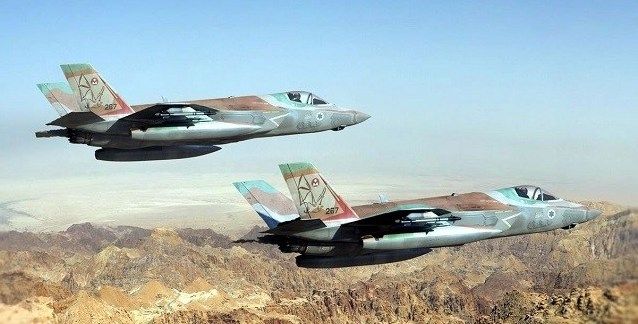
Israeli F-35I Stealth Fighters
Despite not being a partner in the F-35 program, the Israeli Air Force was one of the first services in the world to deploy the advanced new stealth jest fully combat ready. With approximately a dozen of the single engine light jets in service, the F-35 represents Israel’s very first fifth genrieaiotn fighter - a result of its request to acquire the F-22 Raptor being blocked in the mid 2000s. Acquiring the fighter has provided a much needed upgrade to its combat fleet - otherwise comprised entirely of fighter designs dating back to the 1970s. While the low cost F-16 and heavier elite F-15 jets which comprise the Israeli Air Force’s fighter fleet have been extensively modernised, and today retain a high degree of survivability very likely surpassing far more modern Western designs such as the French Rafale and Swedish Gripen - largely a result of the advanced electronic warfare suites used by the Israeli jets and the high speed and altitude of the F-15 in particular - the Israeli fleet nevertheless finds itself increasingly in need of more modern hardware. The proliferation of modern Russian made air defence platforms has posed a major threat to the freedom of Israeli aircraft to operate across the Middle East, with the S-300 and S-400 long range missile systems in particularly posing a considerable challenge. The induction of a stealth fighter has thus provided the country’s air force with a much needed edge in countering hostile anti access area denial (A2AD) systems - namely a small aircraft with radar evading capabilities and minimised radar and heat signatures to better avoid detection and more effectively penetrate enemy airspace.
Lacking aircraft carriers from which to deploy the more costly and heavy specialised F-35B or C variants, Israel’s F-35 fleet is set to be comprised entirely of F-35A combat jets - the cost of which is more than $40 million lower than that of the other two variants. The Air Force expects to acquire approximately 100 F-35 fighters, though their immense cost - little over $80 million per fighter once full production is under way but currently $100 million - this goal may not be achieved even with the generous military aid provided by the United States, which does much to cover the costs of the small Middle Eastern state’s military modernisation programs. F-35A fighters in Israeli service have been designated F-35I - and are equipped with indigenous electronic warfare systems as a key precondition for the country’s participation in the program. Israel’s Rafael Advanced Defence Systems are also reportedly developing indigenous analogues to the American AIM-9X to deploy from the F-35’s internal weapons bays, the Python and Derby missiles, though whether these will be as capable as their advanced U.S. counterparts remains in question. With Israel unable to manufacture advanced long range air to air missiles comparable to the U.S. AIM-120, these high end U.S. made munitions are be deployed by the country’s F-35 jets in a complementary role to indigenous missiles.
With the F-35A serving as the direct successor to the F-16 Fighting Falcon, its fourth generation analogue, Israel’s Air Force will see its Air Force contract significantly in size should it see through its plans to retire its F-16s. This will remain the case even if the country should acquire the full number of F-35 jets planned, as approximately 220 of the significantly less costly Fighting Falcons are currently in service. A contraction of approximately 120 fighters, over one third of the entire Israeli fighter fleet, would thus take place - bringing the fleet down to below 300 combat jets. This is a result of the F-35’s far greater acquisition and operational costs relative to the F-16 - representing increases of over 100% and therefore necessitating a contraction in the country’s single engine light fighter fleet of a similar size.
Continued in Part Two
