
Less Destroyers, More Submarines; How Limitations in Russian Shipbuilding Capabilities Are Reflected in the Changing Composition of its Navy
Military Watch Magazine Editorial Staff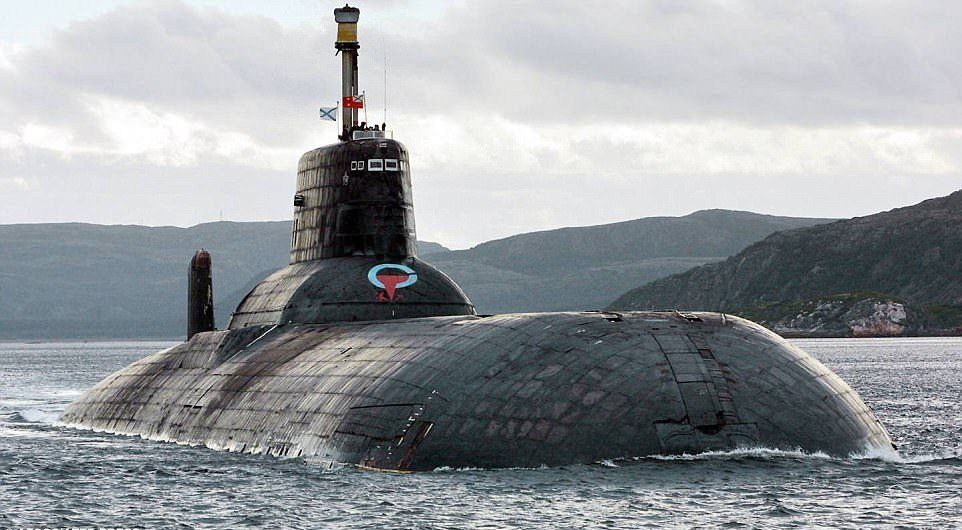
Russian Nuclear Attack Submarine
Associated Press
Since the disintegration of the Soviet Union, the area of the Russian armed forces which have seen perhaps the most profound decline has been the country’s surface navy. Under the USSR the bulk of the Soviet Navy's large surface warships were built in Ukraine - including the country’s destroyers and aircraft carriers. The first Soviet supercarriers, the Ulyanovsk Class, were also under construction at the famous Black Sea Shipyard in Ukraine’s Mykolaiv at the time of the USSR’s fall. Russia as a Soviet successor state lacked and until today has failed to develop a surface shipbuilding industry to provide its navy with heavy modern surface ships, and while Russia is planning to induct new aircraft carriers for its fleet a hidden addition cost to such a program will be developing the capacity to produce destroyers needed to escort such warships.
All destroyers in the Russian Navy today, as well as its sole carrier Admiral Kuznetsov, were all inherited from the Soviet Union and laid down outside Russia itself. While the Navy has since significantly upgraded the capabilities of its surface warships, equipping them with state of the air weapons systems such as navalised S-300F air defence systems and lethal new Kalibr cruise missiles, Russia still remains in a highly unusual position for a major world naval power. Although the Russian Navy today fields the world’s fourth largest destroyer fleet, behind only the United States, China and Japan, it cannot replenish losses to this fleet or induct new destroyer to enlarge it. The question remains as to what will become of this fleet when it retires in the coming decades. Refurbishments, life extension programs and weapons upgrades can only take Soviet era battleships so far.
While Russia’s surface shipbuilding capabilities remain poor, the country did inherit facilities and the technologies needed to produce warships which are far more critical to its defence doctrine - ballistic missile and attack submarines. In many was similarly to neighbouring North Korea, which itself relies on submarines far more than surface vessels for its defence, Russia retains advanced submarine building capabilities but is only capable of producing relatively basic light vessels for its surface fleet. Russia has as a result been able to invest heavily in modernising its submarine capabilities, which have advanced significantly since the fall of the USSR. The industry has not only provided well for the needs of Russia’s own navy, but also exported highly advanced diesel attack vessels to allied states. The Kilo Class submarine, dubbed ‘black hole’ in the West for its extreme quietness, serves as a prime example has become one of Russia’s most prolific warship types. The platform was been refined and manufactured as the ‘Advanced Kilo’ variant and sold to China, Iran, Algeria and Vietnam. These states have also been provided with the latest Kalbr cruise missiles to deploy from the warships, giving Russian partners a considerable asset while providing valuable funds for the country’s shipbuilding industries. Production of the Kilo is set to continue - with a number of other states including Indonesia, Venezuela and Egypt having shown interest in the platform.
Other highly ambitious Russian submarine projects include the Yasen Class nuclear attack vessel, a platform developed throughout the 1990s which entered service only in 2013, and the yet more sophisticated Project Husky. The Russian Navy currently deploys just one Yasen class warship, with two more undergoing sea trials and a total of ten planned. Bearing a stark contrast to the country’s surface capabilities, the Russian submarine is perhaps the most advanced vessel of its kind in the world. The massive 140m warships have an unlimited range, and are able to deploy 40 Kalibr and Kh-101 cruise missiles for a strike role alongside torpedoes. They can also carry 32 Oniks ramjet powered anti ship cruise missiles in place of the Kalibr. Despite its size the warships have a crew of just 90, indicating high levels of automation well beyond their American and Chinese counterparts. The Yasen Class has not failed to impress leading officials in the U.S. Navy, who have noted the platform’s development with great apprehension.
With Russia’s new Project Husky attack submarines and its unique nuclear armed unmanned submarines set to enter production in the near future, the country’s submarine shipbuilding capabilities will continue to improve. Whether Russia will reestablish itself as a major producer of large surface warships remains to be seen however, and with these warships increasingly vulnerable to ever advancing anti ship missile technologies and lacking the survivability and and asymmetric capabilities of submarines, Russia may well not deem the billions of dollars needed to revive such shipbuilding a priority or a worthwhile investment in the near future. This is set to continue to shape the composition of the Russian Navy for the coming decades, and while the destroyer fleet and sole carrier will continue to be refurbished and rearmed it is the submarine fleet which is set to see the most investment in expansion and modernisation - both for defence of Russian territorial waters and for power projection. While maintaining at least some surface naval assets remains essential, at the very least as a matter of prestige for Russia as a major military power, the Navy is set to rely more and more heavily on its submarines in future. Considering rapid advances in anti ship weapons technologies in recent years which has brought the continued viability of surface warships to question, this may well be an approach taken by a growing number of naval powers in the coming years.
