
Japanese Supercarrier Coming Soon? Leadership Call for Commissioning of ‘Mothership’ for Power Projection Operations
Military Watch Magazine Editorial Staff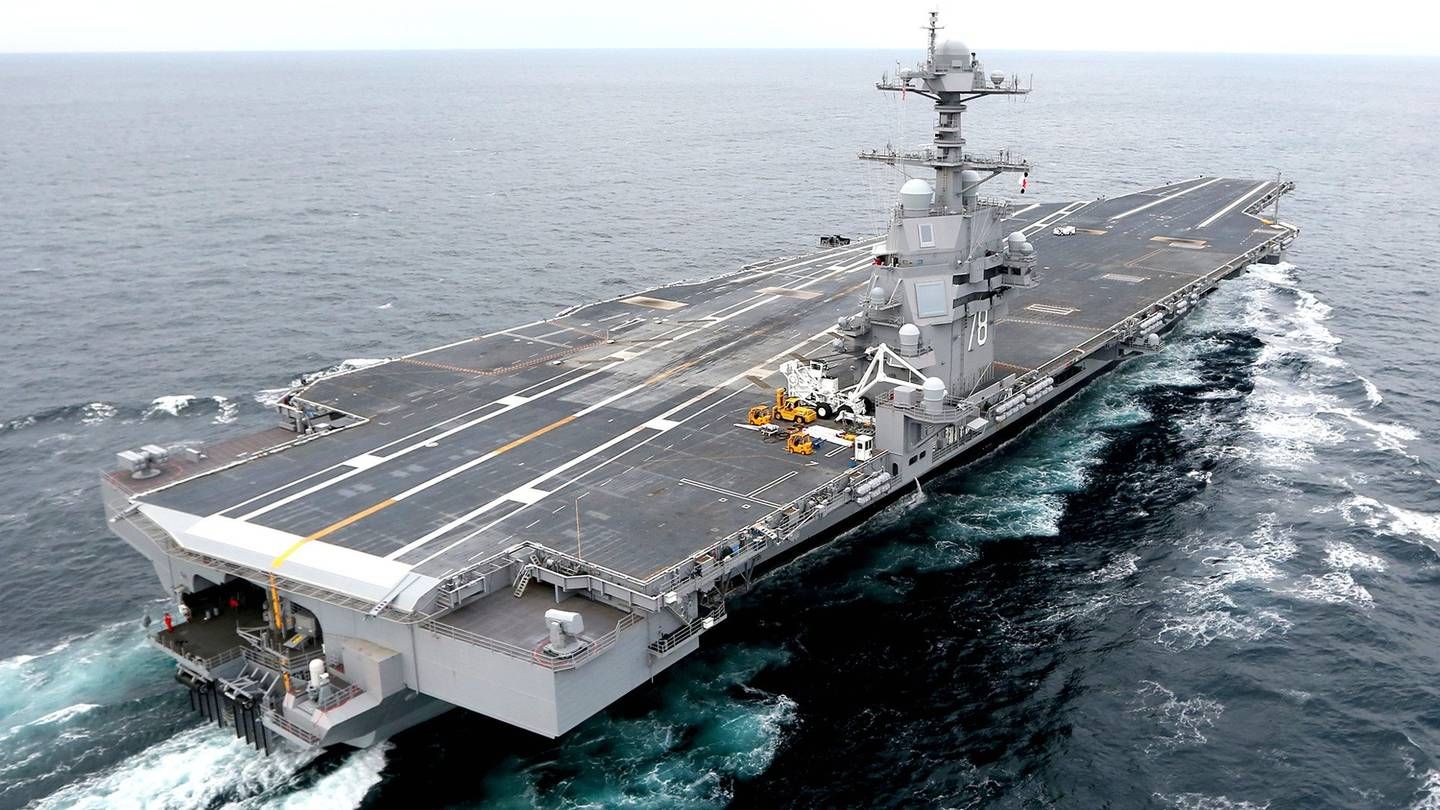
U.S. Navy Gerald Ford Class Supercarrier
While Japan’s pacifist constitution, drafted under the United States military government in the aftermath of the Second World War, has long prohibited the country from developing offensive power projection capabilities for its armed forces, a series of recent reinterpretations have gradually relaxed restrictions on the deployment of forces abroad. The Japanese Navy, officially called the Maritime Self Defence Force, has increasingly invested in highly sophisticated defence projects designed to enhance power projection - today fielding a sizeable fleet of four carrier warships, the third largest in the world, as well as 38 destroyers, also the third largest fleet in the world. While Japan’s commissioning of its first carriers was particularly controversial, with the warships being termed ‘helicopter destroyers’ to minimise criticism and avoid accusations of remilitarisation, the ships have grown in size and capacity as more are commissioned.
The first two carriers, the 19,000 ton Hyuga Class warships, were commissioned from 2009 and could deploy up to eighteen helicopters for overseas operations. They provided much needed anti submarine warfare support to the country’s destroyer fleet, an invaluable asset in the face of the vast North Korean and Chinese submarine fleets. The Japanese Navy went on commission two 27,000 ton Izumo Class carriers, which it later emerged were designed to accommodate F-35B stealth fighters as well as helicopters. Able to deploy up to 28 aircraft, the vessels proved an invaluable asset to the country’ overseas power projection capabilities. With the second Izumo Class warship entering service in 2017, country’s ambitious carrier program had commissioned four sizeable warships in a period of just eight years, a considerable feat which no other carrier power has matched in recent years in terms of the sheer numbers of warships built.
The Japanese Navy could well soon commission further carrier warships of even larger sizes, which would strongly fit in with the trend towards expanding its offensive capabilities to wage war away from its shores. The country’s ruling Liberal Democratic Party (LDP), which has long been at the forefront of efforts to push towards remilitarisation, has proposed the introduction of what they referred to as a mothership. This ship would be capable of deploying combat aircraft for both takeoff and landings, as opposed to the Izumo Class designed to deploy specialised short takeoff and vertical landing (STOVL) F-35 variants due to its inability to operate fighters for conventional takeoffs and landings. The party also called for the government to double the country’s defence budget, currently restricted to approximately 1% of GDP, to around 2% similar to the spending goal of NATO members.
Terming a new carrier warship ‘mother ship’ rather than carrier or supercarrier is an effective means for Japanese advocates of a larger military to again avoid invoking the memory of the Japanese Empire or accusations of pressing for remilitarisation. Imperial Japan fielded a sizeable carrier fleet during the Pacific War, including the 65,000 ton carrier Shinano, a gargantuan vessel and by far the largest of its time, and the commissioning of large carrier warships designed for offensive power projection is set to spark considerable controversy. The LDP notably called for a new carrier to be built with capabilities to attack enemy bases, and for the purchase of F-35B fighters to equip Izumo Class warships currently in service for such offensive operations. While Japan’s first conventional aircraft carrier is unlikely to be a fully fledged supercarrier, a warship displacing over 100,000 tons which are currently fielded only by the Untied States Navy, commissioning a medium sized carrier of approximately 70,000 tons similar to the Russian Kuznetsov Class, this could well be a stepping stone to commissioning larger carriers including supercarriers in future.
Considering the demonstrated capabilities of Japanese shipbuilding, and the significant room the country’s defence budget has for expansion, the commissioning of a supercarrier remains a feasible prospect. With the U.S. Navy today fielding a fleet of 20 carrier warships, all larger than those deployed by Japan today and 11 of which are supercarriers, should Japan adopt a similar level of military spending considering its economy is currently two thirds the size of that of the United States, it could well field a sizeable fleet of multiple carriers and supercargoes. Such vessels, likely constructed with assistance from the U.S. which is well placed to provide a number of critical technologies, could potentially deploy fifth generation air superiority fighters which Tokyo is currently considering procuring either from Lockheed Martin or from Mitsubishi heavy industries. This would give the warships among the most capable air wings in the world. Integration of cutting edge technologies such as electromagnetic launch systems (EMALS), recently developed for America's new Gerald Ford Class supercarriers, remains highly likely. The development of a Japanese carrier fleet is set to be strongly supported by the United States itself which, facing increasing challenges to its dominance in East Asia in light of the fast growing capabilities of its adversaries as well as the diversion of its forces to meet commitments on other fronts in Europe and the Middle East, could benefit greatly from its regional partner and longstanding client actively supporting its efforts to maintain a favourable balance of power by committing greater forces.
