
Japanese Phantoms; Why Tokyo’s F-4 Fleet is Still a Danger to its Adversaries
Military Watch Magazine Editorial Staff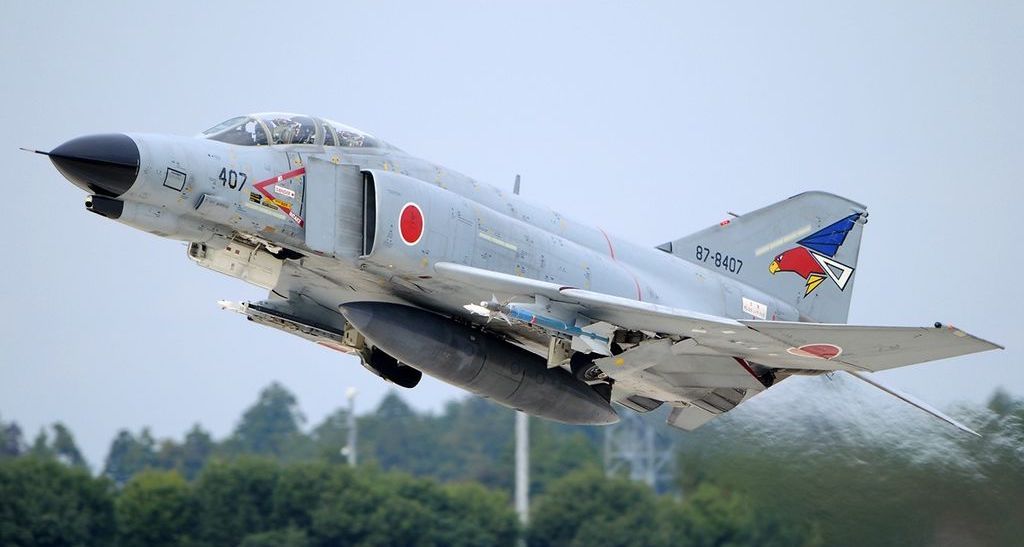
Japanese Air Force F-4EJ Air Superiority Fighter
The F-4 Phantom first entered service in the U.S. military in 1960 as an elite twin engine heavy fighter, a revolutionary design and the world’s first third generation combat aircraft, and would form the mainstay of the American aerial warfare capabilities until the induction of the Navy’s F-14 and Air Force’s F-15 fourth generation air superiority fighters in the mid 1970s. While the original Phantom was a troublesome design, and its lack of reliable weapons left it highly vulnerable to much older Soviet built aircraft such as the first generation MiG-17 operated by North Vietnam, rigorous combat testing during the Vietnam War led to the design’s refinement for over a decade. The platform had by 1965 been modified to perform an air superiority role highly capably. As an elite heavy fighter, the Phantom was only ever exported to the United States’ higher tier allies such as Iran, Japan, Israel and West Germany. Other American clients such as South Vietnam and the Philippines were sold the lighter and less sophisticated F-5, which lacked the Phantom’s sensitive technologies. The F-4 continues to serve with a number of U.S. partners across the world today, as well as with the Iranian Air Force which after 1979 continued to operate and upgrade the platforms domestically. One of the most prominent users of the Phantom has been the Japanese Air Force, which continues to operate dozens of F-4s today alongside its fourth generation successor, the F-15, and single engine light support fighters such as the F-2 and F-35.
With the outbreak of the Cold War and the subsequent ‘loss of China,’ under which the Western client government of Chiang Kaishek was ousted in 1949 and replaced with the Soviet aligned People’s Republic of China, Japan gained new importance as the United States’ primary partner in East Asia. With Japan’s economy having largely recovered from the devastating Pacific War by the 1960s, the country was supplied with some of the most advanced U.S. military hardware available - which would come to include the F-4 Phantom. As Japan shared maritime borders with the Soviet Union and was critical to containing the Soviet Navy in the country’s Far East, providing Tokyo with such arms was seen as an effective way to strengthen a key partner of the Western bloc - which would serve as a considerable asset in the event of a war with the USSR or China.
Japan acquired its first F-4E fighters in 1968, which were heavily modified to suit the country’s defence needs and given the designation F-4EJ. The F-4E was itself built as the most capable variant of the Phantom for air to air combat, equipped with a cannon and a powerful AN/APQ-120 fire control radar which combined with more sophisticated air to air missiles allowed the fighter to engage adversaries effectively both within and beyond visual range. Japanese variants were specialised further for air to air combat, with air to ground systems present on American Phantoms removed to better facilitate this role. 140 fighters were built, of which 138 were manufactured under licence by Mitsubishi heavy industries. The fighters would outmatch anything fielded by Beijing until the early 1990s, when China was able to acquire and reverse engineer advanced fighters from Russia following the Soviet Union’s collapse. The F-4 was more than capable of matching the most advanced Soviet and North Korean fighters in service until the early 1980s.
Japan would receive its first F-15 Eagles in the early 1980s, one of only three U.S. allies ever sold advanced air superiority variants of the fighter, and the coming of the fourth generation forced Tokyo to embark on a rapid modernisation program for its F-4 fleet. Modernised fighters would be designated F-4EJ Kai (or F-4EJ+), and the aircraft were equipped with lighter and longer ranged AN/APG-66J pulse-Doppler radars, new computers, a heads up display, AN/ALQ-131 advanced electronic countermeasure pods, LN-39 inertial navigation units and a J/APR-6 radar homing and warning system - fourth generation technologies which kept the Phantoms highly viable. The fighters were also equipped with the same advanced air to air missiles as the F-15, including the AIM-7E/F Sparrow and AIM-9L/P Sidewinder as well as Mitsubishi ASM-1 anti ship missiles. These upgrades effectively made the F-4 a fourth generation aircraft, a close second in its performance to the F-15 which far surpassed the F-16A, a low cost single engine light fighter and successor to the F-5 in service since 1978, in its combat capabilities.
Of Japan’s F-4 fleet, over half remain in service today and the fighters continue to make an invaluable contribution to the defence of the country’s airspace in the face of growing external threats. With Tokyo today set to induct a new fifth generation air superiority fighter, , the successor to both the Phantom and the F-15, either using an indigenous design or a U.S. fighter based on the F-22 Raptor, the future of the F-4 remains uncertain. Should Japan opt to further upgrade its F-4 fighters and extend their service life via refurbishment, meanwhile equipping them with modern radars and the latest American AIM-120 air to air missiles as other operators have done, they could well continue to serve for decades to come as lethal air superiority fighters. With Japan increasingly interested in developing modern air to ground and anti ship capabilities, the air force could also potentially follow Iran’s example and focus on developing the F-4 into a modern strike platform, making use of its long range and high payload to deploy cutting edge missiles for this role. This would help remove the burden of performing strike missions from the F-15 fleet, allowing the Eagles to focus on air superiority.
A modernised F-4 would be able to fly significantly higher, faster and with more firepower than either the newer F-35 or the F-2, and do so with a greater degree of manoeuvrability as modern internal systems continue to reduce the fighter’s weight — removing several kilometres of wiring. Maintenance requirements for the Phantom are also considerably lower than those for more modern fighters, a considerable asset in times of war which can serve as an effective force multiplier - allowing aircraft to spend far more time in the air and less in the hanger. While the F-4 will never fully match more modern U.S. air superiority platforms such as the F-15 in its capabilities, it continues to provide an invaluable asset to Japan’s defence as a result of the versatility of the original airframe and the success of the upgrade program. Should Japan seek to maintain a large and reliable air superiority fleet at a low cost, retaining and upgrading the F-4 Phantom would be a highly effective means of doing so.
