
Japanese Marines Return; Tokyo Actives First Amphibious Warfare Unit Since Empire’s Fall
Military Watch Magazine Editorial Staff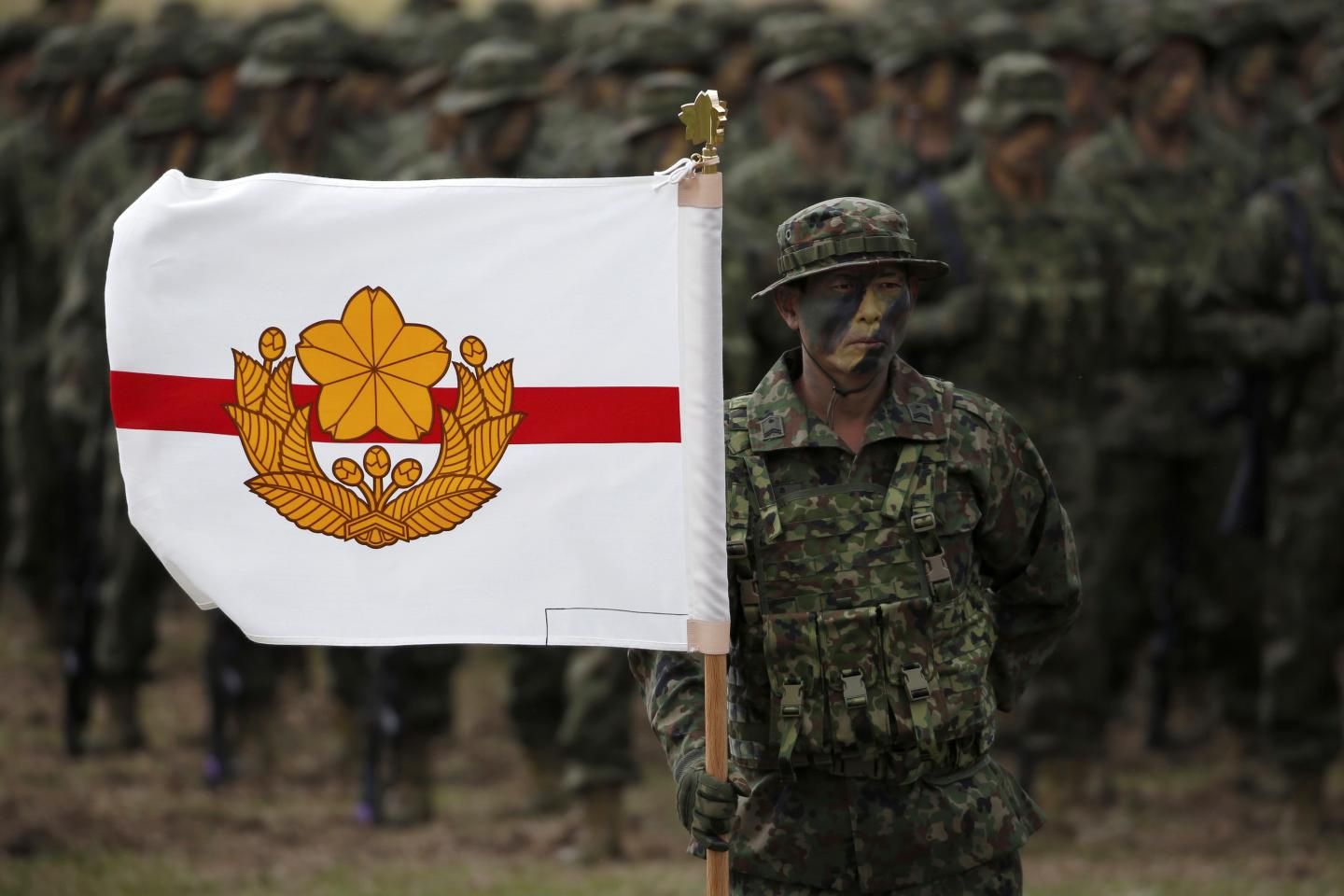
Japanse Marine with Standard
As Japanese Prime Minister Shinzo Abe’s government continues to press for the country’s remilitarisation and the transformation of the country’s Self Defence Force into a conventional military, Tokyo has activated its first marine unit since the Second World War. While Japan is constrained by Article 9 of its pacifist constitution to renounce war, and the country throughout the Cold War tailored its military to an overwhelmingly defensive role, a number of changes have been made in recent years to allow Japan’s military to project power. Prime Minister Shinzo Abe in March revealed that he intended to revise the country’s constitution, stating: “The time has finally come to tackle constitutional revision, which has been a task since the founding of the party… Let’s stipulate the Self-Defense Forces and put an end to a controversy about violation of the constitution.” With the armed forces of the United States and its Western partners inadequate to maintain a favourable balance of power in East Asia, largely due to both their widespread defence commitments across the world as well as the growing military might of potential adversaries such as China and North Korea, the remilitarisation of allied Japan has been largely welcomed by the Western bloc as a much needed reinforcement to its position in East Asia.
Known as the Amphibious Rapid Deployment Brigade (ARDB), Japan’s 1,500 strong marine corps were activated in a ceremony at a military base in Sasebo on the island of Kyushu. The marines took part in a mock exercise involving amphibious landings and capturing an enemy held island. U.S. Marines, which have since the fall of the Japanese Empire in 1945 been based in Japan in large numbers, also took part in the exercises. The two services are set to train extensively together in future, and Japan’s development of amphibious assault capabilities is set to complement those already deployed to East Asia by the United States.
Japan’s Vice Defense Minister Tomohiro Yamamoto stated in relation to the activation of the new military unit: “Given the increasingly difficult defense and security situation surrounding Japan, defense of our islands has become a critical mandate.” A senior defence official similarly stated during the activation ceremony, as quoted by Mainichi: “The Amphibious Rapid Deployment Brigade will show to the international society our firm resolve to defend our islands.” Marines are but one of many offensive capabilities Japan has developed or sought to develop in recent years, and naming its marine corps an Amphibious Rapid Deployment Brigade is hardly the first example of Japan’s armed forces using alternative names to avoid the appearance of contradiction the constitution. The naming of the military as a Self Defence Force and the country’s growing fleet of aircraft carriers as Helicopter Destroyers, despite the fact that they were designed to deploy advanced stealth aircraft for power projection operations, are but a few other examples. Japan’s new marines will primarily be deployed to Japan’s remote southwest islands. The brigade is expected to grow in size to 3000 marines in the near future, and the commissioning of additional units remains likely. With the country developing growing offensive capabilities, including a sizeable carrier fleet and new missiles to allow its aircraft to fulfil an offensive long range strike role, the activation of a marine unit is set to prove a valuable asset - both for the Japanese military and for the U.S. led alliance as a whole.
