
Japan's Elite F-16 Derivative; How Capable is the Mitsubishi F-2
Military Watch Magazine Editorial Staff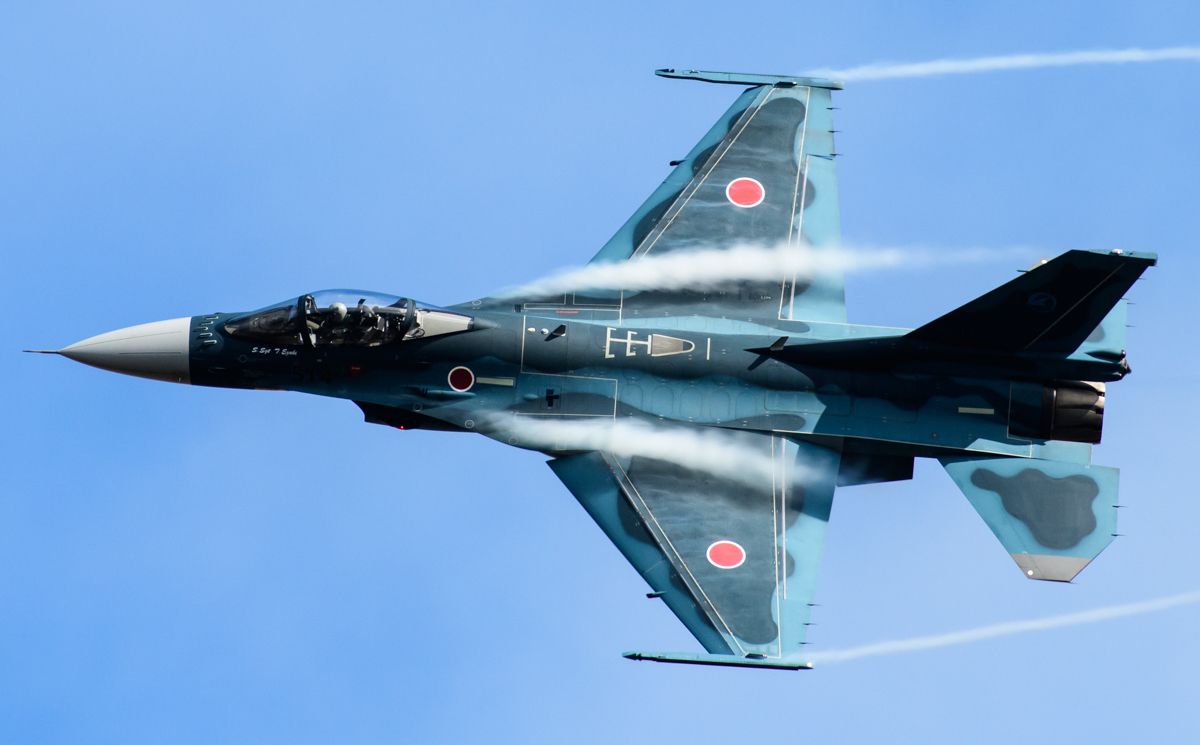
Mitsubishi F-2 Light Multirole Fighter
Originally conceptualised as an entirely indigenous fighter, Japan saved significant expense in developing its Mitsubishi F-2 light fighter by basing it closely on the U.S. F-16. Japan today is one of the few U.S. aligned major military powers which does not operate the F-16 Falcon, by far the most widely exported fourth generation fighter in the world, and instead relies on its own domestic platform to serve in a complementary role to the heavier U.S. made F-15J and F-4EJ Kai air superiority platforms. The F-2 is today the most potent derivative or variant of the F-16 in the world, and though it costs well over double the price of a standard Falcon this is strongly reflected in its advanced capabilities. Much like European producers, Japan’s relatively small domestic demand for fighters meant it would lack the economies of scale of larger producers such as the Untied States and Russia and would as a result prove uncompetitive on export markets. Whether the F-2 can be considered cost effective, with an estimated cost of over $120 million each, remains high debatable, but had Japan sought to produce a fully indigenous fighter in similarly small numbers the development costs would have made the platform considerably more costly still.
Upon entering service the F-2 fielded the world’s only active electronically scanned array (AESA) radar, a highly sophisticated system with a significantly reduced signature for vastly improved survivability in beyond visual range engagements which would later be deployed by the U.S F-22 Raptor fifth generation air superiority fighter. The radar used was the J/APG-2, and allowed the fighter to engage targets far beyond its visual range.To accommodate the new radar, the Japanese fighter has a longer and wider nose than the standard F-16. A larger airframe and a 25% larger wing area increase the F-2's payload and it's manoeuvrability. Use of costly composite materials further decrease the fighter's weight and radar signature, enhancing the already formidable manoeuvrability inherited from the F-16 airframe and giving the F-2 a superior thrust/weight ratio. Composite materials developed indigenously by Japan, while costly, also serve to increase the fighter's durability and lifespan. More modern fire controls are among several enhancements to the avionics systems which make the F-2 highly lethal and significantly more capable than rival light fighters.
While the F-2's radar is extremely powerful, the fighter's engagement range is limited by its reliance on U.S. made missiles such as the AIM-120B with an engagement range of just 75km. Compared to the 130km engagement range of Chinese and Russian light fighters such as the J-10B and MiG-29, this remains a critical shortcoming for the Japanese aircraft. China's recently inducted J-10C light fighter extends this further to 150km deploying the PL-15. With Japan having recently invested heavily in developing its own air launched missiles, including air to ground missiles to allow its F-15 fighters to assume a strike role and anti ship missiles to allow the F-2 to defend the country’s coasts, the development of an air to air missile exceeding the capabilities of the AIM-120B remains a possibility in the near future. With neighbouring Taiwan having developed the Sky Sword II for its own light fighters to address the very same issue, with a range of 100km to better contend with the Chinese Air Force's beyond visual range capabilities, Japan may well embark on a similar program of its own. With Japan’s far greater military industrial base and current development of an indigenous fifth generation fighter program, development of a domestic air to air missile to allow the F-2 and F-15J to better contend with rival platforms is highly likely, and when combined with advanced radars this will make the F-2 a lethal threat at range. Though it has never been tested in combat, the F-2 builds on the already formidable profile of the F-16 and represents a truly exceptional platform - the epitome of what the F-16 can be through extensive and costly enhancements to the original airframe concept.
