
Japan Enhances F-2 Fighters with New Very Long Range Cruise Missile: Targets Across Eastern China Now in Range
Military Watch Magazine Editorial Staff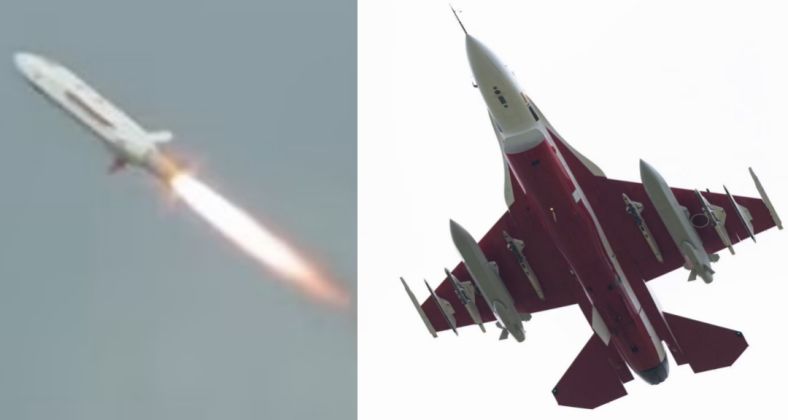
F-2 Fighter with Cruise Missiles and Type 25 Cruise Missile Launch
New photographs have confirmed that the Japan Air Self Defense Force has begun flight testing the air-launched version of its next-generation long-range anti-ship missile, with an F-2 fighter observed carrying the weapon. The missile has received official designation as the Type 25, and represents a substantial evolution of the original Type 12 Surface-to-Ship Missile, incorporating a 1,000 kilometre extended range, compared to roughly 200 kilometres for the Type 12. The new missile also benefits from improved guidance systems and greater flexibility through launch from land, sea and air platforms. The Type 25 missile program has thus provided Japanese forces with a strategic long-range precision strike weapon, and alongside naval targets is reportedly also able to engage selected land targets.
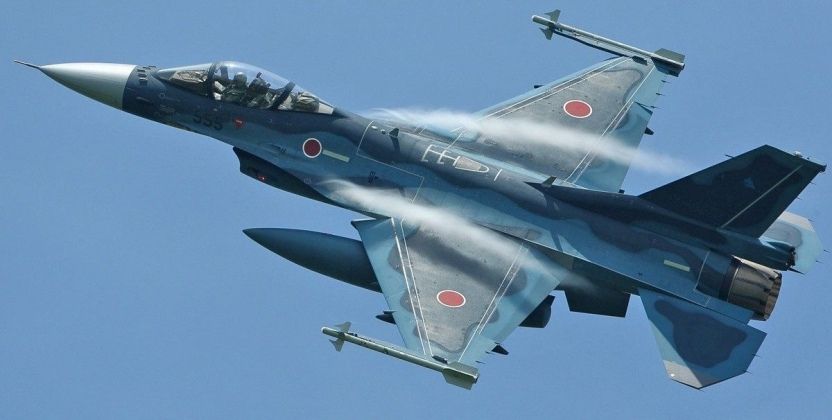
The F-2, jointly developed by Japan and the United States as a derivative of the F-16, possesses a much longer combat radius, which depending on its flight profile and payload and reach approximately 830 kilometres. When combined with a missile capable of flying approximately 1,000 kilometres, the aircraft gains the ability to strike targets approximately 1,800 kilometres from its operating base without requiring aerial refuelling. Such long reach substantially increases the operational flexibility of Japanese air units, and may make the F-2 the most valuable aircraft in the country’s inventory. The F-15 fighters that form the backbone of the Japanese fleet are increasingly obsolete, while F-35 fighters cannot integrate any beyond visual range air-to-ground or anti-ship missiles due to major delays to Block 4 software updates.
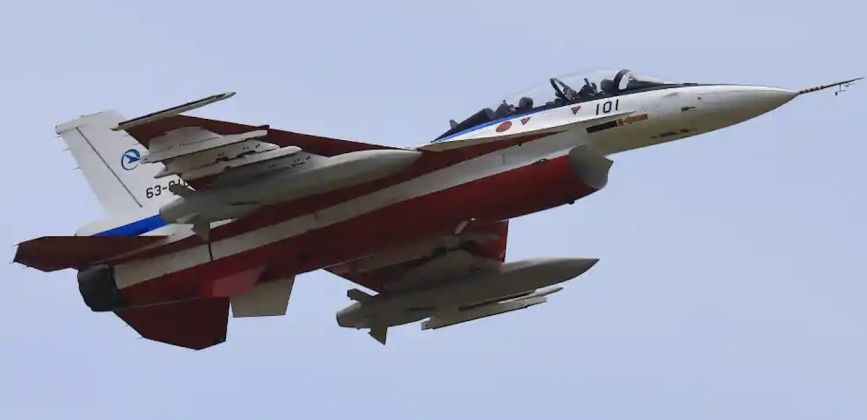
Long-range cruise missiles provide fighters with disproportionately greater operational reaches while, reducing the need for aircraft to penetrate heavily defended airspace, which is particularly important for the F-2 due to its lack of stealth capabilities. Due to the integration of the Type 25, F-2 fighters based in southern Japan will soon able to threaten hostile naval forces over much of the East China Sea while remaining outside the engagement envelopes of many opposing air defence systems. Japanese sources have indicated that the missile employs a combination of satellite navigation, inertial guidance and an advanced imaging seeker, allowing it to discriminate between ships even in complex maritime environments. Open-source reports have also suggested that the missile features a reduced radar signature and a sea-skimming terminal flight profile intended to complicate interception by modern naval air defence systems.
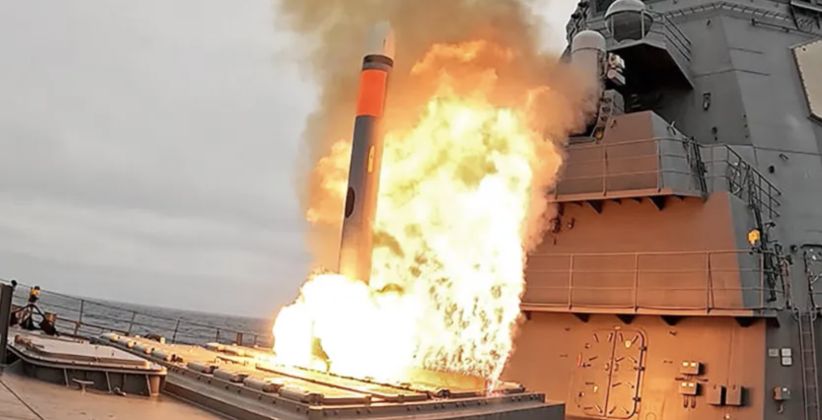
The Type 25 will complement a broader family of Japanese long-range strike systems currently under development, including submarine-launched variants, ship-launched versions and the indigenous Hyper Velocity Gliding Projectile. Together with procurements of Tomahawk cruise missiles from the United States, these weapons form the core of Japan’s emerging long-range conventional strike capability. This has particularly significant implications for Chinese security, as improving Japanese strike capabilities, combined with a considerable Western Bloc military buildup in Northeast Asia, will place growing pressure on China’s defences. Although the F-2 fleet numbers only around 90 aircraft, and the aircraft have far lower lifetime costs than F-15s or F-35s, the integration of the Type 25 may lead them to be seen as the most valuable fighters in the Japanese fleet. Their much lower maintenance needs than Japan’s other two fighter types further adds to their value, with the new missile compensating for the F-2’s limited range relative to the F-15, and its limited stealth and electronic warfare capabilities relative to the F-35.
