
Israeli Frontline Unit Suffers High Casualties From Hezbollah Drone Strike on Exposed Howitzer
Military Watch Magazine Editorial Staff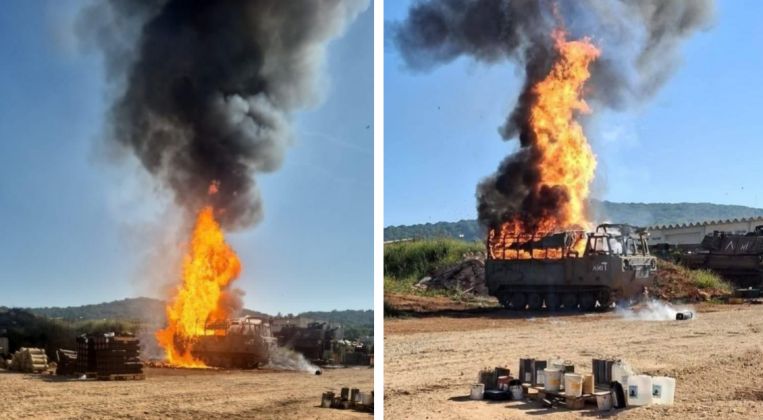
Explosion of M548 Tracked Vehicle After Hezbollah Drone Strike
Footage from southern Lebanon has over several weeks confirmed that the Lebanese paramilitary group Hezbollah is continuing to launch successful strikes on Israeli Army targets, primarily armour, as high intensity hostilities between the two parties continue. Reports on April 30 confirmed that an first person view (FPV) drone strike on an Israeli Army M548 tracked vehicle caused a large explosion which resulted in 12 Israeli casualties, with videos published from the scene appearing to show ongoing secondary detonations of ammunition. The vehicle had been carrying 155mm shells for U.S.-supplied M109 self-propelled howitzers. Neglect by operators appears to have contributed to the vulnerability of the howitzer, as footage shows openly laid out shells directly on the ground with charges, as well as the self-propelled guns themselves, in positions that leave them highly exposed.
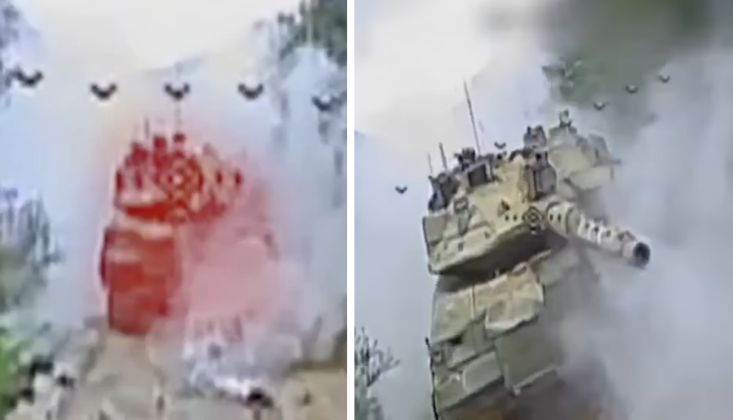
Analysts have observed that Hezbollah’s FPV drones have provided little to no warning when striking, with the aircraft emitting little sound, and proving to be able to bypass the countermeasures of Israeli Army Merkava IV and Merkava V main battle tanks and Namer infantry fighting vehicles. This includes bypassing updated variants of the Trophy active protection system designed for drone defence. Low cost fiberoptic cable-tethered drones are tethered with rocket propelled grenades, and benefit from precision controls that allow them to strike straight to the tank gun opening, the muzzle of the cannon, inside the hatches of armoured vehicles, and other weak points. The drones remain at the lower end of Hezbollah’s arsenals, with the paramilitary group having used both Russian Kornet anti-tank missiles, as well as more advanced Javelin-type non-line of sight anti-tank missiles for longer ranged engagements.
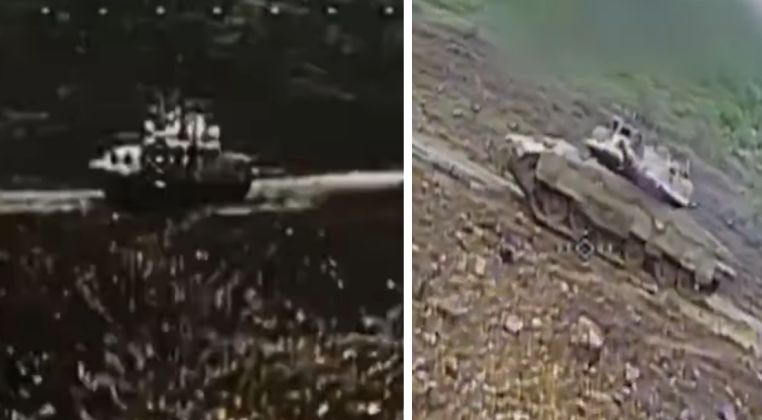
Hezbollah appears to have learned from Russian and Ukrainian experience in utilising fiber-optic guided drones to evade electronic interference. This has fuelled speculation that Russia may have shared knowhow with the paramilitary group either directly, or through Iran or North Korea which have long maintained closer ties with the group. Fighting between Hezbollah and Israel which began on March 1, a day after Israel and the U.S. launched attacks on Iran, is widely reported to be by far the most intensive in the history of the two parties’ decades long conflict. Hezbollah has successfully launched multiple ambushes against Israeli forces in southern Lebanon, with 21 Israeli Merkava main battle tanks reported on March 26 to have been destroyed within a 24 hour period.
