
Israel Simulates F-35 and F-15 Long Range Air Assault as Show of Force to Iran
Military Watch Magazine Editorial Staff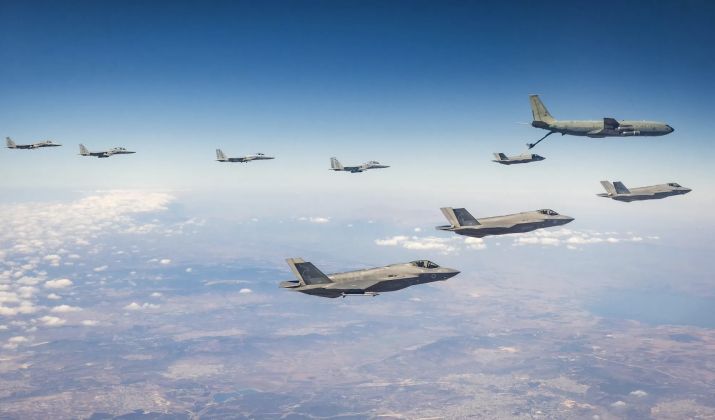
Israeli F-35s and F-15s During Refuelling Operation
The Israeli Air Force has conducted a major aerial refuelling exercise simulating a long range attack using F-35 and F-15 fighters and a Boeing 707 aerial tanker. The exercise comes at a time of heightened tensions between Tel Aviv and Tehran, after Israel assassinated the Chairman of the Hamas Political Bureau Ismail Haniyeh at his residence in Tehran on July 31. With Iranian officials having pledged to respond to the attack, Israeli exercises have been widely interpreted as a show of force to deter possible retaliation. “Aerial refuelling is an operational capability required by the combat force, enabling it to remain airborne for long periods of time,” a spokesperson for the Israeli Air Force stated, before further emphasising their importance. Aerial refuelling is considered vital to facilitate any major air operation against Iranian targets, as Western-made fighter classes generally have much shorter ranges than their Russian and Chinese counterparts which seriously limits the ability of aircraft such as F-35s and F-15s to reach targets on Iranian territory.
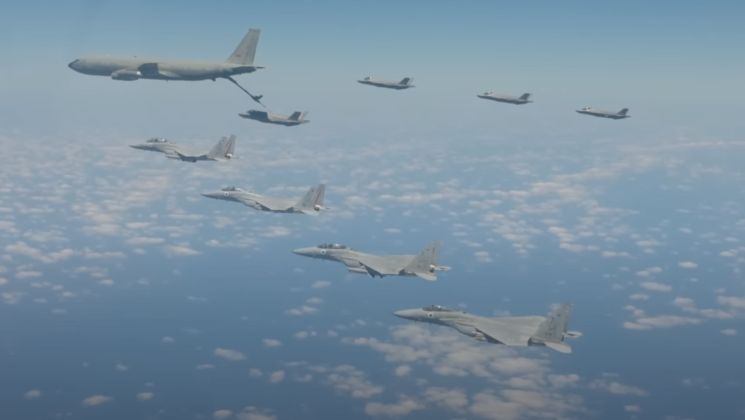
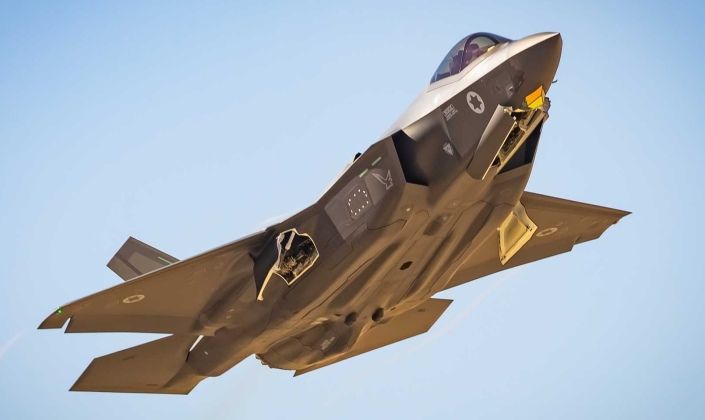
Although the large majority of the Israeli fighter fleet is comprised of very short ranged F-16s, as well as obsolete Cold War era F-15 variants, two elite units of modern fifth generation F-35s are currently in service, with 25 more of the aircraft having been ordered in early June to equip a third squadron. The F-15I is considered the country’s second most capable fighter class, and is a derivative of the American F-15E Strike Eagle. Twenty five of the fighters were ordered in the 1990s. While longer ranged than the F-35, the F-15I’s avionics are considered obsolete today. Further expansion of the Israeli F-35 fleet, which is reportedly capable of deploying nuclear weapons, as well as expected orders for much more capable F-15IA variants - which are based on the cutting edge F-15EX variant - are set to expand options for air assaults against Iran.
Iran notably fields no post-Cold War fighter classes in its fleet, the large majority of which is comprised of Vietnam War era F-4 and F-5 fighters, although the country’s ground based air defence network has proven to be highly sophisticated. The country has placed an order for 24 Su-35 fighters from Russia - reportedly with the option of expanding this to 64 fighters. The Su-35’s avionics, while less advanced than the F-35s, are still far more sophisticated than those of other Israeli fighters, with the aircraft designed to work closely with ground based air defences and integrating a sensor suite particularly well optimised to tracking stealth targets. Su-35 acquisitions, and continuous modernisation of the Iranian ground based air defence network with new generations of indigenous systems, are expected to make an air attack on the country increasingly challenging. While Iranian personnel were reported in December 2022 to be training in Russia to operate Su-35s, it remains uncertain when the first fighters will arrive in the country.
