
Israel’s World Leading Rafael Trophy Active Protection System Outshines Western Competitors; Why the U.S. Turns to Israeli Technology to Enhance the Survivability of its Battle Tanks
Military Watch Magazine Editorial Staff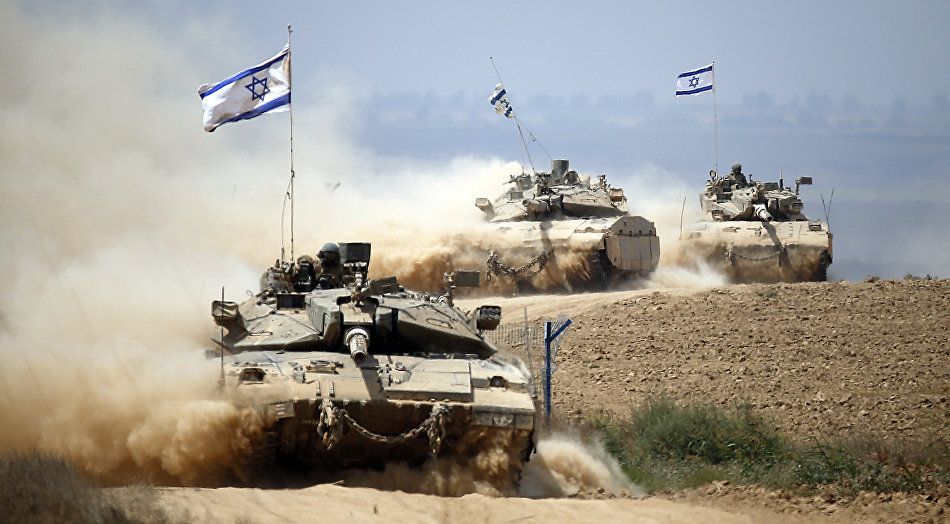
Israeli Merkava IV Main Battle Tanks
Once considered invulnerable, U.S. M1 Abrams battle tanks have suffered heavy losses in recent years both in Saudi Arabian hands to lightly armed Yemeni insurgents and in Iraqi hands against a number of Islamist groups using relatively basic anti armour munitions. Much like the German Leopard II, the Abrams has seen a significantly undermining of its reputation as a result of performance shortcomings in recent Middle Eastern wars, and though it was a world leading platform shortly after entering service near the end of the Cold War the platform’s survivability has failed to keep up with recent developments both in anti tank weapons and in defensive systems.
Unlike Western made battle tanks, Israel’s own Merkava IV armoured platforms retains among the most capable defensive systems in the world - including Rafael’s Trophy active protection system. Designed based on Israel’s experience deploying battle tanks to numerous armed conflicts, first and foremost the country’s brief war with Hezbollah in 2006 which was widely considered the only defeat suffered in Israeli history and in which numerous tanks were destroyer by sophisticated missile attacks, Israeli ground forces quickly sought out a new protection system capable of enhancing the tank's already formidable survivability. This was particularly critical in light of the threat posed by Hezbollah forces, which was beyond comparison to the threats Western powers’ own armoured vehicles faced operating in Iraq, Afghanistan, Somalia and other theatres over the past several decades. Hezbollah largely responsible for forcing the Israeli Defence Force to adopt higher standards than its Western counterparts, particularly as it was an enemy on the country’s very doorstep as opposed to a far off adversary operating on a distant continent as in the case of those the United States and its European allies so often faced in war.
Three years after the war with Hezbollah, Trophy active protection systems began to be integrated onto Israeli battle tanks to ensure a better performance in future conflicts. The defence system functions by intercepting and destroying incoming projectiles, including anti tank missiles and rockets, with a blast similar to that of a shotgun. The platform is far more sophisticated than any analogues developed by the United States or European powers, and includes an Elta EL/M-2133 fire control radar with four panel antennas mounted to give a 360 degree field of view and effectively detect incoming projectiles. The system also includes a powerful internal computer, which calculates the approach vector of incoming projectiles almost instantly as well as the optimal time and angle to fire a round to intercept it. No comparable system has been developed for U.S. or European battle tanks.
As a result both of the effectiveness of the Trophy system, combat tested highly successfully on numerous occasions against Palestinian militants, and the poor survivability of America’s armoured vehicles, which themselves face increasingly potent threats on the battlefield, the United States Army has sought to purchase the Trophy for integration onto its own armoured platforms. This marks an exceptional circumstance when the U.S. has sought to import a complete weapons system rather than manufacture it domestically - a testament to the Trophy’s exceptional capabilities. The Israeli defence system is estimated to cost an estimated $300,000 to arm a single battle tank, and could result in billions in export contracts should it be widely adopted by Western armoured units. With the platform able to protect armoured personnel carriers such as the Israeli Namer as well as heavier battle tanks, the Trophy could well be adopted by a number of other American armoured platforms alongside its Abrams tank. With U.S. adversaries retaining a considerable lead in their own tank protection capabilities, with Russia’s Afganit system designed for its T-14 Armata battle tank set to make the platform among the most survivable in the world, Western powers are increasingly in need of a system like the Trophy to protect their armoured units and retain parity in their survivability with that of near peer potential adversaries.
