
Israel Seeking Permanent Expulsion of Gaza’s Population to Egypt - UN Officials Warn of Ethnic Cleansing
Military Watch Magazine Editorial Staff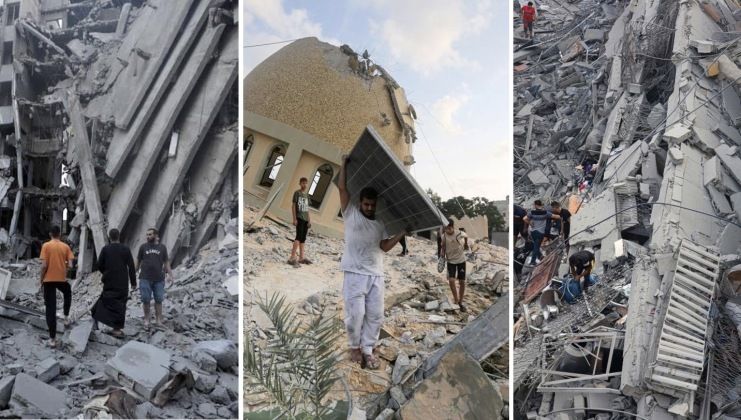
Gazan Streets After First Week of Israeli Strikes in October
Israel’s armed forces, officially the Israeli Defence Forces, are reportedly seeking to engineer the mass expulsion of the Palestinian population in the Gaza Strip into the Sinai Peninsula of neighbouring Egypt, according to the head of the United Nations Relief and Works Agency for Palestine Refugees in the Near East (UNRWA) Philippe Lazzarini. Israel has prevented the population of northern Gaza from returning to their homes after responding to attacks by militias based in the territory with mass bombardment and an invasion invasion in October, and has moved to target civilians further south on a significant scale creating a serious humanitarian crisis and tens of thousands of casualties. Cutting off water and electricity from the Gaza’s population of 2.3 million people, combined with mass targeting of housing and infrastructure, are expected to lead to a further surge in death rates for civilians leaving growing parts of the territory unliveable. Lazzarini warned of Israeli designs for “forcibly displacing Gazans out of the Gaza Strip… the developments we are witnessing point to attempts to move Palestinians into Egypt, regardless of whether they stay there or are resettled elsewhere.”
With Israeli attacks over the past two months having driven more than 1.8 million Gazans from their homes, which represents the largest forced displacement of Palestinians in over 75 years, Lazzarini stressed that Israeli attacks on UN facilities in southern Gaza have contributed to civilian deaths and ensured that nowhere is safe from potential attacks. “The sad reality is that Gazans are not safe anywhere: not at home, not in a hospital, not under the UN flag, not in the north, middle, or south,” he stated. The Israeli Defence Forces have notably attacked areas of southern Gaza which the Israeli government specifically instructed civilians to flee to. As a result of attacks, the bulk of the surviving population were holed up in a “tiny area” of southern Gaza near the Egyptian border. “Judging by policy and humanitarian discussions underway, it is hard to believe that the Palestinians of Gaza who are displaced today will be allowed – or even willing – to return to their destroyed homes anytime soon,” he added. While Israeli forces have on multiple occasions targeted civilians fleeing south, it is expected that the north and middle of the territory will remain depopulated and under Israeli control indefinitely. Lazzarini’s allegations have been supported by statements from Israeli officials, a notable example being Finance Minister Bezalel Smotrich who said the “voluntary migration” of Palestinians out of Gaza was the “right humanitarian solution.” A policy document compiled by the Israeli Ministry of Intelligence and leaked in late October called for the depopulation of Gaza and the forced displacement of its population into Egypt, indicating that this remained a key policy objective.
Egyptian sources have widely reported mounting pressure on Cairo from Israel’s allies in the Western world to accept an inflow of Palestinian refugees, with local officials having issued defiant statements stressing that the country would not accept a relocation of the Gazan population to its territory. This included a statement by Egyptian President Abdel Fattah al-Sisi expressing categoric “rejection and denouncement of policies of displacement or attempts to eradicate the Palestinian cause at the expense of neighbouring countries.” Egyptian Foreign Minister Sameh Shoukry said in late November forced displacement of Palestinians remained an Israeli objective “as it seeks to drive Palestinians from their land by making life in the Gaza Strip impossible.” Egypt has nevertheless accepted limited numbers of injured Gazans for medical treatment, under the assumption that they are to eventually be repatriated. Although Egypt has maintained positive relations with Israel for close to 50 years, and has notably seen its armed forces’ ability to respond to potential military pressure seriously diminish over that time as a result of its acquisitional decisions, the current conflict has the potential to mark a turning point. Cairo in the first week of December warned of a potential “rupture” in relations if efforts to press the Gazan population into Egypt were maintained.
Pressure on Arab states to accept a resettlement of Gazans to their territories has reinforced longstanding perceptions across the Arab world that Israel, which is widely seen as a European colonial settler state due to its foundation by primarily ethnically European migrants in 1948, intends to expand into Gaza through a policy of ethnic cleansing. This has increasingly been compared in the Arab world and beyond to prior efforts to forcefully displace local ethnically non-European populations across the Americas, Oceania, and parts of Africa such as Algeria and Rhodesia under prior colonial settler projects. Israel, however, claims that displacement of the Gazan population is necessary to root out Palestinian militia groups such as Hamas which the country has unilaterally designated as terrorist organisations. In late November Israel submitted a new initiative to the U.S. Congress calling for Washington to condition American aid to Arab countries on their willingness to accept the relocation of Gazans to their territories, with this reportedly having received support from senior officials in Republican and Democratic parties. Representative Joe Wilson, for example, stressed that “the only moral solution [is] to ensure that Egypt opens its borders” to Gazan refugees. Efforts to displace the Gazan population and create conditions for their relocation elsewhere, while placing their territory under Israeli control, has received widespread criticism from across the non-Western world as representing part of a policy of ethnic cleansing. A major surge in American and allied Western military presences in the Middle East, while contributing to Israeli objectives with drone operations, munitions supplies and personnel deployments, has served primarily to deter regional actors, namely Iran and its ally the Lebanese militia Hezbollah, from intervening militarily against Israel.
