Is the United Kingdom a Genuine Nuclear Power? A Look at the British Nuclear Forces' Unique Lack of Independence
Military Watch Magazine Editorial Staff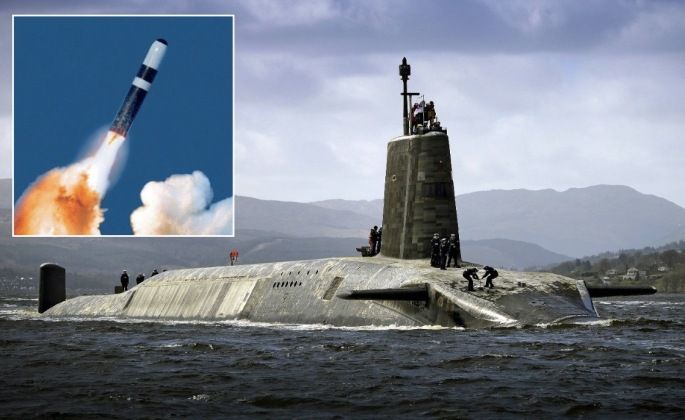
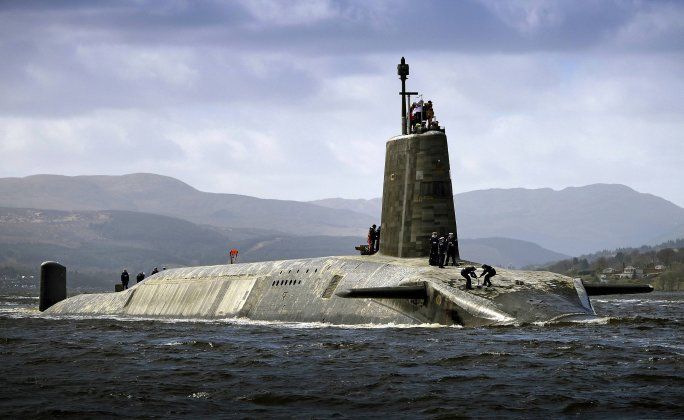
Vanguard Class Submarine and Trident II ICBM
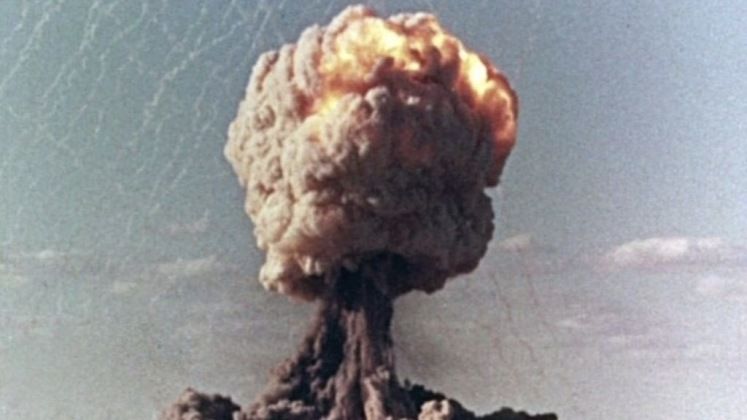
Following its first successful nuclear weapons test on October 3, 1952, the United Kingdom became the third country after the United States and Soviet Union to field an independently developed nuclear deterrent - achieving this seven years after then U.S. and three years after the USSR. London sought to turn the tide in the post-Second World World War world against its decline as a great power, which was well underway by the early 1950s with the vast majority of the British Empire having gained or being well on its way towards gaining independence after centuries of imperial rule. With a successful independent nuclear program which only the world's two superpowers otherwise had, Britain's claim that it was still a leading world power, despite its failing and highly indebted economy and its declining conventional military capabilities, could be substantiated to some degree.
In the wake of Britain's first nuclear test, the United States and the USSR both proceeded to test thermonuclear weapons with destructive capabilities orders of magnitude greater than the atomic bombs previously used. The first U.S. test of such a weapon came exactly four weeks after Britain's first nuclear test, on November 1 1952, with the first Soviet test following on November 22, 1955. The emergence of thermonuclear arsenals led to significant debate among Britain's military and civilian leadership regarding their country's place in a world dominated by two military superpowers, and whether it was worthwhile for a relatively small state with no immediate threat to its own security, which was in any case covered by the American nuclear umbrella, to attempt to qualitatively match the nuclear capabilities of the superpowers and develop its own thermonuclear warheads. Many in Britain's military leadership felt that the country's position would be best served by allocating funds to support declining conventional capabilities rather than spending on costly nuclear weapons, on the basis that conventional war was a far more likely prospect than nuclear war as both the U.S. and USSR would be deterred from using nuclear weapons by the power of one another's arsenals. Despite this, in a decision thought to have been influenced by pride and prestige, Britain invested heavily in developing a hydrogen bomb which it proceeded to test in 1958. The reasons for this were outlined by the Chiefs of Staff Committee which stated: "If we did not develop megaton weapons (thermonuclear bombs) we would sacrifice immediately and in perpetuity our position as a first class power." Nuclear weapons programs thus appeared to be Britain's means of resisting the post-1945 world order and clinging to what it perceived to be its rightful place as a world leading power.

The purpose of Britain's nuclear forces has continued to be questioned to this day, particularly after deep budget cuts under a stringent austerity program affected almost all sectors of government spending in the 2010s and seriously undermined the armed forces' conventional capabilities. According to a report by the British Parliament's Select Committee on Defence in 2006, Britain's nuclear submarines armed with Trident intercontinental range ballistic missiles, which were the only nuclear force the country deployed, remained wholly dependent on the United States to operate and did not represent any form of independence in political or military decision making. The report stated:
"The fact that, in theory, the British Prime Minister could give the order to fire Trident missiles without getting prior approval from the White House has allowed the UK to maintain the facade of being a global military power. In practice, though, it is difficult to conceive of any situation in which a Prime Minister would fire Trident without prior U.S. approval. The USA would see such an act as cutting across its self-declared prerogative as the world's policeman, and would almost certainly make the UK pay a high price for its presumption. The fact that the UK is completely technically dependent on the USA for the maintenance of the Trident system means that one way the USA could show its displeasure would be to cut off the technical support needed for the UK to continue to send Trident to sea."
The report further noted regarding the lack of independence of Britain's nuclear forces - serving as an effective appendage of American nuclear forces:
"In a crisis the very existence of the UK Trident system might make it difficult for a UK prime minister to refuse a request by the US president to participate in an attack. The UK Trident system is highly dependent, and for some purposes completely dependent, on the larger US system... The UK's dependency on the USA has operational significance. For example, the UK's reliance on U.S. weather data and on navigational data provided by the U.S. Global Positioning System (GPS) means that, should the USA decide not to supply this data, the capacity of the UK's Trident missiles to hit targets would be degraded."