
Iraq's Pivot to Russia and What It Means For the Middle Eastern Balance of Power
Military Watch Magazine Editorial Staff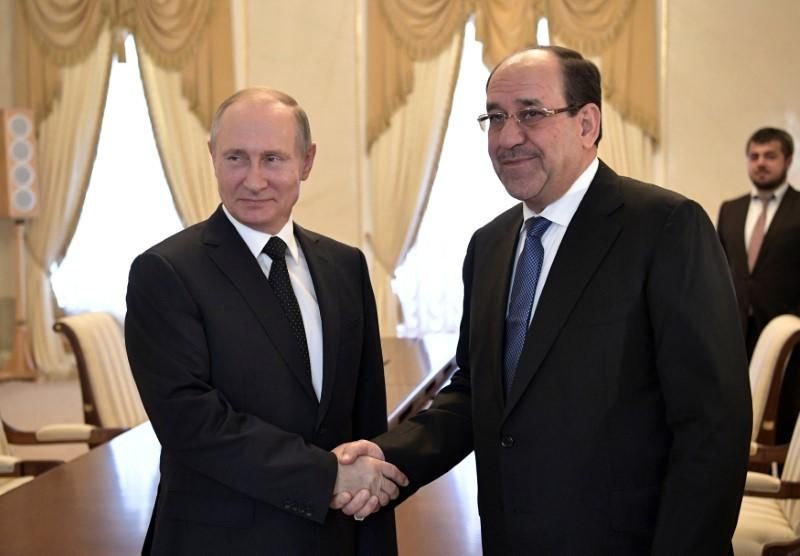
Iraqi Vice President Maliki and Russian President Putin
Since the beginning of the Cold War it was critical for the Western bloc's strategic interests to ensure that as many territories as possible, if they were to fall out of direct colonial administration, would remain close Western partners and kept out of the Soviet sphere of influence. One region of particular importance to the West's strategy of isolating the USSR was the Middle East, which though hardly outstanding in its economies or its human resources, was both strategically located and home to vast fossil fuel reserves. Preventing the Soviet Union from deploying its military in or exporting arms to Middle East and keeping natural resources and trade routes firmly under the control of either the Western bloc or its client states was considered to be of paramount importance.
During the the emergence of Arab Nationalism in the 1950s as a major force in the region seriously undermined the Western bloc's position, particularly as Arab Nationalist states such as Syria, Libya, South Yemen and Egypt closely aligned themselves with the USSR. It was only with the dissolution of the bloc in the 1970s and the emergence of many of its former members as Western clients that the Western bloc's advantage returned. With the end of the Cold War the remaining Russian friendly governments in the Middle East were repeatedly targeted for regime change by the United States and its partners. Iraq, Syria and Libya - the three Arab states with the closest relations with Russia - have all been targeted by both direct U.S. military intervention and military support for anti-government forces. Iran too has formed close ties to a number of major U.S. adversaries and this has been a major factor in its government being targeted for regime change as well. While initiatives to prevent a Soviet or Russian friendly Middle East with military ties independent of the Western bloc from emerging have long been successful, there are signs that this is unraveling.
While regime change efforts against Syria have failed, they have driven the country closer than ever to Russia which has vastly expanded its military presence in the country. Syria's military is meanwhile almost entirely reliant on Russian, and to a lesser extent North Korean, weapons. While Syria's British educated President, not to mention its First Lady who remains a British citizen, were expected to enact reforms and to pivot the country further westwards - the Western bloc's campaign against the country has ended any such prospects. Post-war Syria is set to be rebuilt by multi-billion dollar contracts with both Chinese and Russian firms, and what Western economic and political influence was there has been lost. Iran's economic and military ties to Russia, as well as China and North Korea, have continued to grow and Russia remains the Iranian military's primary foreign arms supplier. More concerning for the Western bloc however is Iran's recent decision to allow Russian forces to deploy to Iranian territory and carry out joint military exercises. The wars in Syria and Iraq have only strengthened cooperation between the two states and both have coordinated their military efforts in Syria.
Since the success of Russia's air campaign in Syria in late 2015 there has long been speculation that the Iraqi government could itself strengthen military cooperation with Moscow. This was confirmed on July 24th 2017 when Iraqi former President and Vice President Nouri and Maliki, who had previously voiced his concern regarding the nature of his country's military ties to the United States, stated while on a visit to Moscow that his country "would like Russia to have a substantial presence in our country, both politically and militarily." The Vice President referred to Russian influence as a stabilizing force, a contrast to the United States which he previously claimed was supporting terrorism. Maliki also called for the Iraqi energy industry, previously notoriously hard on foreign investors, to be opened to Russian investment. While Iraq's military had long relied almost exclusively on American weapons, this too has changed following failures in dealing with the IS terror group. Only days before Maliki's statement the Russian Presidential aide on military and technical cooperation had announced that Iraq had signed "a significant contract for a large batch" of advanced T-90MS Russian battle tanks.
Alongside these parties Algeria and Egypt have both in recent years taken steps to strengthen military and economic cooperation with Russia, and even Saudi Arabia, the United Arab Emirates and Turkey are now seeking both military cooperation and advanced Russian weapons - something historically unprecedented. Jordan, Morocco and Bahrain and Qatar may well follow suite. Russia's decisive military intervention in Syria was a critical factor in this and boosted the country's military prestige throughout the region. Should this trend continue, the endgame the Western bloc has for so long tried to prevent may yet materialise and Western influence in the Middle East, particularly their standing in the military field, may be seriously undermined.
