
Iran’s Deadly Fateh-110 and Fateh-313 Ballistic Missiles; Lightweight Solid Fuelled Platforms Provides Near Instant Response Time to Enemy Attacks
Military Watch Magazine Editorial Staff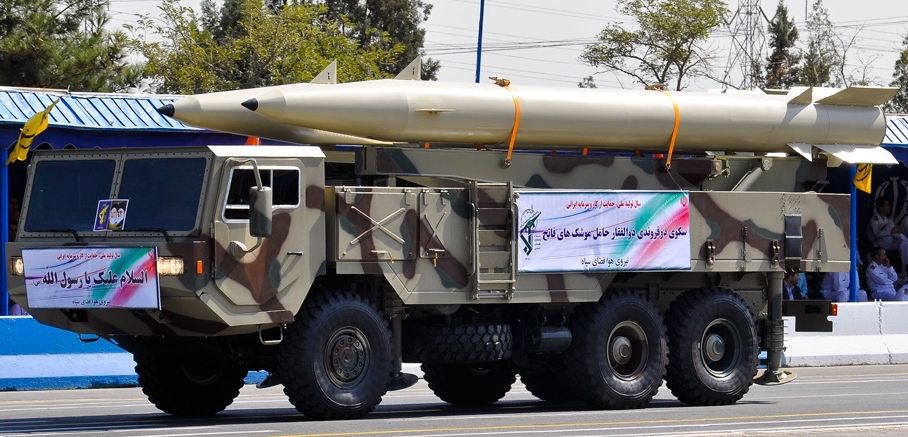
Iranian Fateh-110/313 Missiles on Parade
With Iran having undertaken extensive efforts to modernise its ballistic missile capabilities from the mid 1980s, both to develop retaliatory capabilities against Iraqi Scud attacks and in the Iran-Iraq War’s aftermath to develop a viable deterrent force against potential future adversaries. With China and North Korea serving as the prime suppliers of ballistic missile technologies to the newly founded Islamic Republic, Tehran reportedly imported solid fuel missile technologies from both, gaining Korean assistance based on its experience developing the KN-02 Toksa and importing over 200 Dongfeng 7 missiles - a ballistic derivative of the S-75 surface to air missile. The Fateh-110 was developed as a short ranged single stage solid fuelled platform to complement the capabilities of the country’s predominantly liquid fuelled arsenal, able to engage targets at ranges of little over 200km, and the missile entered mass production in 2002. Technologies reverse engineered from the Dongfeng-7 and technical assistance from North Korea were reportedly key to the platform’s development, which has seen a number of upgrades since entering service - with the design’s range being extended to 250km in 2004 and reportedly gaining a range of over 300km in 2012. The latest variant of the missile was referred to as the 'Third Generation of Fateh-110.’
The Fateh’s relatively light weight and its use of solid fuel, allowing it to be stored fully fuelled and thereby considerably reducing its required launch time, makes it a highly practical weapon - particularly for highly mobile forces making use of guerrilla tactics. The platform has thus been particularly favoured both by the Iranian Revolutionary Guard Corps, which maintain a considerable military presence abroad in Iraq, Lebanon and Syria, as well as by the Iranian aligned Lebanese militia Hezbollah. Due to the high demand for the missile and its importance to the projection of Iranian power in the Middle East, a more sophisticated derivative of the solid fuelled platform was developed for the Revolutionary Guard. Unveiled on August 21st 2015, the Fateh-313 was almost identical to its predecessor in its external appearance but fielded considerably superior capabilities. The missile made use of a new composite body and a superior fuel composite which extended its range to 500km. Considering the missile’s size, this was an impressive feat for the weapons platform - allowing Iranian forces equipped with the light platforms to target Israel fro the territory of Iraq or to threaten Saudi and Emirati oil fields from Iranian territory.
Following Iran's unveiling of the Khalij Fars (Persian Gulf) and Hormoz (Straits of Hormuz) ballistic missiles, an anti ship derivative of the Fateh-110 known as the Al Mobeen was unveiled in August 2018 amid growing tensions with the United States - which relies on its Navy as its principle means of launching strikes in the even of war. The Zolfaghar, another advanced variant, deploys a submunition warhead. Fateh missiles have provided Iran’s ally, the Syrian Arab Army, with a simpler and more cost effective solid fuelled ballistic missile platform for deployment against Islamist insurgents on Syrian territory - relative to the heavier Soviet Tochka and North Korean Toksa in its service. The missile poses a particularly considerable threat to Iran’s adversaries due to its mobility, low maintenance and short deployment time, which allow its operators to set up and launch the missiles with a high degree of precision in under half an hour while on the move. For Iranian guerrilla force operating against a potential Western invasion, Hezbollah forces operating against Israel, and possibly even Yemeni Ansurullah Coalition forces moving from cover to cover to evade Saudi and U.S. attacks, this makes the Fateh a highly valuable asset - arguably far moreso than larger and more cumbersome platforms such as the Scud and Hwasong-6 which are less well suited to guerrilla operations.
