
Iran Announces Mass Production of Indigenous Battle Tanks; What the New Karrar Combat Platform Indicates Regarding Tehran's Ambitions for its Defence Sector
Military Watch Magazine Editorial Staff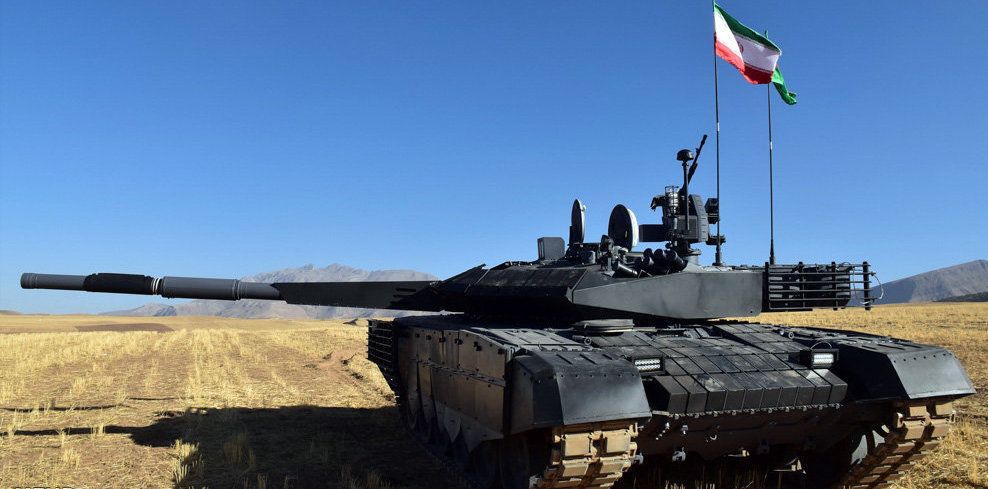
Iranian Karrar Battle Tank
Unveiled in 2017 as the future of Iranian armoured warfare, the Karrar main battle tank represents the first modern platform of its kind manufactured entirely indigenously by the Islamic Republic’s defence sector. Based on experience licence producing over 2,500 the Russian T-72 tanks since the 1990s, the Karrar appears to closely resemble the Russian T-72 and T-90 platforms externally - with a number of analysts naming it an imitation of the T-90 design. With the T-90 today being among the world’s most capable battle tanks, a program to produce a similarly capable albeit slightly heavier battle tank represents the extent of Iran’s ambitions for its defence sector. Indeed, the Karrar is hardly unique in this regard, with Iran having also unveiled an indigenous light stealth fighter, stealth drones derived from the reverse engineered U.S. RQ-170, advanced intermediate range ballistic missiles and air defence platforms based on North Korean technologies, and already fielding a twin engine fourth generation light fighter it claims is comparable to the American F-18 Hornet - to name but a few examples.
In August 2018 Iran revealed plans to fulfil an initial order for 700 Karrar tanks for its ground forces, and followup orders for hundreds and possibly thousands more remain likely should initial variants perform as planned. With export variants of leading battle tank designs such as the U.S. M1 Abrams and Russian T-90 notably lacking the advanced capabilities of platforms manufactured for domestic use, and producing battle tanks indigenously allowing Iran both to better develop its own key technologies such as composite and explosive reactive armour while acquiring the vehicles at a far lower unitary cost, the potential advantages of the Karrar program should it succeed remain considerable. Regarding the implications of new platform's induction, Brigadier General Ahmad Reza Pourdasten noted: “We were once interested in buying the Russian tanks, but since we can manufacture similar models within the country and we plan to do so in the near future, the deal is now off.” This came shortly after claims by Defence Minister Brigadier General Hossein Dehghan, referring to Russia's foremost export tank, that the Karrar was "100 percent Iranian made and it can even be superior than T-90 in some degrees.”
Speaking regarding the Karrar’s capabilities the Iranian Defence Minister stated: ”The tank can compete with the most advanced tanks in the world in three main areas: power, precision and mobility, as well as maintenance and durability on the battleground… The Karrar has the capability to fire missiles and precisely guide them.” Whether the Karrar will be able to match foreign competition remains to be seen, but given the country’s inexperience in developing battle tanks relative to major producers such as Russia and South Korea, both of which have recently taken the lead in developing next generation platforms well ahead of anything deployed to the Middle East, the Defence Minister’s claims appear highly questionable. Indeed, while Iran has access to the technologies of the relatively basic T-72B1 and T-72S, both of which pale in comparison to the latest B3 variants of the elite Russian platform, the Karrar’s ability to match leading tanks of the same generation such as the Russian T-90MS, Israeli Merkava IV or Chinese Type 99 remains highly unlikely. While it may not lead the third generation, the Karrar nevertheless appears to represent a formidable asset, and a major step for Iran’s defence industry towards becoming a world class manufacturer - which in the Middle East is rivalled only by Israel.
