
Introducing the J-20B: China Reportedly Puts Advanced New Stealth Fighter Variant Into Mass Production
Military Watch Magazine Editorial Staff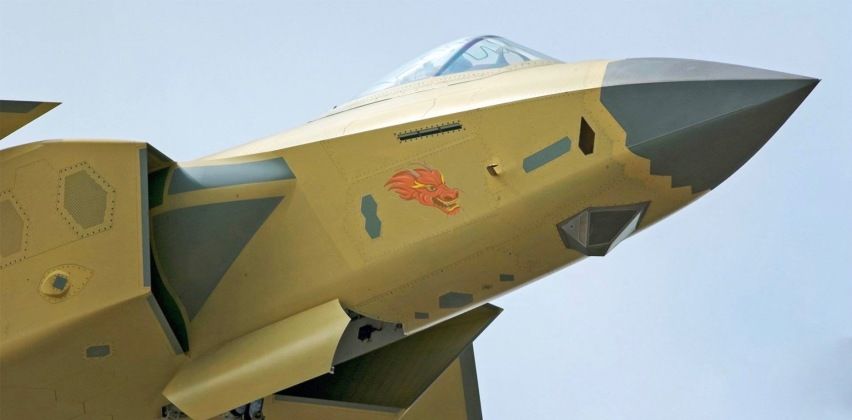
J-20 Fifth Generation Heavyweight Fighter
A number of Chinese and Hong Kong media outlets have reported that a new variant of the country’s first fifth generation fighter jet, the Chengdu J-20, has entered mass production. Citing anonymous military sources, it was reported that the new fighter, known as the J-20B, was officially unveiled on July 8th at a ceremony attended by senior military leaders including the Vice Chairman of the Central Military Commission General Zhang Youxia, who is in charge of weapons development. The original J-20 fighter entered service in China’s People’s Liberation Army (PLA) Air Force in March 2017, and remains until today the only fifth generation fighter developed outside the United States to enter active service. The fighter is a twin engine heavyweight platform specialised in air to air combat, making it analogous to the American F-22 Raptor and considerably heavier and more specialised than the newer F-35. The J-20 boasts a range of advanced capabilities, many of which were not found on its American analogue, including a helmet mounted display, AESA radar guided air to air missiles and a distributed aperture system among others which all served to provide advantages over the F-22. All other fifth generation fighters including the upcoming Russian Su-57 notably rely on air to air missiles with passively scanned radars and considerably shorter ranges than the PL-15 missiles deployed by J-20, with the Chinese missiles' more modern sensor suites better at locking onto stealth targets and much more difficult to jam.
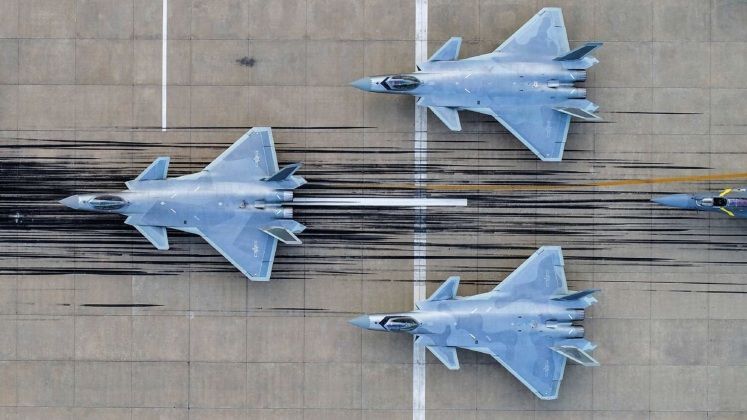
It remains uncertain what new capabilities the J-20B variant has, when or if the original J-20 ceased mass production, and when the new variant will enter frontline service. The only new capability reported is the addition of thrust vectoring engines for added manoeuvrability, making it the second Chinese fighter to integrate such technologies after the J-10C which entered service in 2018. Thrust vectoring provides fighters with enhanced manoeuvrability particularly at low speeds, and the J-10C and F-22 were previously the only non-Russian fighters to integrate it. Unlike the F-22 which relies on two dimensional thrust vectoring however, the J-20 is likely to make use of three dimensional thrust vectoring for much higher manoeuvrability at low speeds - having previously provided such capability to the J-10C. China is thought to have gained access to thrust vectoring technologies through technology transfers from Russia which accompanied its purchase of Su-35 ‘4++ generation’ fighters in 2015.
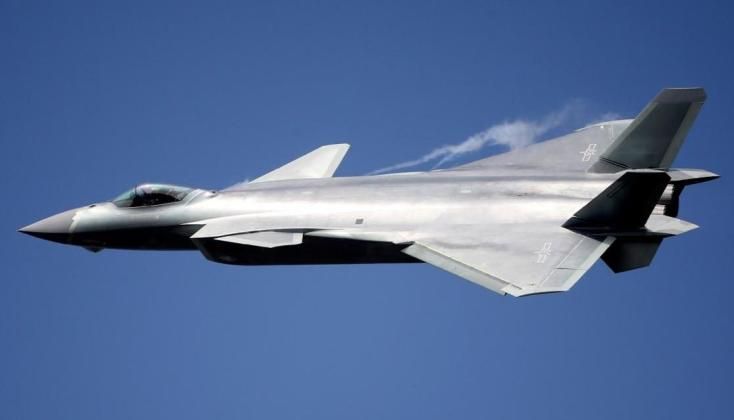
Upon the entry into service of the J-20B, it will be the world’s first fifth generation fighter to be developed into an enhanced new ‘sub generation,’ with plans for an ‘F-22C’ terminated due to budgetary constraints and the lighter F-35 seeing no plans for any similar superior variant announced so far. Speculated new capabilities of the J-20B include more powerful sensors and electronic warfare systems, a stealthier profile, new avionics, side and rear facing radars and possibly new missile racks to facilitate a greater internal payload. It remains uncertain whether there will be any visible differences between the new variant and its predecessor, or whether older J-20 fighters can or will be upgraded to the J-20B standard. One outstanding weakness which the J-20B variant has reportedly not yet fixed is its lack of sufficiently powerful engines comparable to the F119 powering the F-22 - which provides what is thought to be the American jet’s only significant advantage.
China is currently developing a number of next generation engine designs, with the J-20 reportedly set to be equipped with the WS-15 afterburning turbofan. Reports from Chinese media indicate that the WS-15 could be ready earlier than previously anticipated and before the end of 2022, with fighters currently in service relying on weaker WS-10 engines and initially on the Russian AL-31FM2. It remains uncertain whether the J-20 fighters equipped with new engines will receive a new designation such as ‘J-20C’, or whether the engines will be used to retrofit J-20B fighters replacing the WS-10 and AL-31. The WS-15 has a reported thrust of 197kN, making it considerably more powerful than the American F119 and very likely providing the J-20 with an unrivalled flight performance.
