
Indian Army Vice Chief Lt. Gen. Sarath Chand Claims Pakistan Maintains a Superior Industrial Base to his Own Country
Military Watch Magazine Editorial Staff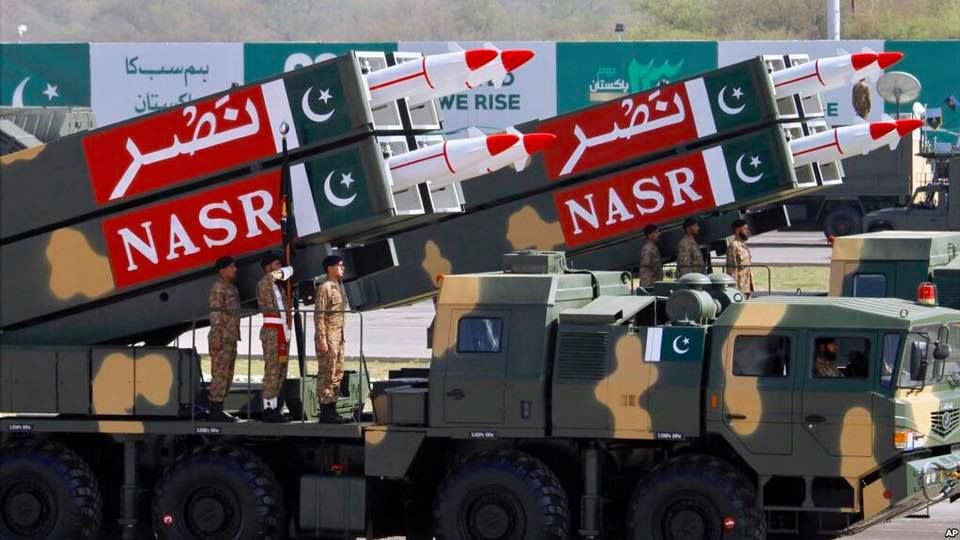
Pakistan's Indigenous Nasr Nuclear Missile Artillery
In an unprecedented statement at the inaugural session of AMICON 2017, a two-day conference organised by the Indian Army and the CII, the country's Vice Chief of Army Staff Lt. Gen. Sarath Chand alleged that in terms of his country's military industrial capabilities relative to those of Pakistan "there is no competition whatsoever." General Chand noted that his county's military industries were unable to keep pace with changing technologies - and were "unsuccessful" in supporting India's defense requirements. He continued: "I would even go to the extent of saying that Pakistan probably has a better industrial base, as far as defence production is concerned, than our country. In fact they export defence equipment abroad, definitely more than what we are doing." This came despite India's economy being almost eight times the size of Pakistan's.
General Chand indicated that his country's military industries may be in such a poor state as a result of assured orders and lack of competition which leads to a lack of accountability. He stated: "There is little or no research and development. They do not even have the capability of absorbing the industry through transfer of technology, and in some cases they have even failed to assemble products that have been imported from abroad. It is very hard to see ordnance factories changing in the present state. Overall it has become an unsuccessful method of supporting our defence requirements."
Regarding the importance of developing a military industrial base, General Chand stated that in the event of war it would leave India reliant on foreign sources to resupply their forces. This is a disadvantage rivals such as China and Pakistan would hardly face. The General stressed the need for reform and support for the country's make in India program.
While there is little doubt that India currently maintains a significant technological advantage over Pakistan in several fields, the unmatched Su-30MKI and Brahmos cruise missiles being but two examples, the country relies far more heavily on imported weapons systems. Not only does Pakistan manufacture its own missiles entirely domestically, but it also relies on a domestically produced fighter - the JF-17 Thunder - as the mainstay of its aerial warfare capabilities. While the JF-17 is far inferior in its capabilities to India's Su-30MKI, the fact that Pakistan has been able to induct a light indigenous fighter into service where India continues to report poorly on the progress of its Tejas program - unlikely to become the mainstay of the country's own Air Force in the near future - demonstrating the significantly superior state of the Pakistan military industrial base. One of India's leading weaknesses is its heavy reliance on foreign weapons, and it is for this reason that reform to its military industries and support for the Make in India program are essential.
