
Indian Air Force's Answer to Pakistan's JF-17 Thunder; Develop Indigenous HAL Tejas to Surpass its Capabilities
Military Watch Magazine Editorial Staff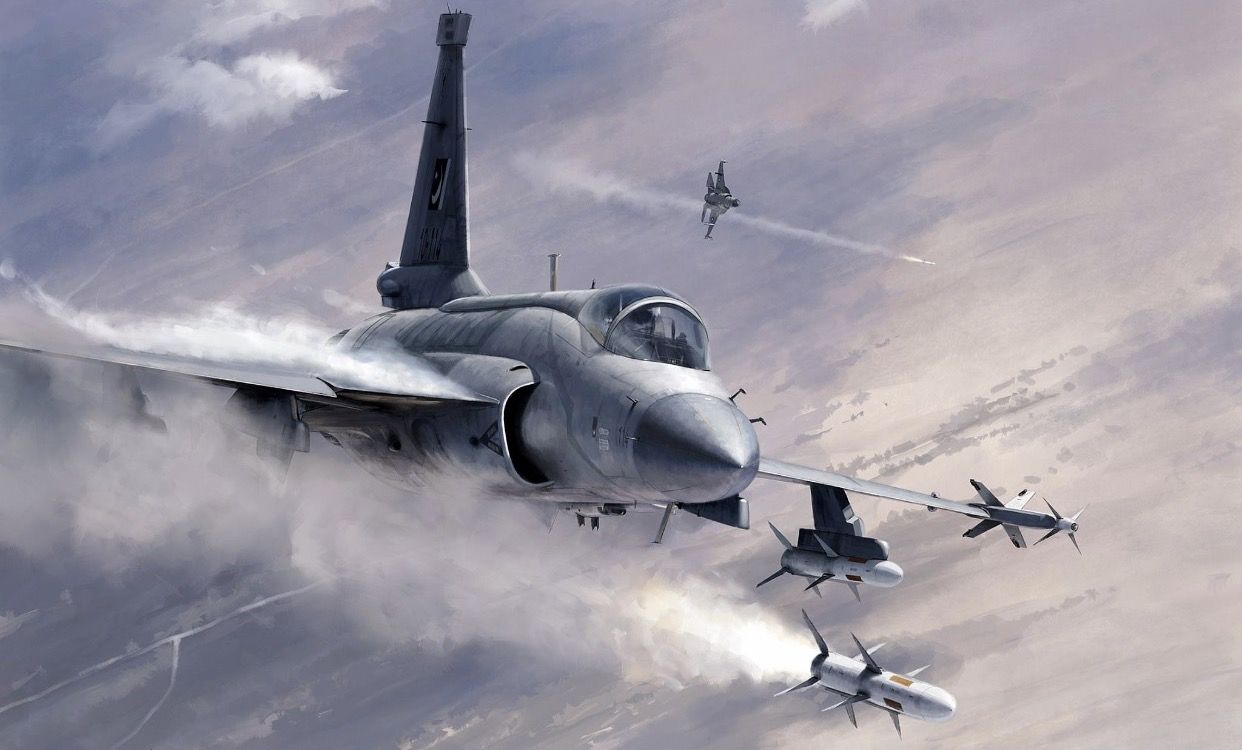
Pakistani Air Force JF-17 Thunder Artwork
Pakistan’s Air Force introduced its first indigenous fourth generation fighter, the JF-17 Thunder, into service in 2008 five years after the light single engine aircraft made its first flight. The fighter was jointly developed by the Pakistan Aeronautical Complex and China’s Chengdu Aircraft Industry Group - the manufacturer responsible for a number of prolific programs including the J-20 fifth generation stealth platform. The JF-17 has since revolutionised Pakistan’s formerly negligible aerial warfare capabilities, replacing dated second generation platforms which Islamabad had long relied on for its defence and reducing its dependance on the U.S. F-16 - an aircraft designed with a similar role and many common characteristics. While the initial JF-17 fighters produced were somewhat unremarkable in their capabilities, closely resembling those of advanced variants of China’s J-7 such as the J-7G which first entered service the year the JF-17 was initially flight tested. Later variants however, particularly the JF-17 Block 3, are highly sophisticated aircraft far surpassing both the J-7 and the F-16C in their performances and incorporating a number of advanced features including AESA radars, radar cross section reducing profiles, highly sophisticated PL-12 air to air missiles and airframes making extensive use of lightweight composite materials for extra durability and manoeuvrability.
While the JF-17 was never intended to match the elite platforms fielded by neighbouring India such as the heavy twin engine Su-30MKI, they are highly capable as light support fighters and their indigenous production has long been a source of great pride for Pakistan’s armed forces. While India’s armed forces field far more capable combat aircraft, namely the Su-30 and to a lesser extent the MiG-29 which Pakistan is wholly unable to match at present, Delhi’s efforts to produce a single engine light fighter have floundered for decades. The HAL Tejas, designed to replace the MiG-21 in the Indian Air Force, was rejected by the Navy and has entered service in extremely limited numbers, leaving India’s armed forces far more reliant on externally procured arms for their aerial warfare capabilities.
Indian Air Force Chief BS Dhanoa, tacitly acknowledging the current dominance of the JF-17, has pledged that the HAL Tejas’ development is set to continue and eventually to eclipse the Pakistani fighter in its combat performance. Speaking on April 26th Dhanoa stated: “There is a very good article in one of the aviation journals. He (the author) says JF-17 is not as technologically advanced as Tejas. So, he said JF-17 is the aircraft of today because they have fielded much more squadrons than us, and Tejas is the aircraft of the future. It has much better systems. It depends on how we equip it. I am sure we can come up with a better plane.” Dhanoa acknowledged recent performance failures with the Tejas upon being questioned, replying: “But HAL got it up in less than six hours and thereafter, Tejas matched with other aircraft detail for detail.”
While arms races continue across the world between major military powers, including the race to develop the first sixth generation fighter between the United States and Russia and a fierce competition to develop the most capable fifth generation fighters between the U.S. and China, India and Pakistan continue to contend with one another over which party can develop the most capable fourth generation light fighter. The far inferior technological bases of both South Asian states' military aviation mean that neither can produce anything more sophisticated than a fourth generation single engine light fighter, and both are reliant on foreign assistance to develop even these relatively basic capabilities. Pakistan's JF-17 has nevertheless emerged as one of the leading fighters of its kind, and whether India’s Tejas will be able to eclipse the Block 3 variant of the fighter remains to be seen. There does remain a significant possibility, considering the far faster speed of the Pakistani platform’s development (the Indian Tejas has been under development for over 30 years) that by time a sufficiently capable variant of the Indian fighter is ready for mass production the JF-17 will have evolved to surpass it. The capabilities of the JF-17 beyond Block 3 can only be speculated, but are likely to be highly formidable should the program continue at its current pace. Pakistan has also begun joint development of a fifth generation light fighter with China, which is set to enter service in the near future, possibly before the Tejas’ completion, and significantly outperform the Indian fighter.
