
India’s Fifth Generation Fighters: No FGFA, No F-35, But Future Su-57 Acquisition Possible
Military Watch Magazine Editorial Staff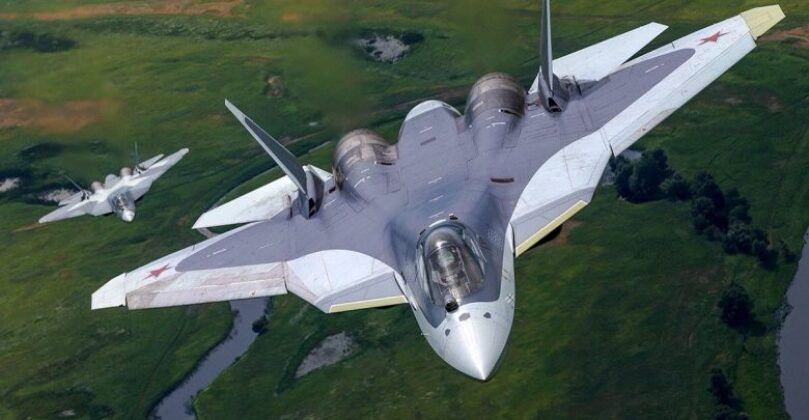
Su-57 Fighters
After over ten years of joint development, reports from April that India had withdrawn from the joint Future Generation Fighter Aircraft (FGFA) program with Russia raised questions regarding the future of the country's fleet modernisation plans. The FGFA program began in 2007, and was set to develop a twin engine heavyweight fighter with next generation capabilities for the Indian Air Force heavily based on the Russian Su-57. The fighter would fill an analogous role to the Russian built fourth generation Su-30MKI which currently forms the backbone of India’s fighter fleet. Following the success of the BrahMos project to jointly develop a Russo-Indian cruise missile, both parties had high hopes for the next generation fighter with Sukhoi's director Mikhail Pogosyan stating upon the program's commencement: “We will share the funding, engineering and intellectual property in a 50—50 proportion.” The fighter would make use of the Su-57 airframe, but would be armed primarily with weapons of Indian origin such as Astra air to air missiles. Per India’s request a variant with a second seat for a weapons systems officer would also be developed.
Ultimately due to a significant discrepancy in the technological bases of the two countries, with India struggling to produce even a basic fourth generation lightweight fighter after decades of delays, such a joint fighter program was particularly difficult. Russian sensitivity regarding the transfer of a number of technologies, which the country’s cash strapped military industries had invested heavily in developing, combined with India’s high demand for technology transfers to provide much needed improvements to its own defence industry, despite paying only a small fraction of the program's costs, meant negotiations were often strained. Two months after Russia’s first overseas deployment of the Su-57, unconfirmed reports emerged that India withdrew from the FGFA program. With Moscow having lost a critical partner for its next generation platform, the country is likely to redouble its efforts to find export partners for the costly next generation fighter. Algeria, Vietnam, Indonesia, Iran and a number of Middle Eastern states remain other possible export destinations. While China has already inducted its own fifth generation air superiority fighter already, the Chengdu J-20, the People's Liberation Army may also show interest in the Su-57.
India for its part is still in need of a heavyweight next generation fighter, particularly in light of the growing capabilities of its neighbours. While it has been reported by a number of Western outlets that Delhi has shown interest in acquiring the American F-35, a single engine lightweight fighter, this has been firmly refuted by a number of high ranking Indian officials. Most recently Air Chief Marshal B. S. Dhanoa, speaking publicly in New Delhi on April 26th, stated: "There is not talk on F-35. The Indian Air Force has not evinced interest and not talked to anyone. It is incorrect to report that we are interested in F-35.” With the F-35 seriously underperforming in its air to air combat capabilities compared to elite heavy platforms such as the F-22 and Su-57, and even older fighters such as the Su-30 and J-11, the platform has been seen as highly unsuitable to meet India’s defence needs. While the Su-30MKI is formidable, Delhi has sought a more modern platform capable of fulfilling a similar role and equipped with stealth capabilities, which would be needed to match elite new Chinese air superiority platforms such as the J-20 and J-11D.
With the F-35 being the only post-fourth generation Western fighter in production, and with India unwilling to acquire Chinese fighters due to tensions between the two countries, Russia remains the only source of such fighters to meet Delhi’s requirements. India has considered two options for its new fighter, both produced by Russia’s Sukhoi. One option would be to purchase the Su-57 when it becomes available for export, as while costly the fighter would perfectly fulfil the country’s defence needs and without the complications of negotiating a technology sharing agreement. The Indian Daily Business Standard, reporting on defence plans by National Security Advisor Ajit Doval and Defense Secretary Sanjay Mitra, stated regarding the Su-57: “India might possibly join the project later, or buy the fully developed fighter outright, after it entered service with the Russian Air Force.”
The country’s second option would be to commission an upgraded variant of Russia’s Su-35 ‘4++ generation’ air superiority fighter, a platform based on the same airframe as the Su-30 but incorporating a number of new systems. The possibility for Sukhoi to develop a variant with stealth capabilities, using radar cross section reducing measures and an AESA radar to increase the fighter’s survivability in beyond visual range combat, has already been explored and remains highly feasible. At Abu Dhabi's IDEX show the CEO of Russia's Rostec Sergey Chemezov stated in regards to the program: "We have been negotiating and have signed the intention protocol for the Su-35. Now we are working on designing ideas for this contract and on creating a manufacturing platform for an aircraft of the fifth generation." With the fighter sharing a common origin with the Su-30MKI, of which India currently fields over 250, a stealth variant of the Su-35 would be easy for the Indian Air Force to integrate and operate alongside its existing fighters. Although this fighter is unlikely to be sufficient to match the Chinese J-20, it could be commissioned to meet the Air Force’s immediate needs until the Su-57 program has matured further, at which time Delhi is likely to seek to acquire the platform to provide a much needed edge against the capabilities of its northern neighbour.
