
India Abandons Plans for a Nuclear Powered Aircraft Carrier
Military Watch Magazine Editorial Staff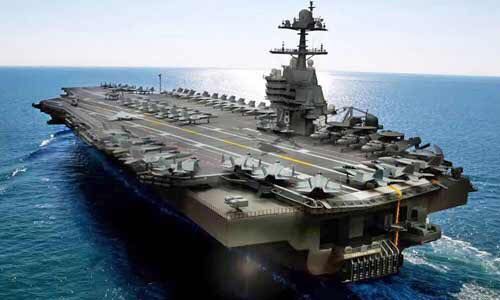
INS Vishal Concept Design
The Indian Navy has altered plans for its new INS Vishal carrier to rely on conventional rather than nuclear power. Nuclear powered carriers are currently fielded only by the United States which fields ten such platform - and by France which fields a single troubled carrier, the Charles De Gaulle. While the technologies are complex and expensive, they give carriers an essentially unlimited range and are thus highly beneficial for power projection - particularly for larger platforms such as the Nimitz class and the Vishal.
The pretext for abandoning the program to develop a nuclear powered vessel was that doing so would take too much time. India's Bhabha Atomic Research Centre (BARC) reported that development of such systems for the carrier domestically would take 15-20 years. Indeed, based on France's experience attempting to develop technologies for even a modest sized aircraft carrier, it is no small feat. India had sought to gain technological assistance from the United States to integrate nuclear powered systems into the Vishal. Whether the U.S. accepted or not, and whether this was in fact a deciding factor in India's decision, remains unknown.
The INS Vishal, though only conventionally powered, is still a heavy 65,000-70,000 tonne platform able to deploy 60 aircraft - the only carrier in the world outside the United States to incorporate an electromagnetic aircraft launch system (EMALS). While its lack of nuclear power shortens its range significantly, so long as the Vishal is not intended for power projection beyond the Indian Ocean its conventional power would not necessarily hinder its effectiveness. The ambitious project is set to be one of the world's more capable carriers, with capabilities closer to those of the most advanced Russian, Chinese and U.S. vessels - far eclipsing those of other nations. That being said the actual performance of the carrier will largely depend on the type of aircraft it will deploy - something which is yet to be determined. Should it lack potent air superiority platforms equivalent to the F-14, Su-33 or J-15, and instead rely wholly on light platforms such as the F-18C or MiG-29, it could well give India's carrier a significant disadvantage against rival platforms.
