
How Powerful is the Chinese Carrier Strike Group Staging a Show of Force Near the Philippines?
Military Watch Magazine Editorial Staff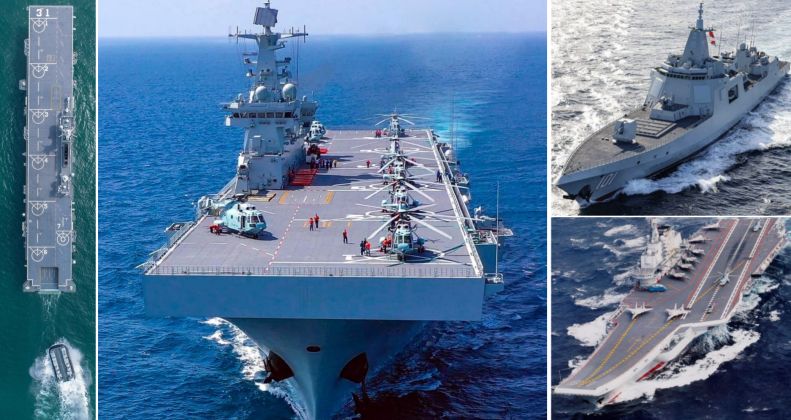
Chinese Type 075 Class Carriers, Type 055 Class Destroyer, and Carrier Liaoning
The Chinese People's Liberation Army Navy has deployed a carrier strike group led by the aircraft carrier Liaoning for operations in the South China Sea. The ships are holding exercises near the Philippines, where the Philippines Armed Forces, alongside forces from the United States, Japan, Australia, Canada, France, and New Zealand, have been jointly holding the Balikatan joint military exercise from April 20. The carrier group is one of the most formidable ever deployed by China, and includes two Type 052D class destroyers, one larger Type 055 class destroyer, four Type 054A class and one Type 054B class frigates, one Type 093B nuclear submarine, one Type 075 helicopter carrier, and one Type 071 dock landing ship. Satellite images have confirmed the deployment of the flotilla for operations.
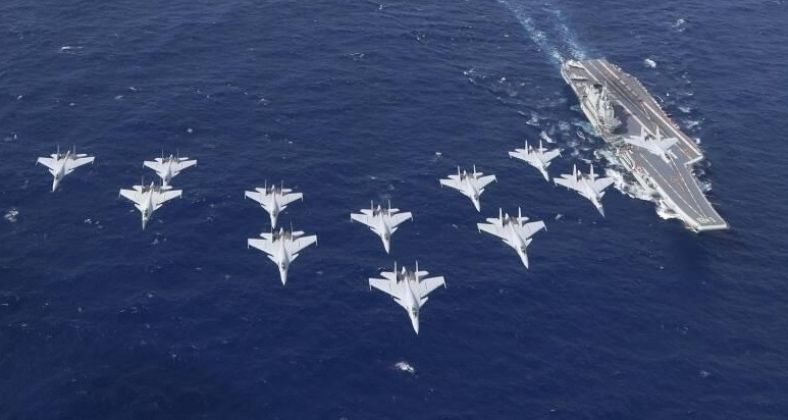
The Liaoning is one of the largest carriers outside the U.S. Navy, and alongside its sister ship the Shandong has on multiple occasions demonstrated the ability to launch rapid sorties near major targets. In May 2022, for example, the Liaoning launched over 100 sorties near U.S. military facilities in Okinawa. In April the following year the Shandong led major exercises near Guam. The recent phasing out of the baseline J-15 and its replacement with the J-15B and J-15D has been a game changer for the Liaoning’s capabilities both for fleet defence and for power projection, with the J-15B in many respects having the highest combat potential of any fourth generation fighter type in the world. The aircraft integrate advanced AESA radars that are among the largest carried by any fighter types in the world, around two and three times the sizes of radars carried by Japanese F-15s and F-35s respectively, which they combine with cutting edge weaponry including PL-15 air-to-air missiles.
Type 075 class ships are among the largest helicopter carriers in the world, rivalled only by the U.S. Navy’s America class ships, and can deploy up to 30 aircraft for a wide range of roles from airborne assaults to anti-submarine warfare. Images from the exercises confirm the deployment of air-cushion landing craft from the Type 075 class ship, which can be used to conduct amphibious landings with support from carrier groups. This has particularly significant implications in the South China Sea, where the U.S. Marine Corps has deployed its own amphibious warfare assets including to take part in the Balikatan exercises. Displacing an estimated 40,000 tons, and with a length of 232 metres, each Type 075 class ship can deploy up to 800 personnel and up to 60 armoured vehicles, as well as up to two Type 726 class landing craft.
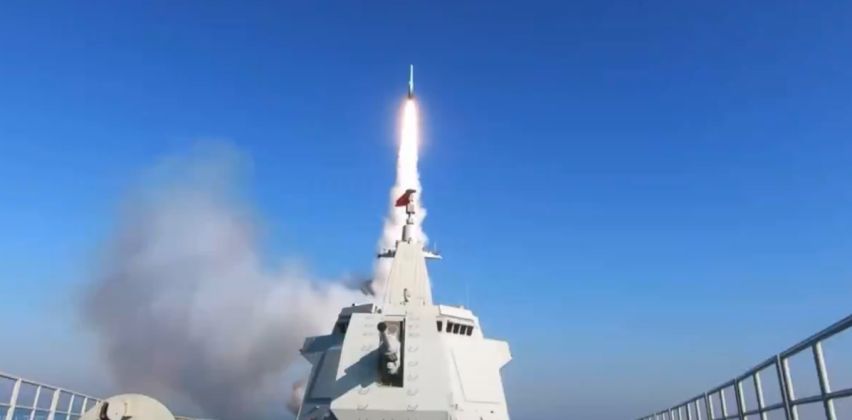
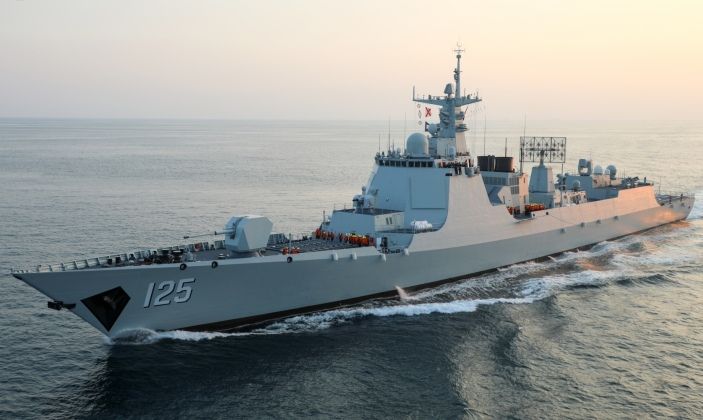
The Type 055 class has a primary armaments suite of 112 vertical launch cells, while each Type 052D destroyer integrates a further 64 cells, which integrate the same surface-to-air, cruise and ballistic missiles. Their HHQ-9B have 300 kilometre engagement ranges, and form the upper layer of the carrier group’s defences. The Type 055 class’ use of a dual band radar system similar, which no Western destroyer class has an equivalent to, provides advanced over-the-horizon detection capabilities. Primary weapons for both destroyer classes include the YJ-100 cruise missile with a 1000km ranges, YJ-18 anti-ship cruise missiles with Mach 3 terminal speeds and complex sea-skimming trajectories, and YJ-21 anti-ship ballistic missiles.
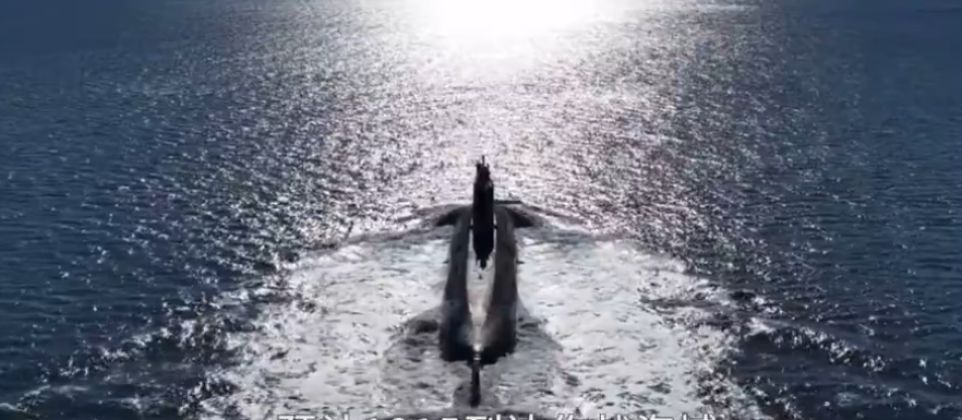
The Type 093 class attack submarine first entered service in 2006, with the service entry of the enhanced Type 093B variant considered to have largely bridged the gap in capabilities with the most sophisticated Russian and U.S. nuclear powered attack submarine types. The integration of air-independent propulsion systems onto the Type 093 class was a leading factor making them quieter than prior generations of ships, and allowing them to remain submerged for longer periods of time. The ships’ capabilities have recently received growing attention following the unveiling of new types of submarine launched hypersonic missiles, including the YJ-19 which has the potential to significantly increase their overall missile carriages. The U.S. Navy has perceived a fast growing challenge from China’s attack submarine fleet, with the service entry of new generations of vessels and associated armaments having occurred at an unparalleled rate.
