
How Badly Damaged is the Russian Bomber Fleet After Ukraine’s Unprecedented Drone Attack?
Military Watch Magazine Editorial Staff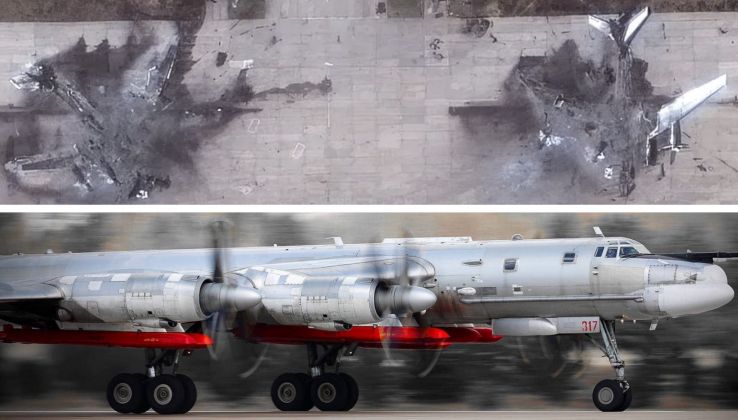
Destroyed Tu-95MS Bombers at Belayaa and Active Tu-95MS
Following the Ukrainian Armed Forces’ successful attacks on major strategic bomber facilities across Russia on June 1 under Operation Spider’s Web, questions regarding the extent of the damage to the Russian Aerospace Forces’ fleet have widely been raised, with the growing availability of satellite and drone footage providing some indications. The attack saw sizeable fleets of short range single use rotary wing drones launched from trucks deep within Russian territory, and engage targets as deep as 4000 kilometres away from Ukrainian borders. The Security Service of Ukraine, or SBU, which is reported to have played the primary role in organising and carrying out the attack, reported regarding the means by which the attack was launched: “During the operation, modern UAV control technology was used, which combines autonomous artificial intelligence algorithms and manual operator intervention. In particular, some UAVs, due to signal loss, switched to performing the mission using artificial intelligence along a pre-planned route. After approaching and contacting a specifically designated target, the warhead was automatically triggered.”
Ukrainian government sources were quick to claim the attack neutralised 41 Russian aircraft, the vast majority of them strategic bombers and A-50 airborne early warning and control (AEW&C) systems. With sources from the country having frequently made highly dubious or outright false claims regarding Ukrainian military successes since the outbreak of full scale hostilities in February 2022, however, it was long expected that the actual losses, although highly detrimental to the Russian fleet’s capabilities, would be much more conservative. The estimate given by Andriy Kovalenko, an official on Ukraine’s National Security and Defence Council, that “at least 13 Russian aircraft were destroyed,” was considered far more credible.
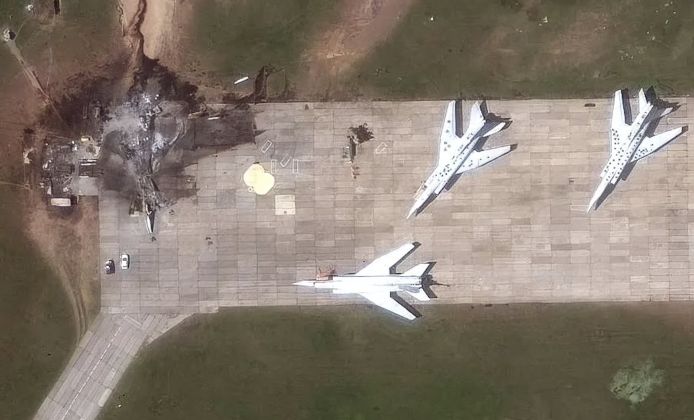
Looking to satellite footage, the most impressive of all the SBU’s attacks was that launched against Belaya Airbase in Russia’s Irkutsk region near the Mongolian border, which permanently hosts Tu-22M3 medium range bombers. Satellite imagery has confirmed the destruction of four of the aircraft. In addition, three Tu-95MS intercontinental range strategic bombers which were temporarily stationed at the facility were also destroyed. Drone footage confirmed that the Tu-95 bombers were already loaded with Kh-101 cruise missiles when targeted, likely in preparation for further sorties against Ukrainian targets. The impact of the drones appears to have detonated the missiles, ensuing the complete destruction of the aircraft. The strike on Belaya Airbase was also confirmed by satellite footage to have destroyed at least two Tu-22M3 bombers.
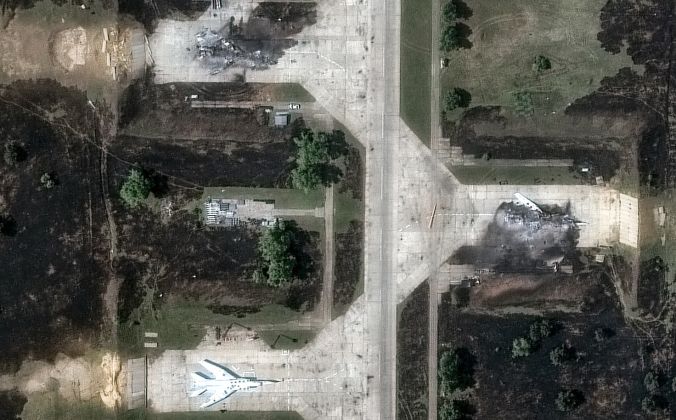
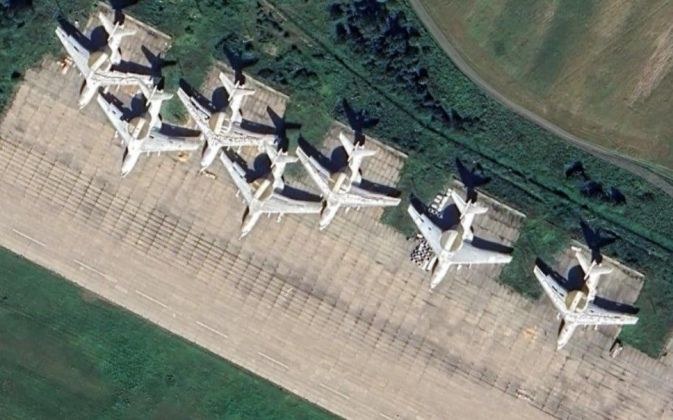
At Olenya Airbase in northwestern Russia satellite images indicate that at least three additional Tu-95MS bombers were destroyed, as well as an An-12 cargo plane. At Ukrainka Airbase at least one further Tu-95MS was hit. At Ivanovo Airbase, which hosts over ten A-50 AEW&Cs in outdoor storage, at least two of the aircraft were hit. It remains probable that the A-50s in question were stored Soviet era aircraft, rather than modernised variants actively used by the Russian Aerospace Forces. Russia’s active A-50 fleet is estimated to stand at only around nine aircraft, which operate to support other kinds of assets rather than in full squadrons. This contrasts with its Tu-95MS and Tu-22M3 bomber fleets which stood at around 60 aircraft each, and were deployed in units to launch strikes together. As a result, the destruction of multiple active A-50s with a strike on a single airbase is particularly difficult.
Overall evidence indicates that Operation Spider’s Web has destroyed seven Tu-95MS bombers, or more than ten percent of the entire fleet, alongside two Tu-22M3 bombers, an An-12 cargo plane, and one or two A-50s that were most likely inactive and in storage. The attack was also confirmed to have targeted Dyagilevo Airbase, which hosts both Tu-22M3 and Tu-95MS bombers, although there were no clear signs of any damage to aircraft base there. Nevertheless, the possibility either of damage to aircraft at Dyagilevo, or of further damage to aircraft at other facilities, remains significant. The operation’s primary achievement, beyond shaking Russian confidence in its strategic depth and bolstering Ukrainian and broader Western Bloc morale, has been its destruction of approximately 8-9 percent of the Russian intercontinental range bomber fleet. This is a particularly significant achievement considering that the Russian fleet is the second largest in the world, and on average deploys by far the newest airframes of any operator of such combat jets. Possible responses could include investment in hardened aircraft shelters, both by the Russian Aerospace Forces and by other services concerned with the possibility of similar attacks, as well as efforts to accelerate production of Russia’s sole bomber class in production the Tu-160M, and acceleration of work to develop a next generation bomber under the PAK DA program.
