
High Ambitions; India Set to Become the Second Nation After the United States to Integrate an Electromagnetic Launch System onto its Carriers
Military Watch Magazine Editorial Staff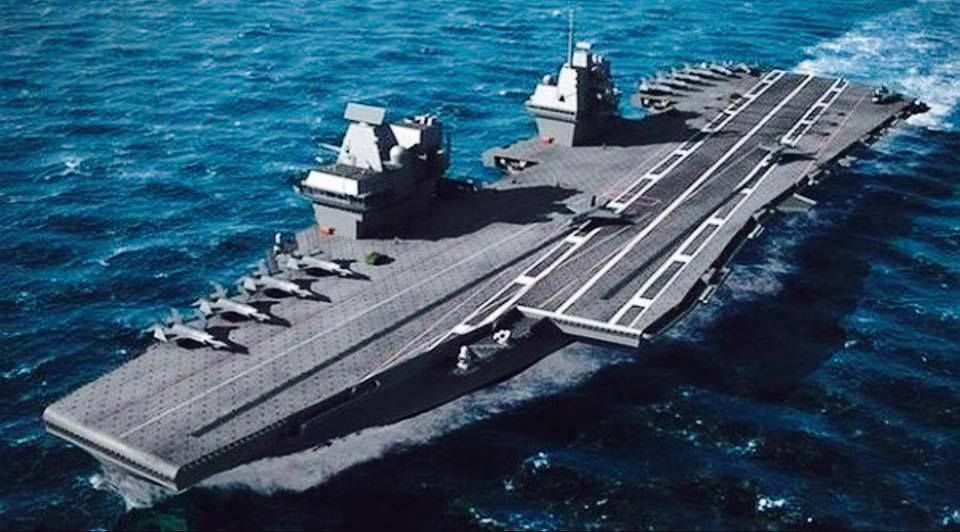
Indian Navy INS Vishal Carrier Concept Design
The Electromagnetic Aircraft Launch System (EMALS) is a cutting edge and highly sophisticated means used to help jets take off from aircraft carriers. It was first successfully tested on a carrier in the second half of 2017 by the U.S. Navy on the newly commissioned USS Gerald Ford supercarrier - the first of a new class of warship. It's complexity led to calls from U.S. president Donald Trump to abandon the program and instead rely on a simpler steam based system, like that used on the Nimitz Class and other aircraft carriers. The high costs of the system were a significant factor motivating calls for its cancellation.
EMALS nevertheless went ahead, and is set to be integrated into the United States' next generation of carriers. It provides several significant advantages over older carrier launch systems, allowing sailors to launch heavier aircraft and doing so more gently than the rough jolt steam systems. The system also takes up less space inside carriers than a steam system. Being able to launch heavier aircraft is a significant advantage in that it allows aircraft with extra weapons and more fuel to be deployed from aircraft carriers. While this will not have significant implications for the carrier based F-35C, which had an extremely limited fuel and weapons capacity due to its need to store weapons internally, for fighters such as the F-18E Super Hornet which are capable of carrying high external payloads this does present a formidable advantage.
The Indian Navy has since 2016 requested an EMALS system for its INS Vishal carrier currently being planned, and in October 2017 this request was granted. This will provide Indian carriers with a launch system more advanced than that of any state other than the U.S. own Gerald Ford class. Whether its new carrier fields the MiG-29, the F-18, or another fighter entirely it will significantly enhance to the power projection capabilities of the Navy by allowing its new flagship by means far beyond the capabilities of other states. With China increasingly emerging as India's primary rival, and India increasingly involved in patrols near Chinese territorial waters in support of American strategic objectives, providing India with more advanced weapons systems will be in accordance with U.S. interests - likely the reason why they have provided India with such systems. With the U.S. Navy overstretched and its Pacific forces outmatched, assistance from the Indian Navy to support the U.S. dominated Pacific regional order would be a significant asset to American regional goals.
