
Heading for Degeneracy? The Decline of the Royal Navy and the End of British Power Projection Capabilities
Military Watch Magazine Editorial Staff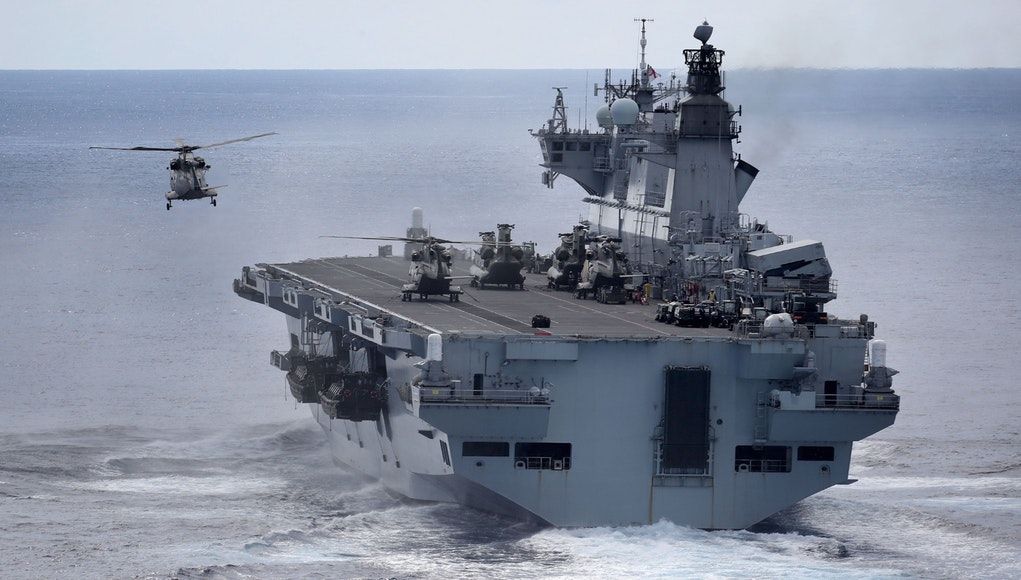
Royal Navy HMS Ocean Helicopter Carrier
Once the most powerful Navy in the world through which Britain built and protected the largest ever maritime empire - the British Royal Navy's capabilities today have been seriously put to question. While Britain pledged to deploy more Naval assets 'East of the Suez Canal' for the first time since the late 1960s - whether these will actually pose a threat to the country's adversaries or affect the balance of power in regions to which is deployed - namely the Persian Gulf and South China Sea - remains to be seen. Aside from the lacking capabilities of the new Queen Elizabeth Class carriers the Navy's other capabilities also leave much to be desired. According to an anonymous Royal Navy source reporting to the British paper, the Telegraph, 68% of the Navy's vessels are out of service and unable to go out to sea. A combination of budget cuts, a lack of staff and fuel shortages was named as the cause. According to the source, this left the Royal Navy a “laughing stock” - with its underperformance revealed during the response to hurricane Irma when France and Holland were both able to send assistance while the British proved far less capable. Julian Lewis, the chairman of the House of Commons Defense Committee stated that this showed how “Defence is far too far down the scale of our national priorities.”
While it was needed for relief operations, Britain's 21,500 ton flagship HMS Ocean suffered engine problems and had its trip to deliver aid cancelled at the last minute. This was a serious embarrassment for the Royal Navy, one of many in recent years, and one of many indicators that it has fallen far from the first rate service it used to be. To make matters worse it was impossible to send one of the Navy's smaller amphibious ships in its stead - as budget cuts and a severe shortage in personnel meant that 74% of the county's amphibious fleet was out of service. Despite its lack of adequate capabilities, the Royal Navy suffered a loss of 4,000 of its staff due to cuts under the 2010 Strategic Defence and Security Review.
Considering the state of the British economy, budgetary increases are unlikely and if anything the Navy will only suffer further cuts. In this state, set only to worsen in future, the Royal Navy's presence in East Asia will likely provide little more than token support to the growing U.S. led alliance in the region targeting China and North Korea. Considering that the service's capabilities have already proven to be cripplingly overstretched - the addition of extra theatres and extra responsibilities, from patrolling the South China Sea to supporting Arab monarchies in the Persian Gulf, will only exacerbate the situation and likely push the Navy past breaking point. It is perhaps on this basis that the former head of the Royal Navy, First Sea Lord Admiral Sir George Zambellas, warned that Britain's military capabilities were set to degenerate into those of a "Third World" country. Indeed, considering the current state of the fleet and the recent embarrassments the Royal Navy has faced, particularly when compared to the more professional, capable and modern navies of Canada, the Netherlands, Sweden, China, Singapore and Japan, it appears well on its way to degeneracy.
