
Footage Shows Word’s Heaviest Destroyer Reconfigured for Radically New Role: Why the USS Zumwalt Sacrificed its Primary Weapon
Military Watch Magazine Editorial Staff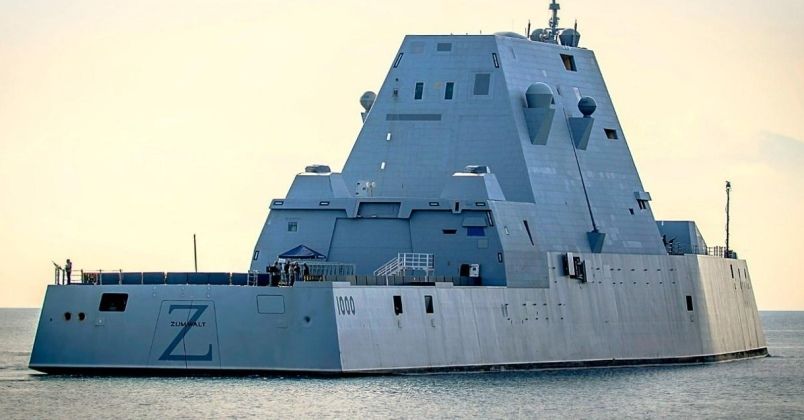
U.S. Navy Destroyer USS Zumwalt
USN
Recent images of the U.S. Navy destroyer USS Zumwalt have revealed a dramatically altered appearance after more than three years in dry dock, reflecting its transformation from a stealth-focused land attack destroyer into the Navy's first dedicated surface combatant designed to deploy ballistic missiles. The destroyer is scheduled to officially return to service in September 2026, although the modernisation program, which began in 2023, is currently around ten months behind schedule. Displacing over 16,000 tons, the USS Zumwalt and its two sister ships are the heaviest destroyers in service anywhere in the world, and at over $8 billion each are by far the most costly, with the Navy’s Arleigh Burke class destroyers costing under $1.5 billion even with costly new enhancements and subsystems.
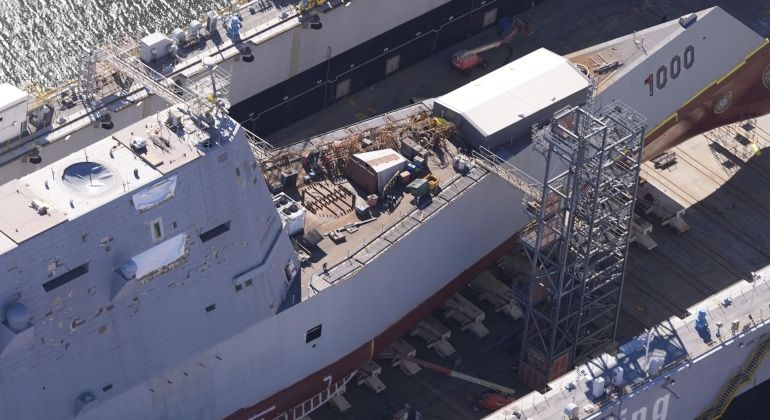
The most outstanding modification is the complete removal of the forward 155mm Advanced Gun System, which was previously intended to serve as the ship’s primary weapon. This has been replaced by four large launch tubes designed to accommodate the Navy's Intermediate-Range Conventional Prompt Strike (IR CPS) hypersonic missile. Surrounding the launcher is a newly installed wave-deflector structure intended to shield the launch system from heavy seas while maintaining the ship's seakeeping performance. The new launcher fundamentally changes the role of the vessel, replacing naval gunfire support with the ability to conduct precision strikes against targets at ranges measured in thousands of kilometres.
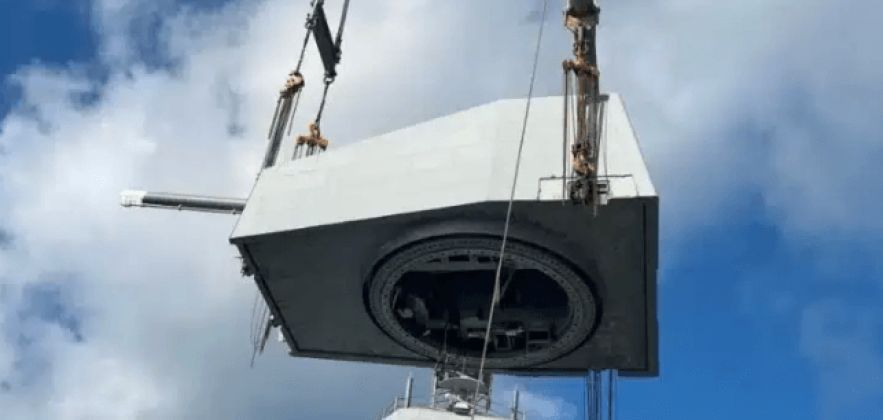
The Advanced Gun System was designed to fire the Long Range Land Attack Projectile (LRLAP) to ranges exceeding 80 nautical miles (148 kilometres). However, after the planned fleet of 32 Zumwalt destroyers was reduced to just three as a result of performance issues, the cost of the specialised ammunition increased to an estimated $800,000 per round, leading the Navy to cancel procurement of the projectiles. Without ammunition for the Advanced Gun System, the destroyers’ future was left in serious question, with he integration of IR CPS missiles representing one effective repurposing of the vessels.
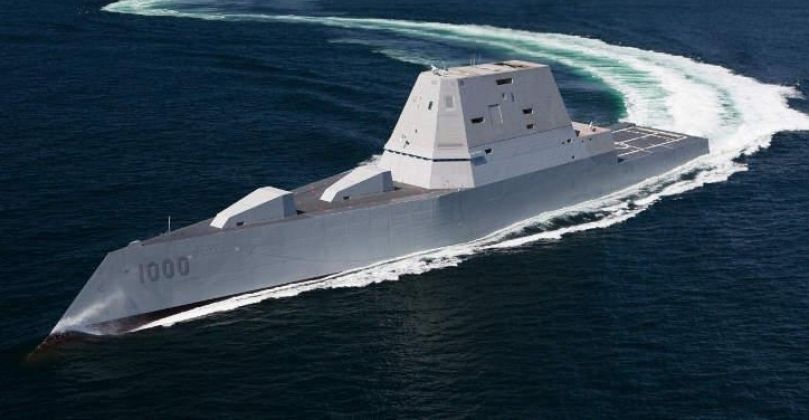
The second AGS gun position has also undergone substantial modification. While the actual gun turret has been removed, the distinctive stealth-shaped housing remains in place, preserving the ship's radar signature. Additional external changes indicate that the modernisation extends well beyond replacing the ship's primary armament. A new mounting base has been installed for the FLIR 380HD electro-optical and infrared sensor system, providing improved long-range surveillance, navigation, target identification, and fire-control capabilities in both day and night conditions. Such sensors will play an increasingly important role as the ship assumes missions centred on long-range precision strike and targeting.
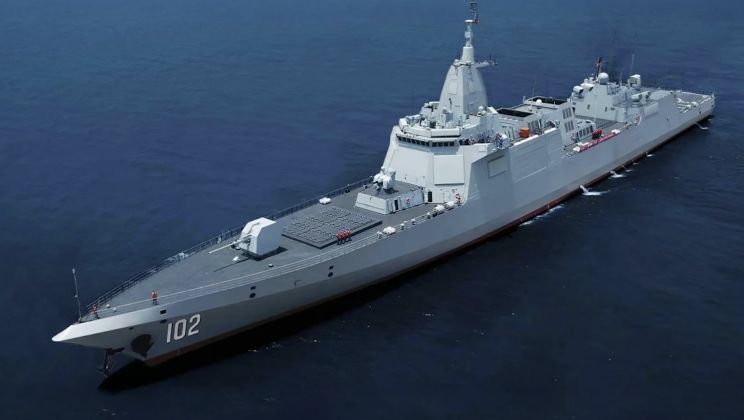
Engineers have also addressed one of the vessel's known engineering shortcomings by relocating the gas turbine air intakes lower on the hull. The revised arrangement is intended to reduce the likelihood of the propulsion system ingesting hot exhaust gases from the ship's funnels, improving engine efficiency and reliability during sustained operations. Although less noticeable than the new missile launcher, the modification represents an important refinement aimed at enhancing the ship's operational performance. According to current plans, Zumwalt is expected to conduct the first test launch of the baseline IR CPS hypersonic missile system by June 2027. A more advanced version of the missile with an anti-ship capability is scheduled for testing before September 2030.
