
First Look at Taiwan’s Secretive Cruise Missile Built to Strike Deep Into China: What is the Hsiung Feng IIE Capable Of?
Military Watch Magazine Editorial Staff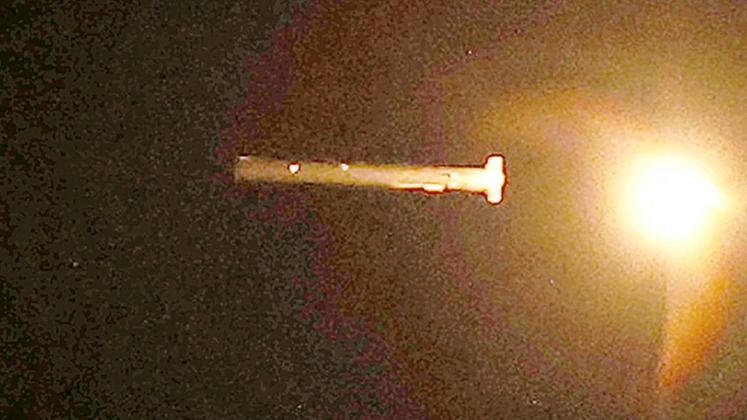
Hsiung Feng IIE Cruise Missile
Taiwanese media has published the first pictures and video clips showing the Hsiung Feng IIE land attack cruise missile - a highly secretive asset thought but not confirmed to have been in service for over a decade. The United Daily News reported the imagery released was captured during a nighttime launch from the Jiupeng military base at the southern end of the island, and is thought to have flown for "many hours.” The Hsiung Feng IIE is known to be a subsonic jet powered missile designed to strike targets deeper inside the Chinese mainland than other assets in Taiwan’s arsenal. It is thought to have begun development in the early 2000s and entered large scale serial production a decade later, with estimates for its range reaching up to 300km while a newer extended range can engage targets at around 1000km.
The Hsiung Feng IIE was shown briefly illuminated by the burning solid booster that was being discarded, with the base at Jiupeng where it was filmed having for years served as a missile test facility and hub for the Republic of China’s National Chung-Shan Institute of Science and Technology (NCSIST). Taiwan, officially the Republic of China, remains in a state of war with the Chinese mainland, and has invested heavily in asymmetric assets such as mobile cruise missile launchers and surface to air missile systems to compensate for its overwhelming disadvantages in conventional fields such as air power. The ability of subsonic missiles without significant stealth capacities to bypass the mainland’s multi layered air defence network, which is among the densest and most advanced in the world, remains highly questionable. This is considered the case not only for the Hsiung Feng IIE, but also for the complementary air launched Wan Chien cruise missiles carried by indigenous Ching Kuo fighters.
