
Why the First F-16 Fighter Built For a Modern Taiwan Strait War Carries Five External Fuel Tanks
Military Watch Magazine Editorial Staff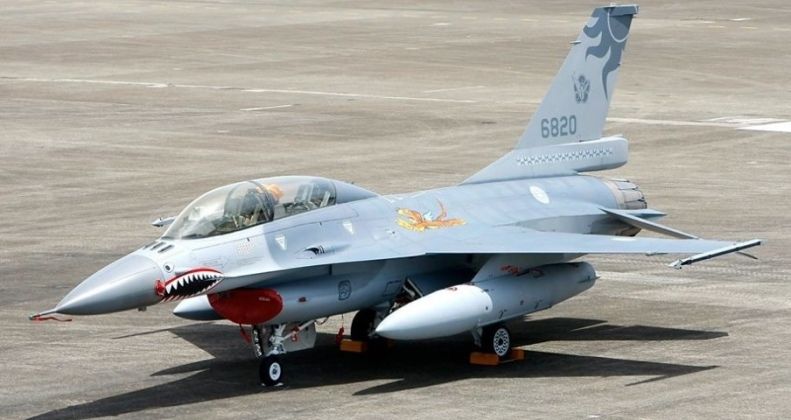
Republic of China F-16B Block 70 With Two External Drop Tanks
During the first sighting of an F-16 Block 70 fighter built for the Republic of China Air Force in the air near Fort Worth Naval Base in Texas, the aircraft was seen integrating five external fuel tanks, including three drop tanks under its fuselage and wings, two further conformal fuel tanks. The configuration has highlighted the gradual evolution of the F-16 program to increasingly rely on outstandingly high external fuel carriage to a much greater extent than was the case in the late 1970s with the fighter type first entered service. The F-16’s relatively small size and lightweight design limit its internal fuel capacity, and significantly restrict its combat radius. This makes external fuel carriage almost indispensable for most operational missions, particularly in the Pacific where operations over longer distances are considered vital.
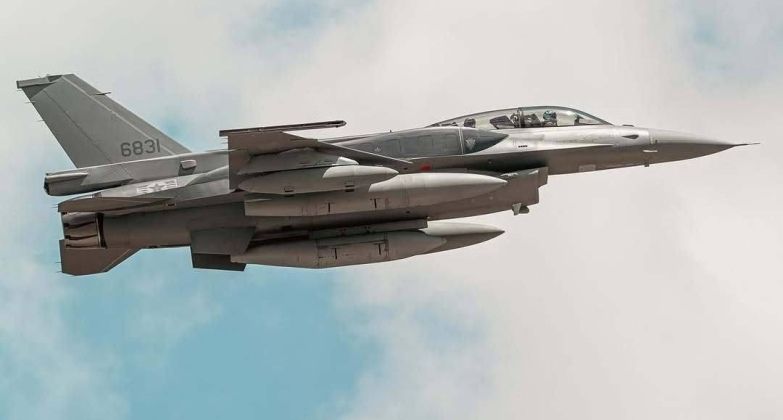
While F-16s have frequently been seen flying with one or more underwing drop tanks, the advanced Block 60 and Block 70/72 variants have frequently integrated conformal fuel tanks mounted along the upper fuselage. The concept of fitting conformal fuel tanks to the F-16 emerged in the early 1990s, driven largely by export customers seeking greater range without sacrificing payload. The first major proposal was the F-16ES (Enhanced Strategic), developed for an Israeli strike fighter competition. Flight testing of prototype conformal tank shapes began in 1994, demonstrating that the tanks could be integrated with only minimal effects on handling characteristics while significantly extending mission radius. Although the F-16ES was ultimately not selected, its conformal fuel tank design became the foundation for later production variants. Following successful aerodynamic trials during the 1990s, Lockheed Martin refined the design and completed formal U.S. Air Force development flight testing in 2002. The tests confirmed that the tanks could substantially increase unrefuelled range and endurance while maintaining the F-16’s excellent handling qualities, particularly in subsonic flight.
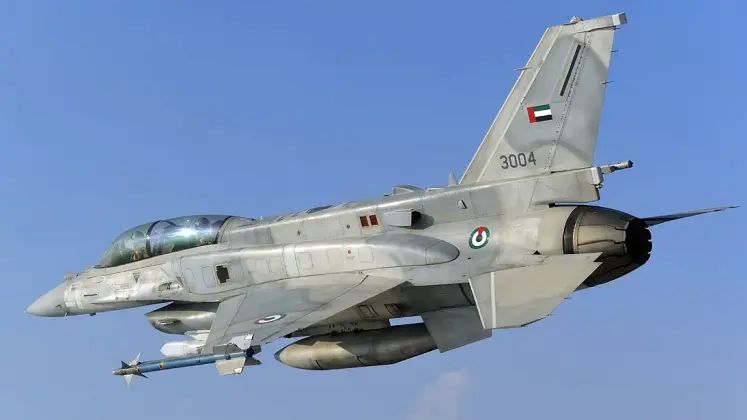
According to Lockheed Martin, integrating large fuselage-mounted tanks without significantly degrading the aircraft’s aerodynamics represented a major engineering achievement. The first production aircraft to incorporate conformal fuel tanks was the F-16E/F Block 60, developed for the United Arab Emirates and delivered beginning in 2004. On this variant, the tanks became a defining external feature, mounted along the upper fuselage behind the cockpit and blending smoothly into the aircraft’s shape. The Block 60 combined conformal fuel tanks with advanced avionics, an AESA radar, and an internal targeting system to create one of the most sophisticated F-16 variants ever built. Subsequently, conformal fuel tanks became available on Block 50/52 fighters exported to Israel, Greece, Poland, Turkey, Singapore, Morocco and Egypt. The two conformal tanks together carry approximately 1700 litres each, which can increase operational range and endurance by 20–40 percent depending on mission profile and weapons load. For the original F-16ES concept, Lockheed projected an unrefuelled strike radius of over 1,650km with a typical heavy strike load, approaching that of the much larger F-15E Strike Eagle.
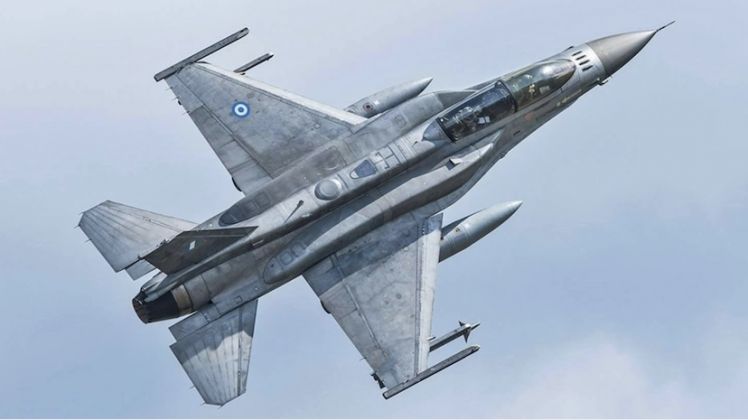
The use of these additional fuel tanks provides a much needed extension to the aircraft’s endurance and combat radius, but comes at a substantial cost to flight performance. Underwing drop tanks increase aerodynamic drag, add weight, and occupy hardpoints that could otherwise carry weapons or electronic warfare equipment. The additional drag reduces acceleration, climb rate, sustained turn performance, and top speed while increasing fuel consumption during manoeuvring. The aircraft’s famed agility - one of the defining characteristics of the F-16 design - is therefore noticeably degraded when flying in a heavily fuel-laden configuration. It is notable that Chinese and Russian fighter types other than the Chinese lightweight J-10C fighter are rarely seen with external fuel tanks, reflecting the fact that they generally have far longer ranges than their Western counterparts, and particularly than the F-16. The Chinese J-20A air superiority fighter, for example, has more than double the combat radius of the F-35, and close to triple that of an F-16 if operating on internal fuel alone.
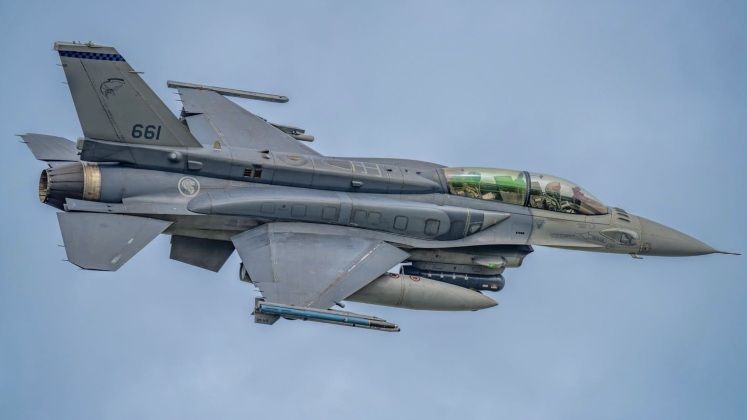
The principal advantage of conformal fuel tanks is that they free the underwing hardpoints, in contrast to external drop tanks which do. An F-16 equipped with conformal tanks can therefore carry additional air-to-air missiles, precision-guided bombs, electronic warfare pods, or reconnaissance equipment while still enjoying greatly extended range. Because the tanks are closely integrated with the fuselage, they generate far less aerodynamic drag than conventional external fuel tanks, particularly during subsonic cruise. They also reduce dependence on aerial refuelling and allow aircraft to remain on combat air patrol or loiter over target areas for significantly longer periods. These advantages are especially valuable for nations that may have limited tanker fleets or need to conduct long-range strike missions.
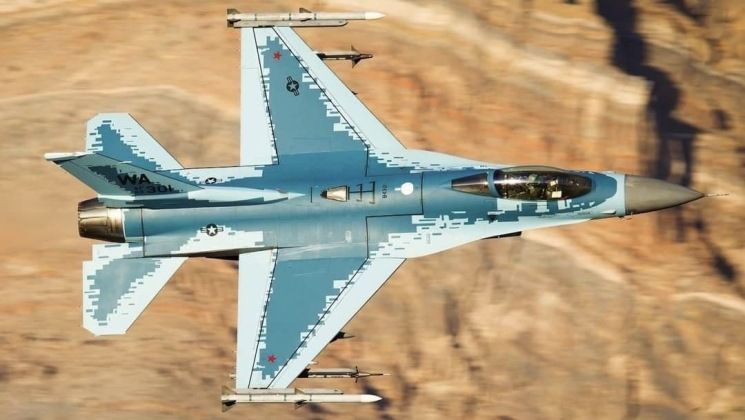
Although conformal tanks are much more aerodynamically efficient than underwing drop tanks, they are not without penalties. The additional fuel and tank structure add substantial weight, increasing the aircraft’s inertia and reducing acceleration and instantaneous manoeuvrability compared with a clean F-16. At supersonic speeds, drag also increases, although generally less than would be experienced with equivalent external tanks. Furthermore, unlike conventional drop tanks, they cannot be jettisoned during combat, meaning the aircraft retains their weight throughout the mission, and are thus weighed down during combat.
