
Fifty Years Operating U.S. Aircraft; How Israel Has Enhanced American Jet Fighters to Improve their Combat Performance
Military Watch Magazine Editorial Staff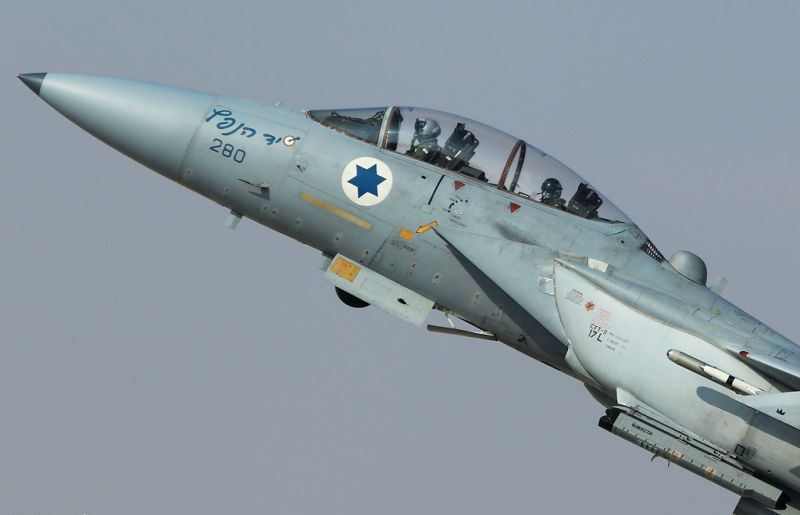
Israeli F-15 Eagle
Within a decade of receiving the F-4 Phantom, Israel would aquire its first U.S. made fourth generation fighters. The country was the world’s third to operate a fourth generation platform when it received its first F-15A in 1977, after only Iran and the United States itself. Unlike the F-4, which was phased out of frontline service once newer platforms begun to be fielded, Israel would be forced to rely on its fourth generation platforms for well over forty years before suitable 4+ or fifth generation replacements could be acquired. While the Air Force acquired its first F-35A fighters in 2015 to replace the F-16 Fighting Falcon in a light fighter role, due the United States’ refusal to provide Israel with the F-22 Raptor the country is set to continue to rely on the F-15 heavy fighter for air superiority indefinitely - possibly until a sixth generation fighter is made available for export in the 2030s. The Israeli Air Force has as a result had to initiate a massive and continuous program to modernise its fourth generation fighter fleet.
One significant advantage Israel’s Air Force has is that it faced no near peer rival capabilities in the Middle East. The only other states fielding modern heavy fighters are Saudi Arabia and Iran, the former which is a close military partner highly reliant on the United States to operate its fleet, while the latter fields a relatively small fleet of around 30 F-14 fighters of the same generation as Israel’s own fleet. With state of the art heavy platforms such as the Su-35 ‘4++’ generation or J-20 fifth generation air superiority fighters having not yet proliferated to the Middle East, Israel is able to rely on upgrading its fourth generation platforms to maintain its capability advantage over its potential adversaries. Potential future sales of advanced jets such as the MiG-35 to Syria and Iraq however could seriously undermine this.
Perhaps the most prolific U.S. fighter to have received Israeli upgrades has been the F-15I Ra’am, an extensively modified variant of the F-15E strike fighter. Despite being designed primarily for an air to ground role and lacking the specialised air to air combat capabilities of the F-15C, the F-15I was nevertheless also highly capable in air to air combat - today forming the elite of the Israeli Air Force. The fighters cost approximately three times as much as the lighter F-16 fighters Israel also operated as the mainstay of its fleet, but this price difference was strongly represented in the strike platform’s capabilities. The F-15I was fitted with modernised avionics, Sharpshooter targeting pods, Elisra SPS-2110 electronic warfare systems and new electronic warfare systems. A Display And Sight Helmet (DASH) helmet mounted sight provides crew members with targeting systems which standard F-15E platforms operated by the U.S. Air Force lack. The platform was also equipped with Python 3 and Python 4 missiles, and further upgrades and new weapons are expected in future.
Israeli’s long experience with upgrading U.S. made fighters has also led it to export its services to a number of third parties - many of them operating weapons systems absent from Israel’s own arsenal. Perhaps the most significant example of this has been Israeli services contracted by the Thai military to upgrade its F-5 fleet. Though it is a Vietnam War era light fighter never operated by the Israeli Air Force, which was instead equipped with the heavier and more costly F-4, Israeli engineers’ proficiency at upgrading such dated aircraft was nevertheless put to great effect to provide the Thai military with a viable modern combat platform despite its age. Several sets of consecutive upgrades applied by Israel have given the Thai Air Force capabilities comparable to the F-16, F-18 and other modern light fighters. The first set of upgrades involved the installation of display front and range weapons with HUD/WAC (Head-Up Display/Weapon Aiming Computer), decoy systems, AN/ALE-40 and warning detection systems and AN/ALR-46 Radar Warning Receiver. The fighters were also equipped with Israeli Python-3 air to air missiles from its four hard points, advanced 15km range platforms incidentally also used to modernise the BVR capabilities of China's MiG-21 fighters - granting both second generation platforms formidable beyond visual range capabilities rivalling those of early fourth generation fighters.
Further Israeli upgrades to the Thai F-5 fleet would provide Multi-Function Displays, pilot helmet mounted display, weapon sights Display And Sight Helmet and joystick Hands On Throttle And Stick - modern features beyond the technology level of early fourth generation fighters. Upgraded fighters were also equipped with Israel’s new Python-4 and Python-5 BVR air to air missiles. Further Israeli upgrades included EL/M-2032 radars, modern avionics, and DASH IV pilot helmets. New active radar seekers had an impressive range of approximately 50km, while fighters were also equipped with advanced electro-optical infrared homing seekers.
What Israeli upgrades for the Thai F-5 fleet demonstrated was the extent to which it could modify supposedly ‘obsolete’ U.S. combat aircraft to make them viable in modern combat and often surpass the capabilities of more rival more modern systems. While the United States has relied more on developing new fighters and quickly phasing out older ones, Israel has retained older platforms and kept them viable in a way few other clients for Western arms can match. Whether this will suffice however in light of the growing ‘4++’ and fifth generation weapons systems deployed to the region by potential adversaries and the likely future proliferation of such systems to Iran and its allies, remains to be seen.
