
F-14 Technologies On An F-5 Airframe; Could Iran’s New Kowsar Light Fighter be a Major Game Changer?
Military Watch Magazine Editorial Staff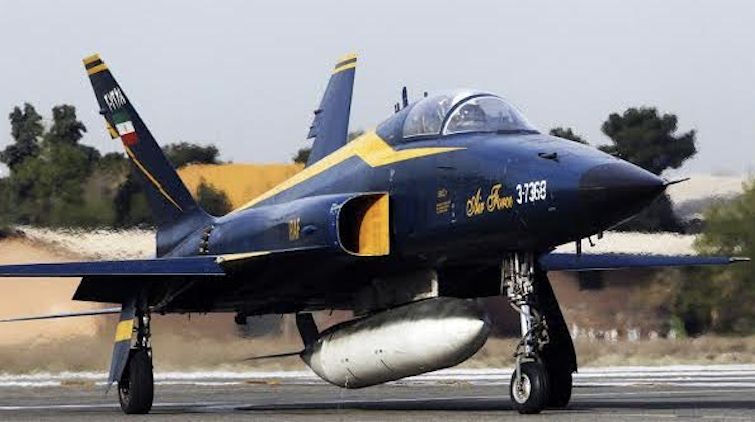
Iranian Air Force Saeqeh Twin Engine Light Fighter
Unveiled in August 2018, the Kowsar fighter appeared to be the latest iteration of the Iranian twin engine light fighter concept closely based on the American F-5E Freedom Fighter - following on from the unsuccessful Azarakhsh and the relatively basic Saeqeh. Building on the Saeqeh’s capabilities, and reportedly replacing a number of advanced foreign built systems with those of Iranian origin, the fully indigenous new jet is expected to be produced at an extremely low cost and integrate a number of state of the art features including the use of heads up displays, digital military data networks, multi purpose digital monitors, ballistic calculation computers, smart mobile mapping systems and new radar and avionics systems. Despite demonstrating a considerable degree of sophistication, which according to Iran’s defence industry has made it a fourth generation fighter, the capabilities of the Kowsar and its viability as a light fighter for the country’s fleet is heavily dependent on its ability to deploy state of the art munitions - a notable weakness of its predecessor the Saeqeh.
There is reason to believe that the Kowsar may well be a game changer for the Iranian Air Force, as while the airframe design itself is somewhat unremarkable in fields other than versatility, low cost and ease of maintenance - the considerable advances in avionics, radar and missile technologies made by Iran’s defence industry since the Saeqeh entered service in 2007 strongly indicate that its successor is set to be a far more capable aircraft. One particularly outstanding development has been the successful testing and mass production of the Fakour-90 long range air to air missile just weeks before the Kowsar’s induction - a platform reverse engineered from the U.S. AIM-54 Phoenix which remains one of the Iranian Air Force’s most potent assets in the event of an air war. The AIM-54 is the longest ranged air to air missile ever developed by a Western nation, and was fielded exclusively by the F-14 Tomcat fleets of the U.S. Navy and Iranian Air Force. With the Phoenix’s retirement, the Fakour-90 is a considerable more capable munition with an estimated range of 250-300km - and its induction marks a potential turning point for Iranian military aviation allowing it to retaliate against enemy aircraft at long ranges using indigenously made munitions.
What was particularly notable about the Fakour-90’s entry into mass production, despite the AIM-54’s exclusivity for the heavy F-14, was a statement by Iranian Defence Minister Amir Hatami that the platform was set to be used by a variety of aircraft - indicating that fighters other than the F-14 will for the first time be equipped with the Fakour-90. The Saeqeh was at the time considered a leading candidate to be equipped with these munitions, but with the induction of the Kowsar - a fighter fielding far more capable radar and avionics systems capable of better deploying the missiles at extreme ranges - the fighter is very likely to be the platform referred to by Minister Hatami. With the Iranian military having already developed advanced new radars for the F-14, based on but more capable than the already highly formidable American AN/AWG-9 pulse doppler radar, more compact variants of this same indigenous system, the most formidable the country has access to, are quite likely deployed onboard the Kowsar. While the Kowsar’s lighter airframe cannot deploy the same sizeable payload of six heavy missiles as the Tomcat, deploying two Fakour-90 missiles on each fighter alongside visual range platforms based on the AIM-9 Sidewinder would be a game changer for the Iranian fleet - allowing transform from a vastly outnumbered force which struggles at long range to one which can field a vast beyond visual range capable fleet using exclusively indigenous technologies.
The development of the F-5 airframe for beyond visual range engagements has notably been attempted by Taiwan and Singapore, both of which equipped their jets with heavily upgraded avionics and U.S. made AIM-120B air to air missiles with a 75km engagement range. Taiwan's F-5 jets have also been modified to deploy the indigenous Sky Sword II - a formidable platform with a 100km engagement range which allows the relatively old jets to post a threat to China's cutting edge new combat aircraft. The Kowsar could in much the same way prove to be a beyond visual range combat capable advancement of the Saeqeh design - which making use of a number of the formidable technologies fielded by the F-14 Tomcat can itself pose a serious threat at range. Whether Iran will also attempt to equip the fighters with a miniaturised variant of the Fakour-90 missile, possibly with a 50% range reduction which would still surpass the ranges of all Western made missiles fielded by U.S. allies in the Middle East or by the vast majority of the U.S. Air Force and Navy’s fighters. Development of a variant using similar avionics, but allocated a ship hunting role and deploying indigenous Nasr and Qader missiles - advanced indigenous variants of the Chinese C-704 and C-802 - which are currently deployed by the country’s F-4 Phantoms, also remains a possibility following the placing of these munitions into mass production and the military expressing its desire to expand the number of combat jets armed for such a role in service. The development of the simple and somewhat unremarkable looking Kowsar could well thus mark a major turning point for the Iranian Air Force and the success of Iranian military aviation, providing the country with a highly viable light fighter to complement its elite heavier F-14 Tomcats and planned future orders for Russian made Flanker air superiority jets.
