
Customising Old Fighters for Today’s Battlefields; How Israel Converted F-15D Fighters to Enhance its Overstretched Ra’am Strike Fleet
Military Watch Magazine Editorial Staff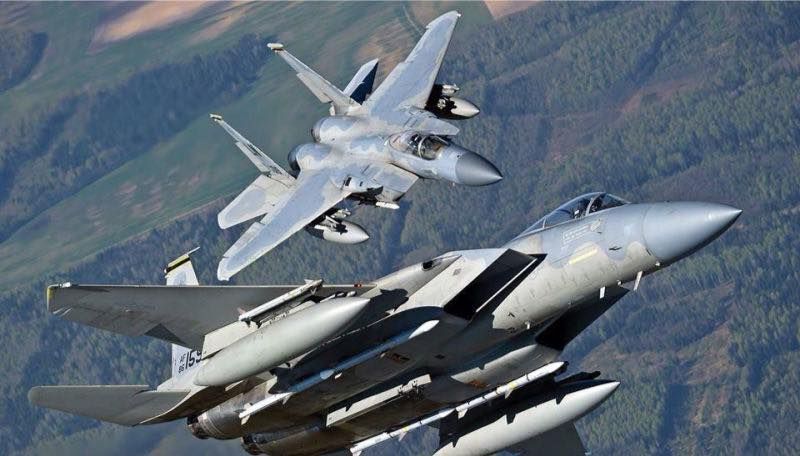
F-15 Eagles
The F-15 Eagle was developed as a fourth generation heavy air superiority fighter to replace the Vietnam War era F-4 Phantom in the U.S. Air Force. The platform entered service in 1976 as the world's second fourth generation combat aircraft, two years after the F-14 Tomcat - a fighter designed with a similar high end role but developed for the U.S. Navy rather than the Air Force. The Eagles were reserved for export for the United States’ closest allies, and only Israel, Japan and Saudi Arabia were ever sold air superiority variants of the platform. The Iranian Air Force, while offered the F-15, opted to acquire the more costly F-14 instead - with the Tomcat's longer engagement range using AIM-54 missiles and superior sensors being prioritised by Iranian Air Force over the superior visual range capabilities of the Eagle. These four operators of American fourth generation air superiority fighters continue to rely on them heavily to this day, and none of then have since been able to acquire more capable fighters for an air superiority role.
Israel’s F-15 fleet remains one of its formidable assets, particularly as all neighbouring states rely on lighter and less capable multirole fighters for their defence such as the F-16 and Dassault Rafale which pose little challenge to the Eagle in the air. The Israeli Air Force was the first client for the Eagle, the first to deploy it in combat, and was sent its first F-15A/B fighters for evaluation in 1976 - the very year the platform entered service in the United States Air Force itself. This made Israel the third country in the world after the United States and Iran to acquire fourth generation fighters. Since acquiring the F-15 however, Israel’s defence needs have evolved considerably and today the primary threat to the country’s security come not from large enemy air forces, but rather from ground based assets such as infantry, ballistic missiles and air defence platforms. As such, the 58 F-15 air superiority fighters are not Israel’s most valued asset today. That place is reserved for the F-15I Ra’am strike fighter, an extensively modified variant specialised for a long range air to ground attack role closely based on the U.S. F-15E Strike Eagle. With Israel fielding just 25 of the Ra’am strike fighters, and its F-15 air superiority fleet largely inactive due to a lack of near peer air superiority threats, the military has sought to modify some of its air superiority platforms to allow them to serve in the strike fleet.
While Israel had previously lightly modified its F-15 fighters for a strike role, specifically to carry out Operation Wooden Leg in 1985 targeting hostile Palestinian forces based in North Africa over 2000km away and taking full advantage of the Eagle’s range to minimise aerial refuelling requirements, the capabilities of these domestically modified air superiority platforms paled in comparison to those of dedicated F-15I strike variants. This would change in the 1990s, when following the delivery of the F-15I the Israeli Air Force took measures to expand its strike fleet by expanding more extensive modifications to its air superiority eagles to expand its strike capabilities. The F-15D, a twin seat variant of the F-15C air superiority fighter, were acquired in large numbers at a relatively low cost from the United States, and these fighters were chosen for induction into the strike fleet.
The F-15C and D variants already had more internal fuel storage capacities than the original F-15A and B, and this was further expanded to allow the platforms to engage in long range strike missions alongside the F-15I. Israel was able to acquire conformal fuel tanks from the United States, made initially to modify F-15 fighters for a strike role which has been the original intention of the F-15E program rather than building entry new separate fighters. These conformal tanks were used to further extend the F-15D’s range, while the addition of external fuel tanks further enhanced the range to make them comparable to the F-15I variant. While the additional weight compromised the platform’s air to air combat capabilities, it made for a far more effective strike fighter.
The Israeli Air Force favoured the F-15D twin seat fighters in particular for modifications for two reasons. The first was that they were less optimised for an air superiority role than the single seat C variant, and were developed largely with the training of pilots in mind rather than to maximise air to air combat capabilities. The second was that the fighters were expected to serve as forward deployed networking and command and control nodes, and were heavily modified for this role. Making use of data links, the F-15D can be used to absorb information from F-15I fighters in the field and direct them to maximise effectiveness. The platform can also network with other Israeli fighters such as the lighter and shorter ranged F-16I. This allows the F-15D to serve as an effective force multiplier for strike operations, an invaluable asset.
The F-15D can also be equipped with satellite communications equipment to transmit information on the battlefield situation acquired from accompanying strike fighters to Israeli command centres, and receive orders or information from command back in Israel for accompanying fighters - a capability which has great value for long range strike missions. A strike on military or nuclear facilities in Iran for example, a highly contested battle space far from Israel itself, would be one such situation where the F-15D’s ability to serve as a long range networking and command and control node would come invaluable. The need for a twin seat fighter for such a role is clear, with one crew member acting as pilot while the other coordinates attacks and transmits information from the second seat. The development of the F-15D into a support aircraft for F-15I strike missions is an invaluable asset, one which is increasingly needed as Israel moves to expand its strike fleet in response to growing threats posed by regional adversaries such as Iran and Hezbollah. The platform is set to serve the Israeli Air Force for many years to come, and may well outlive the increasingly ageing F-15 air superiority fleet due to the importance of its new role.
