
Taipei Threatened by China's New Stealth Fighters? Why the J-20 is Unlikely to See Action over the Taiwan Strait
Military Watch Magazine Editorial Staff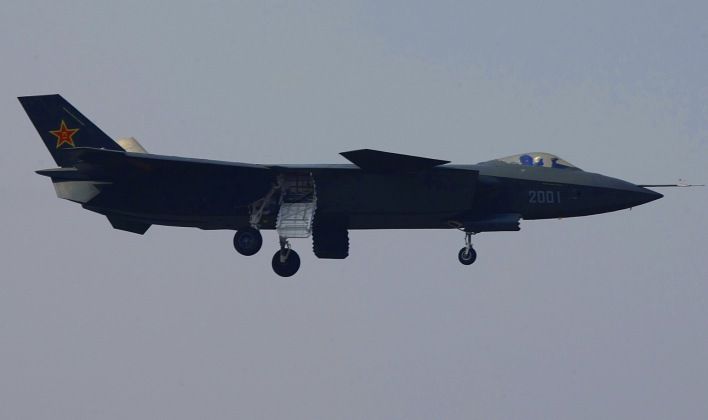
J-20 Stealth Fighter
Amid growing tensions in the Taiwan Strait, operations by military aircraft from the Chinese People’s Liberation Army (PLA) near Taiwan have become an almost daily occurrence while military exercises simulating offensive action have increased considerably. Just days after unprecedented military manoeuvres, in which PLA Air Force H-6K heavy bombers circled Taiwan escorted by its new Su-35 air superiority fighters in a formidable show of force to Taipei, Chinese state media outlet CCTV warned that Beijing could deploy its new J-20 fifth generation fighters to the Taiwan Strait in the near future. During a China Central Television (CCTV) program about Taiwan-related conflict, a military scholar with the China National Defence University noted that Taiwan’s defences remained highly vulnerable to stealth incursions by the J-20. He further noted that the Taiwanese leadership feared “precision strikes on the leadership or key targets” by the fifth generation stealth fighters, noting that J-20 “could come and go at will above Taiwan.”
The CCTV report on the J-20 comes shortly after the elite fighters held their first maritime combat exercises in the South China Sea since entering service in early 2017. The report noted that the fighters had held mock dogfights, and were designed to pierce through an adversary’s air defences and launch precision strikes. It further noted that the antiquated F-16A, Ching Kuo and Mirage 2000 fighters, early fourth generation lightweight platforms with limited usefulness in air to air combat today, would stand little chance of intercepting China's latest fighter.
The J-20 provides the PLA Air Force with capabilities only the United States Air Force can match with its own F-22 Raptor. All aspects of the fighter’s performance are well beyond those of Taiwanese light platforms such as the F-16A - an aircraft which has served since to 1978 and forms the backbone of the Taiwanese fleet. While the J-20 would be more than capable of targeting Taiwanese military facilities with impunity, and could well make use of its radar evading capabilities to make incursions stealthily as the CCTV report stated, the fifth generation fighter's deployment to the Taiwan Strait in the near future remains unlikely.
A key reason why the J-20 will likely be held back from a conflict with Taipei is to deny potential adversaries opportunities to study the aircraft. Taking its American counterpart the F-22 as an example, the U.S. Air Force provided adversaries the opportunity to study the fighter's capabilities by deploying it arguably unnecessarily to Syria. Prominent figures in the leadership of the United States Air Force, when operating its F-22 Raptors over Syria in range of Russian radars and surveillance equipment, revealed to their chagrin that doing so had allowed the Russian Military to obtain a ‘treasure trove of information’ on the Raptor’s capabilities testing its stealth with their advanced radar equipment while observing firsthand how America's foremost next generation fighter operated. U.S. Air Force Lt. Gen. VeraLinn Jamieson stated regarding the Raptor's deployment to the Middle East: "The skies over Iraq and specifically Syria have really just been a treasure trove for them to see how we operate. Our adversaries are watching us, they're learning from us... Russia has gained invaluable insights and information with operating in a contested airspace alongside of us in Syria." The loss of secrecy was a major blow to the effectiveness of the F-22 which allowed Russia to better develop countermeasures against it and potentially even learn from the design to develop its own next generation fighter.
With the relatively basic requirements of the U.S. intervention in Syria not requiring a fighter as advanced as the Raptor, deploying the F-22 to the warzone could in retrospect be viewed as a major blunder. The J-20 likewise would see one its most critical attributes, its secrecy, compromised by providing adversaries with valuable information. Peacetime flights near Taipei would give Taiwanese radar operators and American instructors thought to be based there ample opportunity to examine the J-20’s performance and stealth capabilities. Even in wartime deploying the fighter when older platforms such as the J-11B and Su-35 would be more than adequate to ensure an overwhelming advantage would unnecessarily compromise the J-20. With Taipei’s defences, such as they are hardly requiring the deployment of the PLA Air Force’s latest fighter, Beijing is unlikely to deploy the J-20 to the Taiwan Strait either as a peacetime show of force or for actual combat. Should it do so, special countermeasures such as the use of luneberg lenses to nullify its stealth capabilities and prevent Taiwanese defences from studying its radar cross section reducing airframe are likely.
