
Chinese Navy Tests Advanced New Missile Defence System For Fast Expanding Destroyer Fleet
Military Watch Magazine Editorial Staff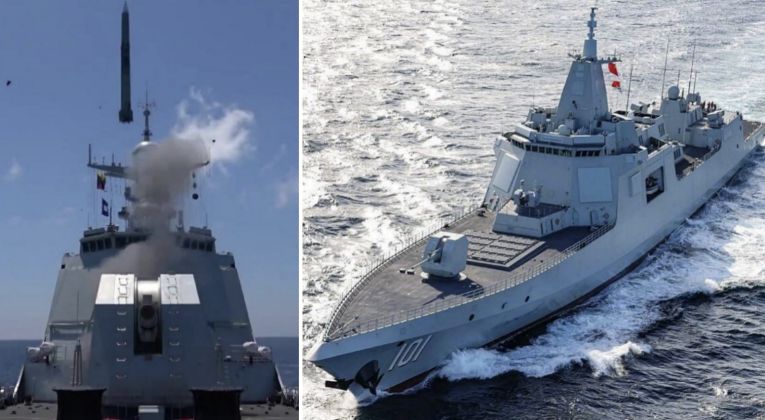
HHQ-9 Launch From Chinese Type 055 Destroyer (left) and Type 055 Destroyer
Chinese state media has provided details of the Chinese People's Liberation Army Navy’s recent certification trials for a new terminal air-defence and anti-missile system in the Bohai Sea, which are expected to revolutionise the anti-missile capabilities of multiple classes of combat ships. The trials tested the system's interception capability under complex electromagnetic conditions, including against ultra-low-altitude penetration targets. The new system is expected to be integrated onto the Navy’s Type 055 and Type 052D class destroyers, and possibly onto lighter ship types such as the Type 054 class frigate, and will fill the ultra-low-altitude defence gap between existing missile defence systems such as the HH-9 and HHQ-16, and close-in weapon systems such as the Type 1130.
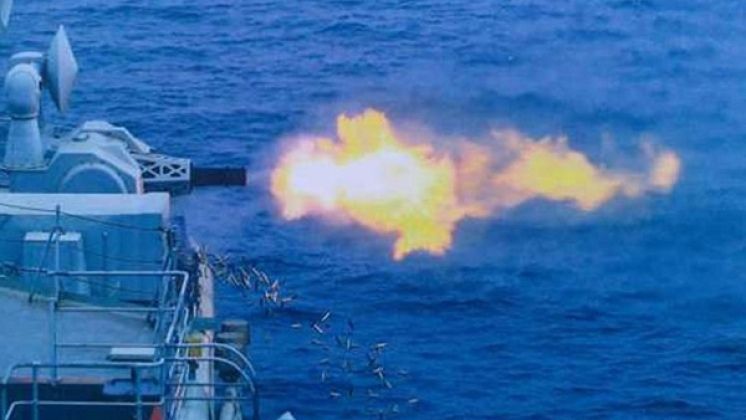
Footage released by state media has shown the new missile defence system intercepting and destroying multiple high-speed target drones, which were conducting ultra-low-altitude sea-skimming penetration manoeuvres. These drones simulated realistic high-threat attack scenarios by flying at ultra-low altitudes over the sea and conducting concealed penetration manoeuvres. This was intended to simulate attacks by both small targets and hypersonic missiles. Commenting on the simulation of complex electronic warfare conditions during the exercises, local military commentator Li Yaqiang observed: "Electronic interference is now widely used in actual combat and has even become a form of warfare in itself… How to effectively overcome such interference is a problem that modern weapon systems must solve."
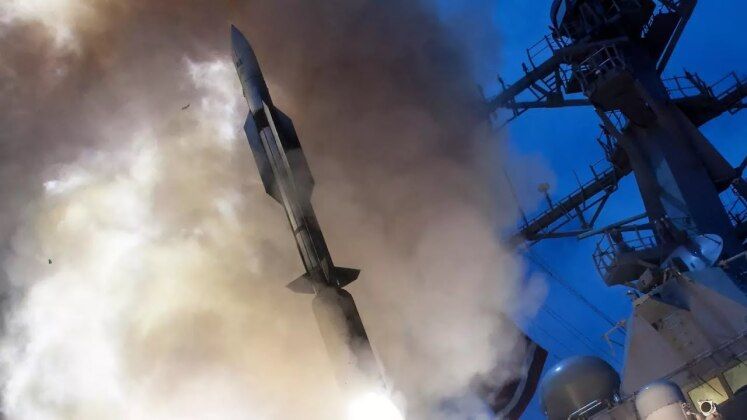
The new defence system was reportedly capable of intercepting sea-skimming targets flying at altitudes of just 5-10 metres, fuelling speculation among Chinese analysts that it may employ "lofted dive" trajectories, as was famously done on the 40N6 missiles from the Russian S-400 system. Some analysts have also speculated that the system may use kinetic-kill technologies, which allow missiles to be designed to be much lighter and more manoeuvrable. The development of the new system has occurred as part of a broader trend towards a wide range of cutting new armaments being integrated onto Chinese destroyers, with the YJ-20 hypersonic anti-ship ballistic missile expected to enter service in 2026 after years of testing, and providing what is widely considered the most formidable ship-based anti-ship missile capability in the world.
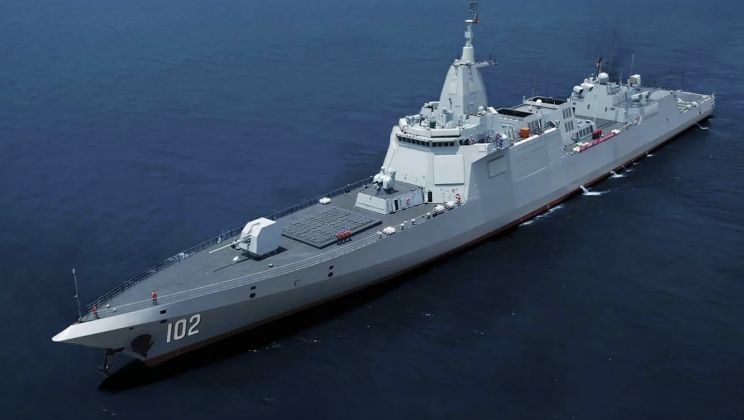
Type 055 class destroyers are among the largest and most heavily armed in the world, with each integrating 112 vertical launch cells which can accommodate a wide range of cruise and surface-to-air missiles, the latter which current form a four-layered defensive network around the vessels. The ships’ situational awareness is also near unrivalled, with each integrating a dual band radar system similar to the SPY-3/SPY-4, which the U.S. Navy had intended but failed to integrate onto the Zumwalt class destroyer. Such radars provide a particularly high degree of situational awareness, including over-the-horizon detection capabilities. The ships are considered optimal for carrier escort duties, while the lighter Type 052D class provides many of the same capabilities with a smaller less powerful sensor site and a smaller arsenal of 64 vertical launch cells. Although potential Chinese adversaries remain years behind in the development of hypersonic anti-ship missiles, the rapid development of new generations of missile defences is considered critical to stay ahead of prevailing threats.
