
Chinese Ground Units Deploy New ZRY222 Combat Robots With Rocket Launchers to Support Infantry in Exercises
Military Watch Magazine Editorial Staff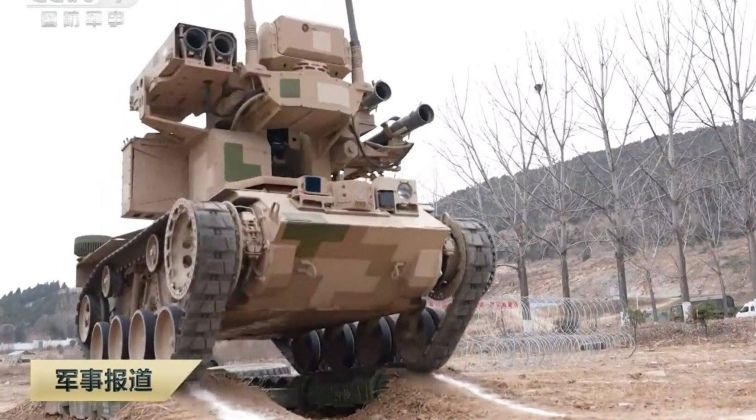
ZRY222 Combat Robot
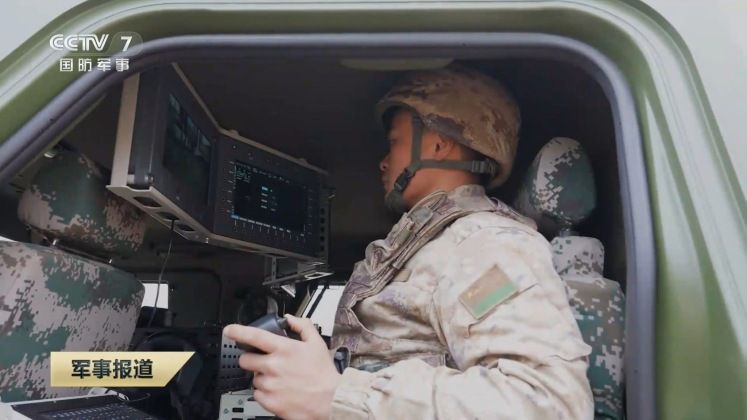
Chinese People’s Liberation Army Ground Forces units operating under the Eastern Theater Command troops used the ZRY222 tracked unmanned fire support vehicle to provide during exercises. The robots are each controlled remotely from a modified Mengshi off-road vehicle fitted with a control console, and each deploy four guided rockets, a 7.62mm gun, and reconnaissance equipment. First unveiled in September 2025, the semi-autonomous robots weigh approximately 1.2 tons, and are sufficiently light and fast to accompany ground forces, with their design having capitalised on Chinese industry leads in both artificial intelligence and robotics. The deployment of the ZRY222 and other robot designs are expected significantly reduce risks to advancing ground personnel.
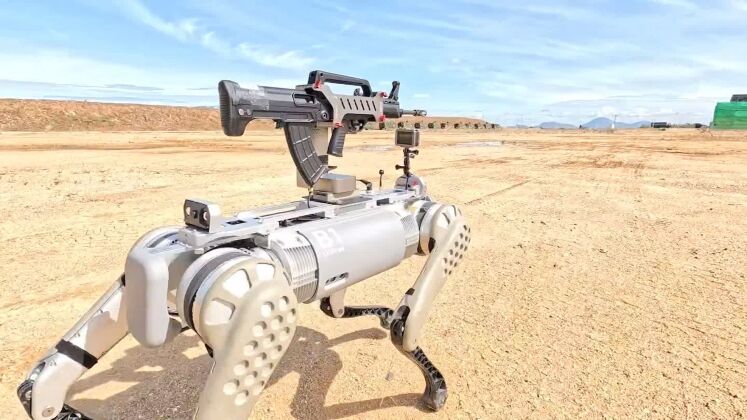
Chinese ground units have made growing use of combat capable and logistics robots for a wide range of roles, with prior exercise showing robot dogs mounting automatic weapons being used to help advancing forces clear buildings. Chinese industry has continued to more broadly achieve major advances in the automation of ground warfare systems and in the reduction of requirements for ground personnel. The Type 100 main battle tank in particular, which was revealed to have entered service in September, featured unprecedented levels of automation and a new grew layout heavily optimised for operating alongside and controlling drones and loitering munitions. The tank’s design has also been seen by analysts to pave the way to the development of an unmanned future variant.
Previously in July 2025 images confirmed that the Chinese SH16 155mm tracked self-propelled howitzer was undergoing field trials, and unprecedentedly reduced crew requirements from three to just two personnel — one driver and one gunner/commander. A year prior in June 2024 next generation lightweight battle tank was confirmed to have reached a prototype and trial stage, and among a range of revolutionary features never before seen on operational armoured vehicles, it reduced crew requirements to just two personnel through high levels of automation. This compared to three personnel on Chinese, South Korean and Russian tanks, and four on Western tanks. Beyond the Ground Forces, in the Air Force and the Navy unmanned missile carrying aircraft and ships are respectively expected to similarly serve as force multipliers for manned fighters and destroyers.
