
Chinese Carrier Personnel Train For High Intensity Fighter Landings as Fleet Requirements Grow
Military Watch Magazine Editorial Staff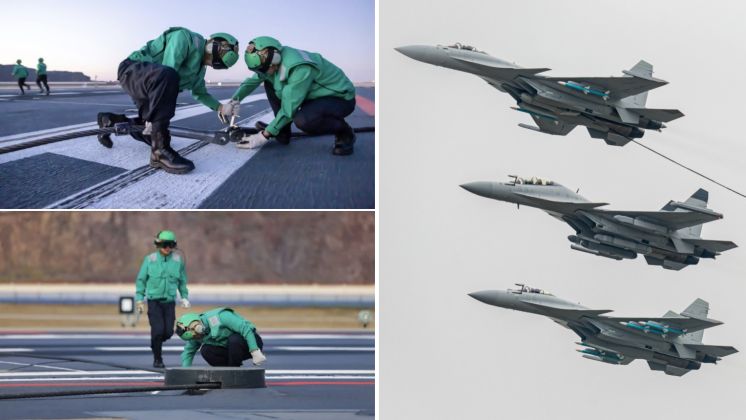
Chinese PLA Naval Aviation University Carrier Landing Training and J-15 Fighters
Images fro the Chinese People’s Liberation Army Naval Aviation University have shown arrested landing training being conducted on full scale replicas of carrier decks, with J-15 fighters in the university’s fleet used to train both naval aviators and crew on carrier decks. The J-15 first entered service in 2013 to form the fixed wing component of the air wing of the Navy’s first aircraft carrier the Liaoning, and was developed as a derivative of the Air Force’s J-11B air superiority fighter. It remains uncertain to what extent older baseline variants of the J-15 have remained in frontline service, as the new J-15B variant has been introduced into service with significantly improved ‘4+ generation’ capabilities and a combat potential several times higher. After the J-15B’s introduction, it was widely speculated that older J-15s would be relegated to operations from bases on land and to training duties.
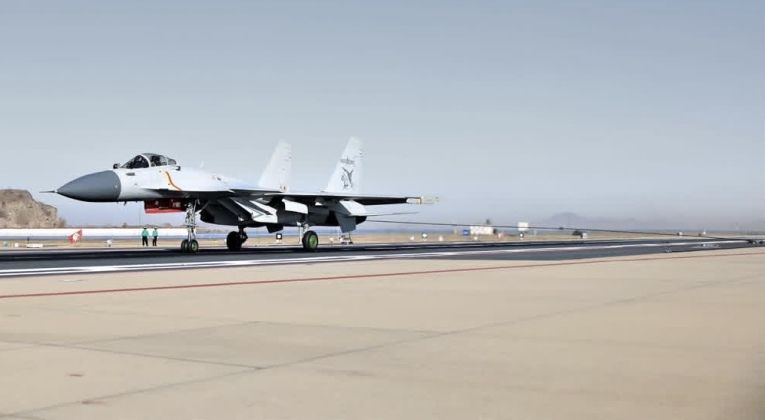
All aircraft carriers deploying diverse ranges of fixed wing aircraft use arresting gear wires for arrested landings, which aircraft attach to upon landing allowing them to stop safely on a very short flight deck using a combination of precision flying and mechanical braking. Unlike ground-based runways, carrier decks are short and constantly in motion, pitch and roll, and heave with the sea, while having a no go-around margin once fully committed, forcing aircraft to land at higher angles and rely on the external stopping force of arresting wires rather than on wheel brakes. Arresting wires are typically 38–40 millimetres thick, are connected below deck to hydraulic or water-twister energy absorbers, and can absorb tens of millions of joules of kinetic energy.
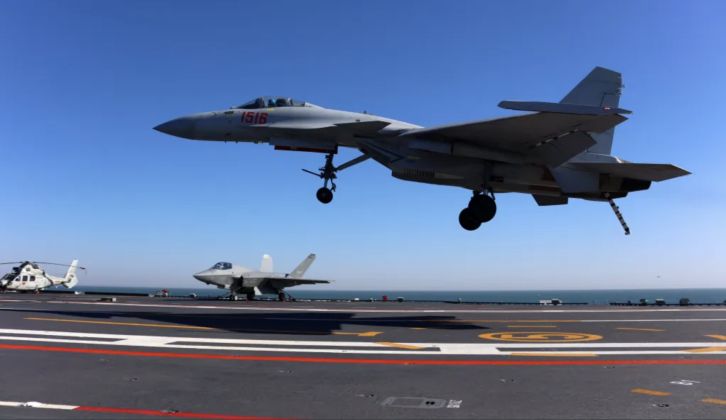
The United States, China, France and India all deploy aircraft carriers with arresting gear, with carriers that lack such gear typically being much smaller and only being able to accommodate aircraft with vertical landing capabilities, which have more limited combat potentials and are far more costly to operate. All three of China’s aircraft carriers designed to operate fixed wing fighters, the Liaoning, Shandong, and Fujian, use arresting gear to accommodate J-15 fighters and J-15D electronic attack aircraft, with the Fujian also accommodating J-35 fifth generation fighters and KJ-600 airborne early warning and control systems. The complexity of arresting operations Chinese personnel are required to train for has grown, as the Fujian’s much lager air wing, and its ability to launch three fixed wing aircraft simultaneously where the prior two carriers could launch one, has increased requirements to recover aircraft very rapidly in sequence. It is expected that the Fujian’s crew will be required to be able to make recoveries with spacing of as little as 25-35 seconds during high intensity operations.
