
China’s New Unmanned Long Range Stealth Fighter Now Being Tested on Carrier Decks
Military Watch Magazine Editorial Staff
GJ-11 Unmanned Stealth Fighter on Carrier Sichuan
New footage has confirmed that the new Chinese aircraft carrier Sichuan has begun testing the integration of an unmanned long range stealth fighter thought to be from the GJ-11 series. The aircraft appeared on the Sichuan’s lift, and subsequently on its deck, hours before the carrier went out to sea for its second set of sea trials. The possibility remains that what was seen was a full scale mockup used to practice flight deck management, rather than an actual aircraft. The Sichuan, a Type 076 class carrier, is one of just three carrier types in the world integrating an electromagnetic catapult launch system (EMALS), and for close to half a decade before its launch in December 2024 it has been expected to serve as a carrier for unmanned fixed wing aircraft, in particular long range flying wing designs like the GJ-11. In parallel to ongoing work to operationalise a naval variant of the aircraft, the a land based variant of the GJ-11 began its first known deployment in the Air Force in October 2025.
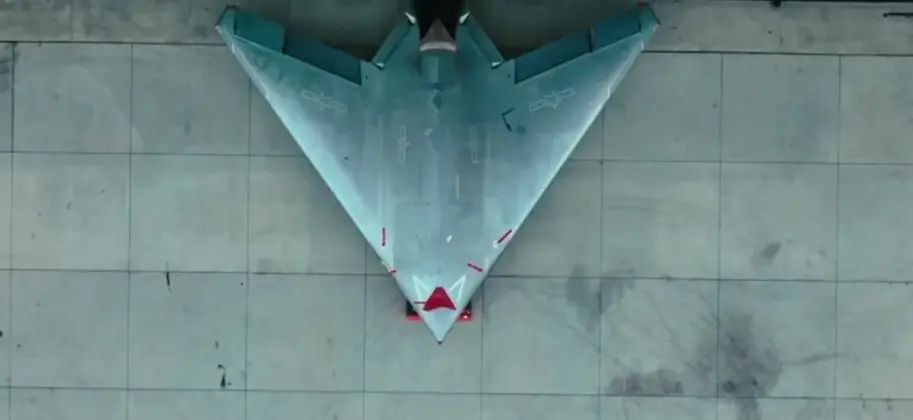
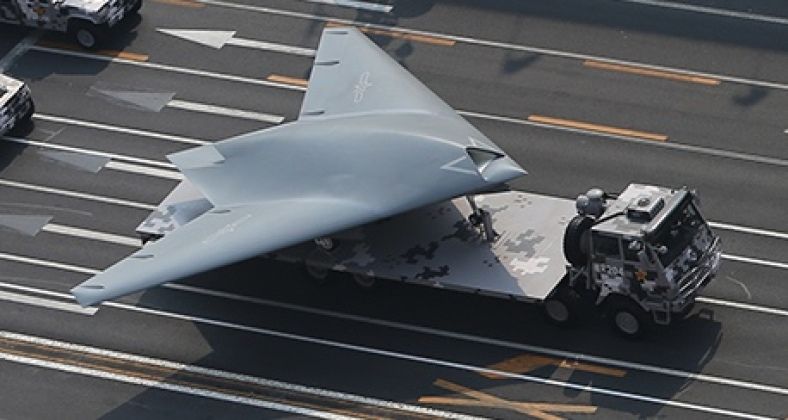
Although flying wing aircraft like the GJ-11 are not well suited to achieving high levels of speed or manoeuvrability, their designs are optimal for high altitude long range operations and for retaining high degrees of stealth. The American B-2 Spirit bomber program, which first flew in the late 1980s, played a pioneering role in operationalising these designs, despite the program having itself been far from successful. GJ-11 squadrons deployed from carriers could provide a highly potent offensive capability, with their ability to take off from from ships far out at sea, combined with their advanced stealth capabilities and long ranges, expected to make strikes and the directions from which they wil be launched difficult to predict. The GJ-11 is one of several unmanned stealth fighters confirmed to be under development in China, with work currently ongoing on more ambitious programs to develop more manoeuvrable aircraft with higher levels of autonomy, such as the Dark Sword fighter.
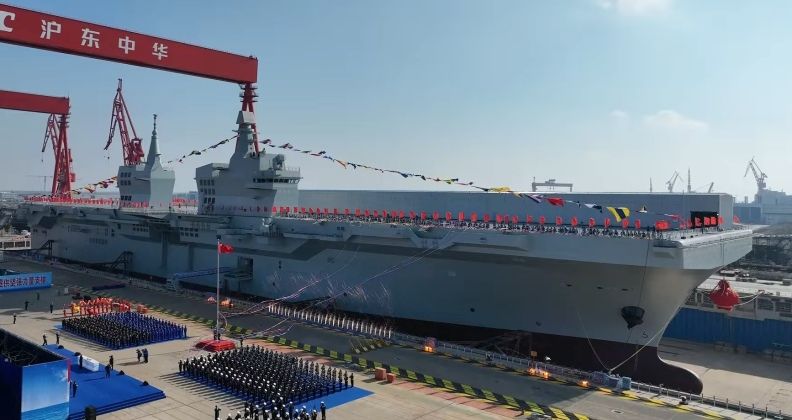
Although the Chinese People’s Liberation Army Navy’s J-35 fifth generation fighter is the only stealth aircraft in the world integrated with a carrier EMALS, and alongside the American F-35B/C is the only carrier-based stealth fighter operational worldwide, this is expected to change once the Sichuan and its air wing enter service. The Sichuan began its first sea trails on November 14, 2025, and displaces 50,000 tons, making it larger than the significant majority of carriers in the world. The ship blurs the line between an amphibious assault ship, like the lighter Type 075 class on which its design is based, and a full aircraft carrier. The design has no direct analogues with similar displacements or capabilities anywhere in the world, and has the potential to be particularly revolutionary for Chinese carrier aviation.
The U.S. Navy has shown a strong interest in fielding carrier-based stealth aircraft since the 1980s, although cancellation of the A-12 program, and the limited feasibility of a planned carrier-based variant of the F-117 stealth fighter, seriously delayed plans to do so. Post-Cold War budget cuts also brought an end to plans to field either a carrier-based variant of the F-22 fighter, or a direct successor to the F-14 fighter/interceptor with stealth capabilities. The F-35 is thus the only stealth aircraft deployed from carriers in the Western world, although it is only expected to fully be capable of high intensity combat in the early 2030s once the aircraft are belatedly brought up to the Block 4 standard. It is expected that the benefits of fielding unmanned stealth aircraft like the GJ-11, and advances in artificial intelligence and in data links making their operations more effective, will increase interest from multiple carrier-operating countries in fielding a similar capability to that currently being pioneered onboard the Sichuan.
