
China’s Unique Type 076 Drone Carrier Ship Continues Far Seas Testing
Military Watch Magazine Editorial Staff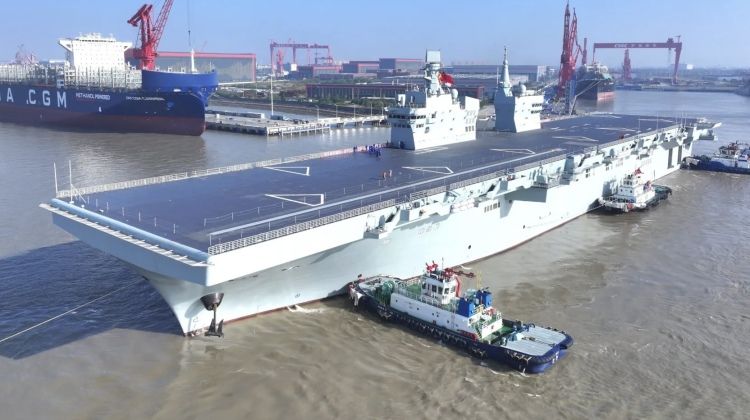
Type 076 Class Drone Carrier
The Chinese People’s Liberation Army Navy Type 076 class aircraft carrier, the Sichuan, has begun a major phase of cross-regional testing and training operations. The Navy announced that the carrier had departed Shanghai and sailed to the South China Sea to conduct a new round of trials following its earlier sea-testing program. According to official statements, the deployment was intended to test multiple onboard systems under operational conditions and gather data for future fleet operations. These activities are particularly important because the Type 076 is one of the most ambitious warship designs China has ever built. Unlike previous Type 075 assault ships, in which the design is based, the Type 076 combines traditional amphibious assault capabilities with features normally associated with aircraft carriers. Most notably, it is equipped with an Electromagnetic Aircraft Launch System (EMALS) and with associated arresting systems, allowing it to launch fixed-wing unmanned aircraft in addition to helicopters and landing craft. This has led many analysts to describe it as the world’s first purpose-built “drone carrier.”
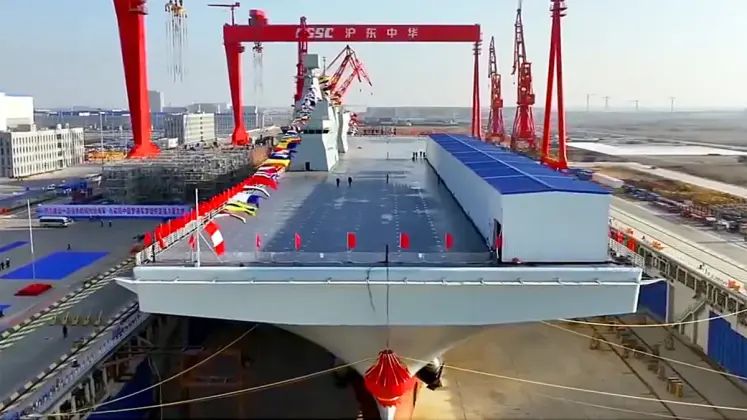
The Type 076 design has been widely viewed by analysts as a major enhancement to Chinese naval power projection capabilities. With a displacement exceeding 40,000 tons and the ability to deploy helicopters, amphibious forces, landing craft, and potentially large numbers of drones, it could support amphibious assaults, expeditionary operations, maritime security missions, and long-range reconnaissance. The integration of electromagnetic catapults may eventually allow the ship to operate advanced strike and surveillance UAVs at much greater tempo and range than conventional helicopter carriers. Although the vessel has not yet entered active service, the successful completion of successive sea trials indicates that the Navy is steadily moving toward commissioning what may become one of the most capable amphibious assault ships in the world. The ongoing South China Sea testing campaign is thus being closely observed by analysts as a key milestone in the development of China’s next-generation amphibious and unmanned naval aviation capabilities.
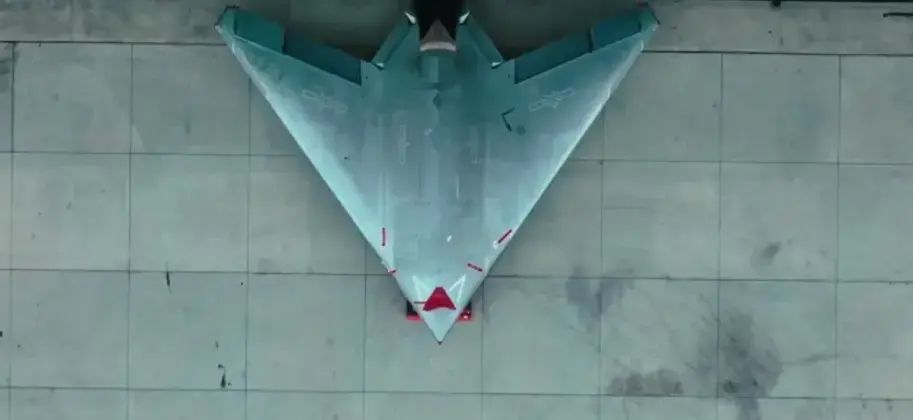
The Type 076 class’ EMALS is particularly important because it enables the operation of large unmanned aircraft. Instead of relying solely on helicopters, the Type 076 is expected to deploy reconnaissance drones, electronic warfare drones, and potentially stealthy strike UAVs. Reports and imagery have linked the ship to naval versions of advanced Chinese unmanned combat aircraft such as the GJ-series UCAVs, including concepts resembling the flying-wing GJ-11 unmanned bomber. Compared with a conventional ski-jump launch system, EMALS offers several advantages. The electromagnetic catapult accelerates aircraft more smoothly, reducing stress on airframes and allowing a wider range of aircraft weights to be launched. This is particularly useful for drones carrying large fuel loads and heavy sensors and weapons. It also enables higher sortie generation rates because launch settings can be adjusted electronically for different aircraft types.
