
China Tests Advanced Missile Interceptor System to Guard Against Hostile ICBMs; A Step Towards Complete Nuclear Parity with the United States
Military Watch Magazine Editorial Staff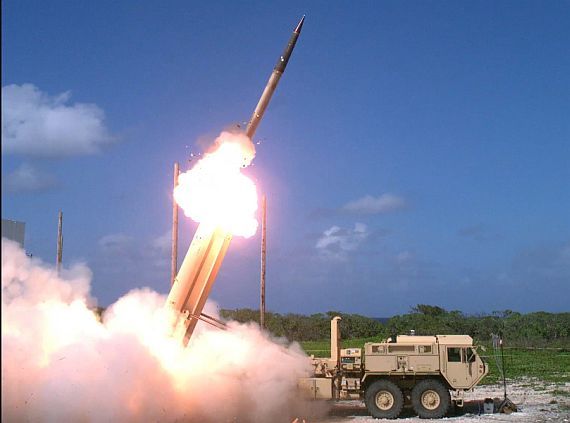
U.S. THAAD Air Defence System
With the United States deploying growing numbers of its most advanced missile defence systems to the Pacific, from THAAD in South Korea to the Aegis Ashore in Japan, China has made significant developments in its own missile shield. While the U.S. Military has a significant advantage in that it can deploy Interceptors far from its borders across the Pacific to provide cueing information to secondary Interceptors on the mainland, China hopes to develop a defence system superior to that if the U.S. The People's Liberation Army can do so through both through advanced air defence cooperation with Russia, a world leader in the field which has sold China some of its most advanced systems, and by focusing on gaining a qualitative advantage through realistic weapons testing - where U.S. surface to air missile systems have proven notoriously unreliable.
According to a statement by the Chinese Ministry of National Defence, the PLA conducted a successful test of its Ground Based Midcourse Defense (GMD) system in February 2018. The Ministry stressed that the aim of the test was defensive in nature. According to the Chinese state paper People’s Daily the new air defence system consists of a control station, sensors and interceptors - using X band radars and satellites to scan the skies and calibrate the trajectory and velocity of any missile for effective interception. Ground based interceptor missiles will then be guided towards their targets with greater precision and will neutralise them in near space before they reach the atmosphere. Much like the U.S. THAAD platform, most missiles used by the Chinese air defence system have no warheads and rely on their kinetic energy to destroy incoming missiles. The lack of explosives reduces the risk of accidentally detonating a warhead in the air - which in the case of high payload nuclear missiles could be lethal.
Much like the U.S. mainland's Ground-Based Midcourse Defense (GMD) the Chinese interceptor missiles under development will target incoming missiles in near space. Both systems in this way differ from THAAD, which intercepts missiles in their terminal high altitude (hence its name Terminal High Altitude Air Defence) after it has entered a country s airspace. The PLA is notably also developing an analogue to THAAD, the HQ-19 surface to air missile system, which will target both low orbit satellites and missiles in their terminal entry phase. This weapons system is set to be deployed on the Navy's new Type 055 destroyers, and will likely eclipse the targeting altitude of the United States Navy's own ship based system - the Aegis.
The U.S. GDM has a success rate of 56%, though this figure is hotly disputed due to the 'fixed' nature of weapons testing and highly unrealistic ideal circumstances under which testing has been carried out. With China increasingly expressing signs of a sense of vulnerability due to the far larger size of the U.S. nuclear arsenal relative to its own, around twenty times as many, investment in developing a more advanced interceptor system could be key to undermining this U.S. advantage - and combined with a slightly expanded arsenal could give China something approaching complete nuclear parity.
