
China's Military Secures its Position at the Disputed Spratly Islands
Military Watch Magazine Editorial Staff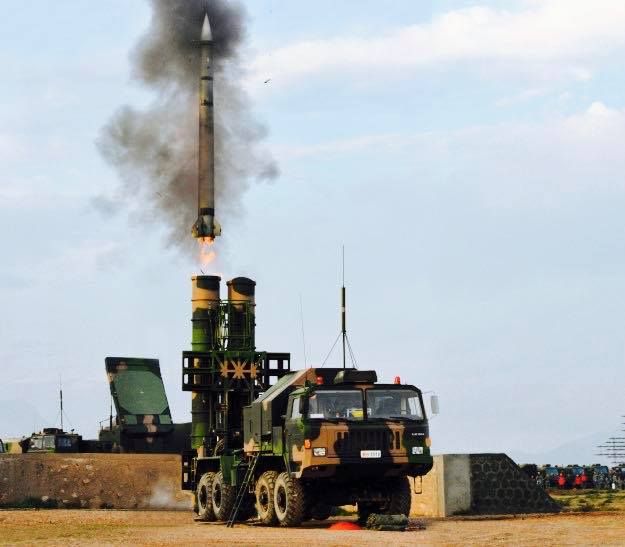
HQ-9 SAM System
Amid growing tensions with the United States over China's territorial claims to the South China Sea, Beijing has gradually strengthened its defensive military deployments to the region in the face of a growing U.S. Naval Presence. While China previously worked on constructing artificial islands and using these to deploy radar and air defense systems and construct runways, the country's military has in December 2017 for the first time confirmed the deployment of advanced air superiority fighters to the disputed Woody Island, part of the strategically critical Parcel Island chain and currently under Chinese military control.
Known in China as Yongxing, the island is the largest of the Paracels, known in China as the calls the Xisha Islands. Yongxing currently has a 3km long runway allowing larger transport aircraft to land. To overcome the island's harsh climate, the military has constructed sealed thermo-stabilized hangers to protect its fighters from the elements. This makes long term fighter deployments a possibility, as hangars prevent the high humidity and heat from taking their toll on the aircraft. The state run Global Times reported in regards to this: The special hangar helps to realize regular deployment of fighter jets in the Xisha Islands. Other islands in China could also use such aircraft hangars and China's overall control of air and sea in the South China Sea would be greatly improved as well."
The fighter China has chosen for its first deployment to Yongxing was the J-11B, a long range high performance platform one of the world's most potent air superiority fighters. The J-11B represents the most advanced Chinese made platform other than the fifth generation J-20, though it is far more suitable for deployments to the sea climate that its more modern counterpart. Not only has the J-20 entered service only very recently, but the fighter's stealth capabilities and the high maintenance of its stealth coating in particular make it unsuitable for a deployment to the harsh sea climate. As a new and untested platform, deploying the J-20 to the remote island of Yongxing would be extremely risky, and the J-11B remains the best option for Beijing for the time being.
Alongside its air superiority fighter, China has also deployed the HQ-9 air defense system to Yongxing Island, as well as advanced anti-ship cruise missiles. The construction of three man made islands nearby, all boasting hangars and airfields, allows China to rapidly deploy a far larger fleet of fighters to reinforce the Spratlys at any times should the situation require it. Hardened shelters with retractable roofs, useful for the deployment of mobile missile launchers, have also been constructed. China has further constructed formidable radar installations and sensor arrays on the islands, positioning them by its air defenses to provide protection against enemy aircraft or missiles. Between them, the deployment of several of China's most advanced weapons systems and the construction of facilities to allow the islands to be quickly reinforced makes the disputed position highly secure.
