
China's Latest Combat Jets Demonstrate High Level Performance; What the J-10 and J-20 Mean for Chinese Military Aviation
Military Watch Magazine Editorial Staff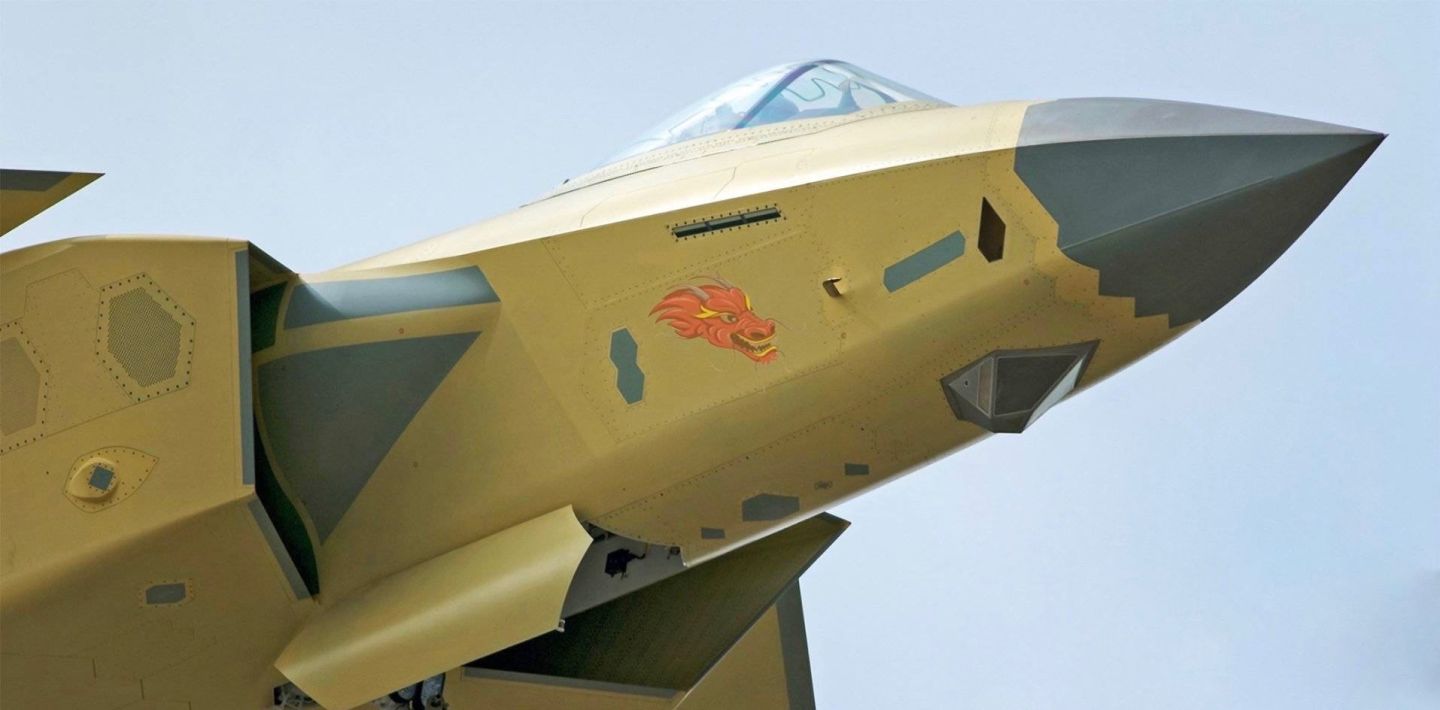
J-20 Fifth Generation Air Superiority Fighter
At Airshow China 2018 the People’s Liberation Army (PLA) showcased two of its most prolific fully indigenous combat jets - the J-10B single engine multirole fighter and the J-20 fifth generation twin engine stealth air superiority fighter. The demonstrated was observed across the world as a sign the country’s rapidly advancing military aviation, with pilots demonstrating a number of impressive manoeuvres during the fifteen minute performance. While the PLA long relied on domestic derivatives of Soviet and Russian designed jets as the backbone of its air fleet, namely the J-11 air superiority fighter and J-7 single engine light fighter derived from the fourth generation Soviet Su-27 and second generation MiG-21 respectively, the entry of the J-20 and J-10 into service in the 2010s and 2000s respectively issued in a new era of Chinese military aviation.
The J-20 represents the first fifth generation fighter and the first in the world with advanced stealth capabilities to enter service outside the United States, and its induction in 2017 was a landmark in Chinese military aviation history demonstrating a shift away from a heavy reliance on the acquisition and reverse engineering of foreign technologies and towards manufacturing of fully indigenous state of the art systems. While J-20 fighters have previously been seen testing the cutting edge WS-15 fifth generation engine, which far surpasses European and Russian competition and is rivalled only by the American F119 and F135 in its performance, those at the airshow reportedly fielded an enhanced version of the older WS-10 - which restricts the aircraft’s manoeuvrability and acceleration to an upper end fourth generation level. The fighters did however field advanced two dimensional thrust vectoring systems, considerably enhancing their manoeuvrability in much the same way as those on its American analogue - the F-22 Raptor. The PLA is reportedly currently developing three dimensional thrust vectoring systems for its new fighters, including the upcoming and more advanced J-20A, which will provide extreme manoeuvrability comparable to that of the Russian Su-35.
The J-10B, while since surpassed in its capabilities by the newer J-10C which entered service in mid 2018, is another indigenous design which represents a step towards self sufficiency in Chinese military aviation. While using a fully indigenous airframe, radar and avionics systems, the single engine light fighter’s WS-10 engine is derived from a Russian design used on twin engine Su-30 air superiority fighters, which combined with its light weight allows the J-10 to perform extreme manoeuvres such as the Pugachev's Cobra - in which an aircraft flying at a moderate speeds momentarily raises its nose to slightly beyond the vertical position before dropping to a horizontal flight. Speaking to Chinese state media regarding the developments in Chinese military aviation recently demonstrated, Air Force Lieutenant Colonel Zhang (first name unknown) stated: ”in the past, the engine was a well-known weakness of Chinese fighter jets, since we relied heavily on imports, but the J-10B proves that China can build first-class, thrust-vectoring engines to power our advanced fighters." He noted that thrust vectoring engines and the resulting superiority in manoeuvrability gave jets a considerable advantage in visual range combat - one which no Western fighter other than the F-22 is yet to integrate. Such levels of manoeuvrability were formerly only possible for Russian fighters alone. The J-10’s development has seen it become one of the world’s foremost single engine fighters, particularly in the case of the newer J-10C which is widely considered the most capable fighter in the world in the single engine category.
