
China’s J-16 Fighters Entering Service in Larger Numbers: Form Lethal Triad Alongside New J-10C and Stealthy J-20
Military Watch Magazine Editorial Staff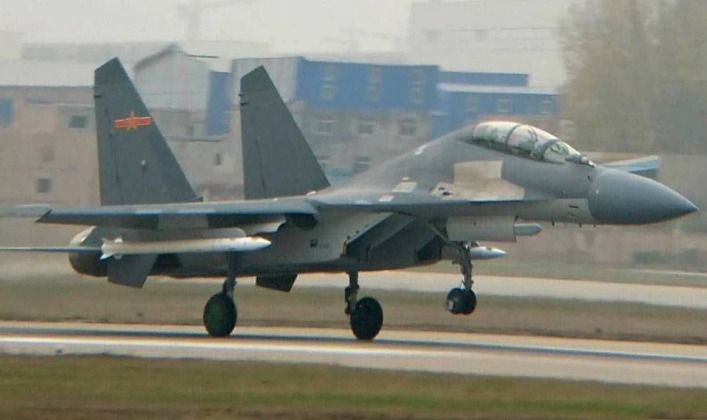
J-16 with PL-XX Missiles
The J-16 twin engine heavyweight fighter was developed for China’s People’s Liberation Army (PLA) Air Force as the most revolutionary and extensive iteration to date of the Su-27 Flanker airframe, which the country acquired and manufactured under licence during the 1990s and has since developed into a number of specialised new derivatives. J-16 serial numbers indicate that the PLA has accelerated up its induction of the aircraft into service in 2018. This coincides with the termination of production of another Flanker model, the J-11B, which had first entered service in 2009, as well as a lull in production of the J-11’s carrier based derivative the J-15, leaving more capacity on production lines at the Shenyang Aircraft Corporation for the latest Flanker model. New variants of the J-16, namely an electronic attack variant designated J-16D which is the first Flanker intended for such a role, are expected to further diversify the roles Flanker play in PLA service.
As the latest Chinese Flanker the J-16 is considered a ‘4+ generation’ fighter fielding fifth generation level avionics, sensors and weaponry, and is set to play an important role in China’s armed forces for decades to come. While inheriting the high flight performance and advanced air superiority capabilities of the Su-27’s airframe, the J-16 is far more versatile than the original fighter with a range of guided bombs and standoff missiles in its arsenal making it a formidable strike fighter. The aircraft is also highly capable in the specialised role of neutralising enemy bombers and support aircraft such as tankers using the mysterious and very large PL-XX long range air to air missile, which has an estimated range of 500km and is well suited to engaging such targets. The missile is the longest ranged in the world, and is not known to be deployed by any other fighter classes, and has its operations largely facilitated by the J-16’s very large AESA radar - an attribute inherited from the original Flanker which was designed to accommodate some of the largest fighter radars in the world.
The J-16 is one of three of a new generation of PLA Air Force fighters alongside the sophisticated J-10C single engine light fighter which entered service earlier this year and the stealthy J-20 fifth generation fighter which became operational in March 2017. These aircraft between them form a highly complementary triad, as first demonstrated publicly in combat exercises in June 2018 where the J-20 was was tasked with clearing the skies and gaining air superiority in order for the J-16 to proceed with precision strikes on ground targets. The lighter J-10 provided support in either role as needed. While the J-16 is more than capable of holding its own against all manner of threats in air to air combat, the synergy between it and other complementary new fighters makes for the most lethal and effective combination to combat near peer threats. The entry into service of the J-20, which is thought to be fielded as a dedicated air superiority fighter, has taken pressure off the J-16 for air defence roles. With numbers of all three of these fighters expanding, they today represent the new elite of China’s air force, and while the J-20 has gained by far the most attention as the world’s first non-American stealth fighter, the the roles fulfilled by the J-10C and J-16 are also critical to China's plans for the modernisation of its fighter fleet with both expected to enter service faster.
