
China Continues Rapid Development of New Technologies for Stealth Fighter Program
Military Watch Magazine Editorial Staff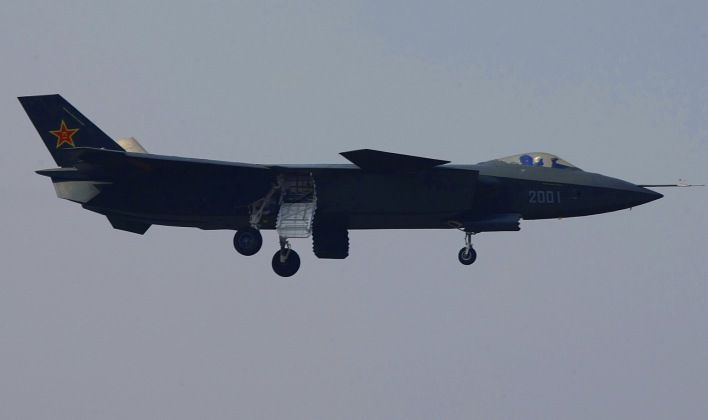
J-20 Stealth Fighter Prototype
China’s People’s Liberation Army (PLA) Air Force inducted its first fifth generation fighter into service in 2017, with the Chengdu J-20 heavyweight stealth jet being the first of its generation ever to be developed outside the United States. As China’s equivalent to the U.S. F-22 Raptor designed for air superiority, the J-20 is set to shift the balance of power in the skies over the Pacific significantly further in China’s favour by undermining the American and allied monopoly on next generation aircraft. While the PLA has shown a great deal of faith in the new fighter, it has evolved significantly in the year since its first induction. Although prototypes and initial production batches of the J-20 relied on advanced variants of the the Soviet Saturn AL-31 engine used on advanced fourth generation aircraft, in January 2018 China successfully tested the WS-15 engine with next generation capabilities to rival those of the F119 powering the F-22 Raptor.
Another key development in improving the J-20 design was announced in March 2018 by the deputy director of science and technology at Aviation Industry Corp of China Yang Wei. Director Wei stated regarding the modernisation of the J-20 in an exclusive interview with the China Daily newspaper: “We are not complacent about what we have achieved. We will develop the J-20 into a large family and keep strengthening its information-processing and intelligent capacities. At the same time, we will think about our next-generation combat plane to meet the nation’s future requirements.” Regarding the J-20’s significance as a platform symbolising the advancement in China’s defence industry Wei stated: “In the past, we had to follow others’ paths when it came to designing military aircraft because our research and development capabilities were primitive in this regard, but now we have become capable of designing and making what we want to have.”
Other technologies currently under development for application on China's stealth fighters include metamaterials, fine surfaces engineered on a nanoscale theoretically capable of bending infrared radiation and thus significantly enhancing the J-20's already formidable stealth capabilities. China’s research into the development of metamaterials and their potential use on the J-20 were reported by CCTV and Sina respectively. Regarding the role of the J-20, director Wei stated: “Of course, it will be tasked with penetrating air defence networks, but that will not be its only mission. It definitely has multiple functions. How we will use it depends on its production and deployment scale.” The fighter’s advanced stealth capabilities, long range and armament of very advanced PL-15 long range missiles makes it ideal for such a role. With the U.S. Air Force notably lagging behind in installing upgrades on the F-22, China’s efforts to rapidly modernise the J-20 could well lead its stealth platform to overtake its the capabilities American counterpart in future - while the J-20 is set to be fielded in far greater numbers than the F-22 due to the latter's extremely high acquisition costs and particularly its operational costs resulting in the early termination of production. The PLA Air Force is also set to induct the other fifth generation fighters into service, including a medium weight design based on the FC-31 program which is likely to benefit from integrating many of the technologies developed for the J-20.
