
China’s J-35 Stealth Fighter Flies in New ‘Beast Mode’ Configuration For Greater Air-to-Air Firepower
Military Watch Magazine Editorial Staff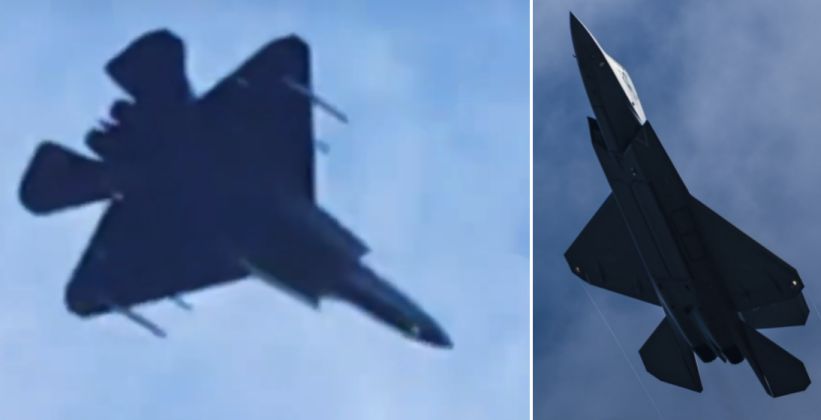
J-35 in `Beast Mode` and J-35
New footage has shown the J-35 fifth generation fighter in a new configuration with externally mounted weaponry, namely with four PL-15 long range radar-guided air-to-air missiles under its wings. Combined with the six missiles the fighter can accommodate in its internal weapons bays, this provides considerable firepower for engagements with other aircraft. The J-35 was developed under a joint program between the Chinese People’s Liberation Army Air Force and the Navy, with variants developed for both services confirmed to have entered service in 2025. The naval variant J-35 was designed to operate from supercarriers such as the new warship Fujian, while the role of the Air Force’s variant remains less certain.
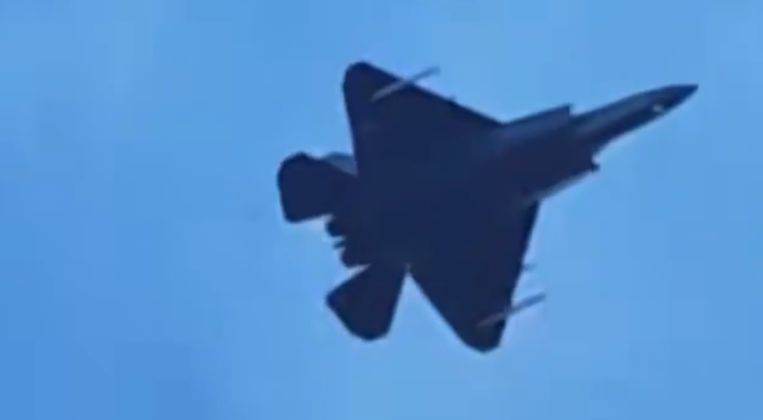
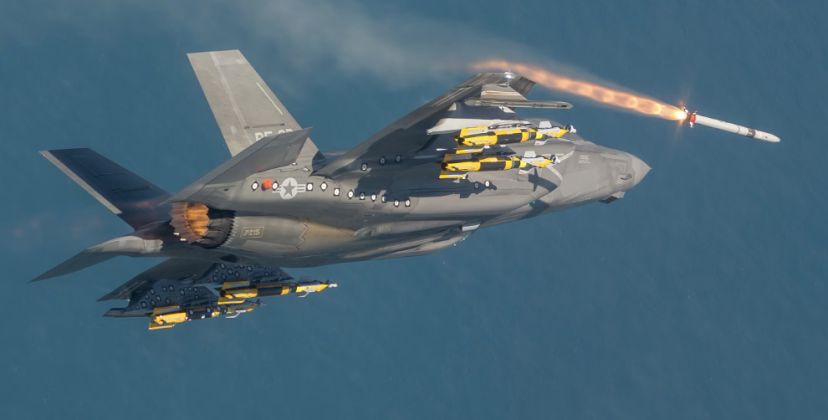
External missile carriage is uncommon for fifth generation fighters, as it alters and increases manifold their radar cross sections, thus nullifying the benefits of their radar evading stealth profiles. The ability to be configured in such ways, however, can increase fighter units’ versatility, and can be preferable in a number of operational scenarios. It is notable that the U.S. Armed Forces have developed missiles for their own fifth generation fighter, the F-35, which can only be carried externally, such as the AGM-158 cruise missile, potentially due to confidence that the missile’s long range would limit the aircraft’s vulnerability. The PL-15 has a considerably longer range than most air-to-air missile types, which may allow J-35s to engage targets in relative safety at longer ranges while carrying missiles externally. External missile carriage to maximise firepower is referred to informally in the United States as the F-35’s ‘beast mode’ configuration.
The J-35 is the second fighter type of its generation to enter service, following the larger and longer ranged J-20 air superiority fighter which was confirmed to have joined the Air Force more than eight years earlier in February 2017. The fighter program has benefited from significant research and development work done for the J-20 program from the late 1990s, with this aircraft having seen its stealth capabilities incrementally improved since it first entered service. In September Chinese state media revealed that the radar cross section of the J-35 was smaller than a human palm, roughly that of a sparrow, which was credited to its special fuselage design and metamaterial technologies. Its stealth capabilities are thought to be comparable to those of newer production batches of the J-20 and F-35, and significantly superior to those of the older F-22 and Russian Su-57.
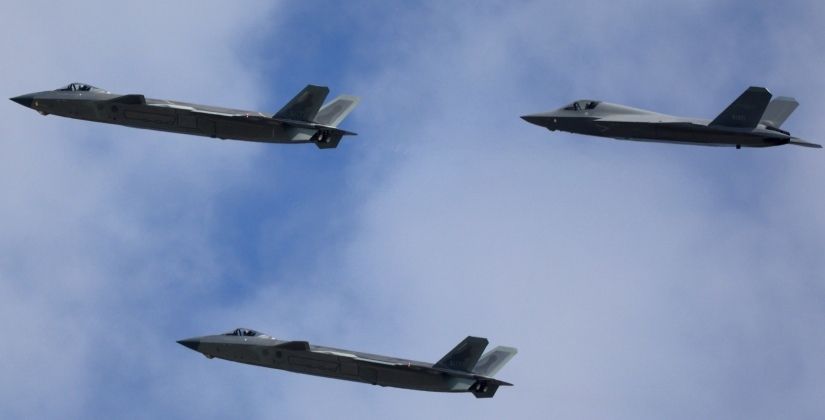
With a maximum takeoff weight of close to 30 tons, it is only slightly smaller than the F-22 and significantly larger than its closest foreign rival the F-35. As a significantly smaller aircraft than the J-20, it may be procured by the Air Force as part of a high-low combination, in which it is favoured for its lower operational costs and maintenance needs. The J-20’s significantly greater capabilities, however, including integration of a larger more powerful radar, higher weapons payload, and much longer range, are expected to ensure that the J-35 cannot seriously challenge the J-20 fleet for funding, and that the J-20 will continue to be prioritised for very large scale procurements. The J-20 and J-35, alongside the U.S. F-35, are considered in a league of their own in terms of their sophistication as fifth generation fighters, with the three being significantly more advanced than the older F-22 or than the rival Russian Su-57 fighter.
