
China Demonstrates Advanced Hypersonic Glide Vehicle Strike Capability on Missile Forces’ 60th Anniversary
Military Watch Magazine Editorial Staff
Chinese DF-17 Missiles with Hypersonic Glide Vehicles
Footage released by Chinese state media marking the 60th anniversary of the People’s Liberation Army Rocket Force, which is responsible for operating the large majority of the country’s ballistic missile arsenal, has shown the DF-17 hypersonic missile units taking part in operations. The footage featured road-mobile DF-17 transporter-erector-launchers conducting field deployments and launch preparations, highlighting one of the Rocket Force’s most advanced conventional strike capabilities. The inclusion of the DF-17 appears intended to emphasise the modernisation of the Rocket Force over the past decade, with the service having been the first in the world to operationalise missiles that integrate hypersonic glide vehicles for tactical strike roles.

The DF-17 is regarded as one of the world’s most innovative missile systems, as it combines a ballistic missile booster with a hypersonic glide vehicle. Instead of following the predictable parabolic trajectory of a conventional ballistic missile, the booster releases the glide vehicle into the upper atmosphere, where it descends toward its target at hypersonic speeds while performing aerodynamic manoeuvres in both pitch and yaw. This combination of high speed and manoeuvrability makes interception almost impossible. This has recently been demonstrated by Russia and Iran’s recent demonstrations of the capabilities of their respective Oreshnik and Fattah 2 missiles against targets in Ukraine and Israel, with Israeli sources concluding that defending against such missiles would require an entirely new approach to missile defence.
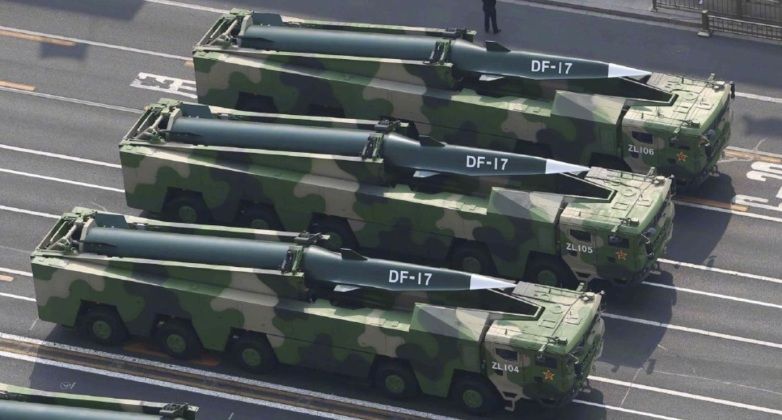
The DF-17 also offers a high degree of precision strike capability, with its glide vehicle is believed to use advanced guidance systems, enabling it to accurately engage fixed high-value targets such as command centres, air bases, logistics hubs, and hardened infrastructure. Its speed and low-altitude terminal flight profile increase the likelihood of penetrating enemy defences before interception can occur. Another major advantage is the DF-17’s road-mobile launch platform. Mounted on a transporter-erector-launcher, the missile can be concealed, rapidly repositioned, and launched from dispersed locations. This mobility significantly enhances survivability by complicating enemy surveillance and pre-emptive strike planning, allowing launch units to relocate frequently and operate from prepared or improvised sites. The missile was designed to integrate into China’s network-centric reconnaissance-strike complex, and it is thought to be able to receive targeting information from satellites, over-the-horizon radars, unmanned aircraft, maritime patrol assets, and other intelligence platforms.

One of the DF-17’s most significant potential roles is anti-ship warfare, particularly against large naval formations operating in the western Pacific. Unlike a conventional anti-ship ballistic missile that descends steeply toward its target, the DF-17’s hypersonic glide vehicle can approach from a flatter trajectory while manoeuvring laterally, making its path much less predictable and increasing the difficulty of interception. The missile’s high speed dramatically reduces the time available for a warship to detect, classify, and engage the incoming threat. A hypersonic glide vehicle can cover hundreds of kilometres in just minutes, compressing the decision cycle for ship commanders and limiting opportunities to launch defensive missiles or deploy electronic countermeasures. The missile’s ability to target both warships and bases in the Pacific strengthens China’s broader anti-access/area-denial strategy, complicating potential efforts by Beijing’s Western adversaries to project power into East Asia. The DF-17 is one of multiple missile types with hypersonic glide vehicles that have been brought into service, and is likely the first in the world with such a vehicle to have become operational anywhere in the world.
