
China Debuts New AI-Assisted Aerial Refuelling Capability to Optimise Air Fleet For Long Range Operations
Military Watch Magazine Editorial Staff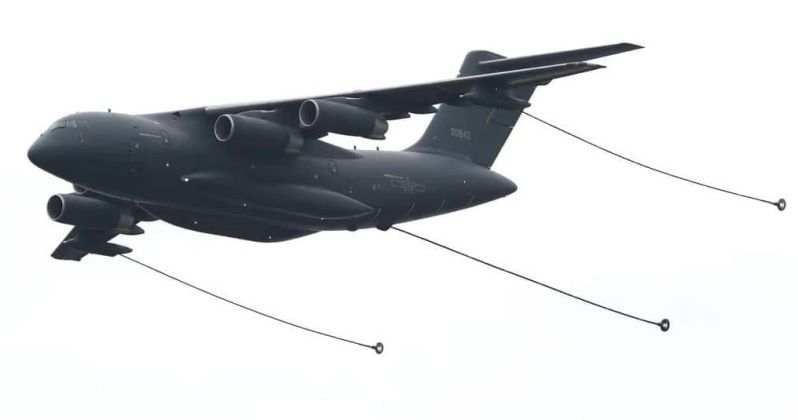
YY-20 Tanker
The official publication of the Chinese People’s Liberation Army (PLA) has announced a new AI-assisted task dispatch smart artificial intelligence system for its aerial tankers, which has streamlined its aerial refuelling operations to improve efficiency and safety. Referred to as the Aerial Refuelling Area Management System, it is reported to have first been introduced during training in late 2025. The system monitors real-time airspace situations, employing built-in algorithms to automatically calculate real-time fuel levels for all participating aircraft within the area. It then generates the most optimised pairing plans between tankers and fighters based on the fuel levels, airspace capacity and flight duration of each aircraft.
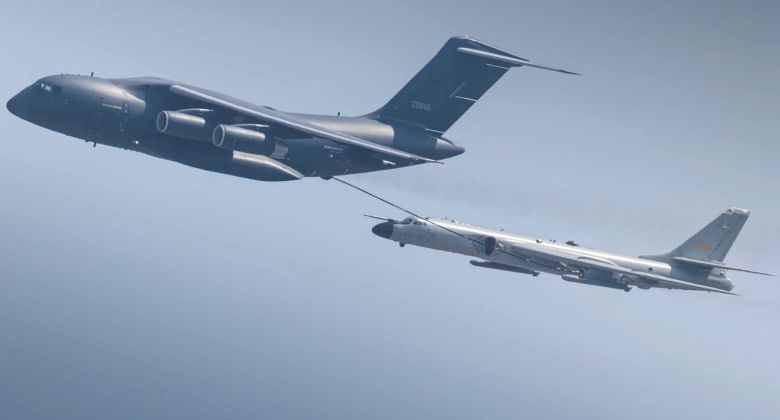
Speaking to the PLA Daily, Air Force officer Yu He, who was involved in developing the Refuelling Area Management System, elaborated: “The ‘smart task assignment’ programme recommends scientifically sound and highly efficient solutions, enabling the maximisation of aerial refuelling effectiveness.” The pairing process was previously like a “blind choice”, he stated, as tankers loitered passively while fighter pilots usually selected the nearest available one. This often created operational bottlenecks, overloading some tankers as others remained idle. “The old random refuelling-receiving model had become a critical weakness limiting combat effectiveness and was ill-suited to the demands of future battlefields… Thanks to the new system, aerial refuelling efficiency has been further improved,” the report stated.
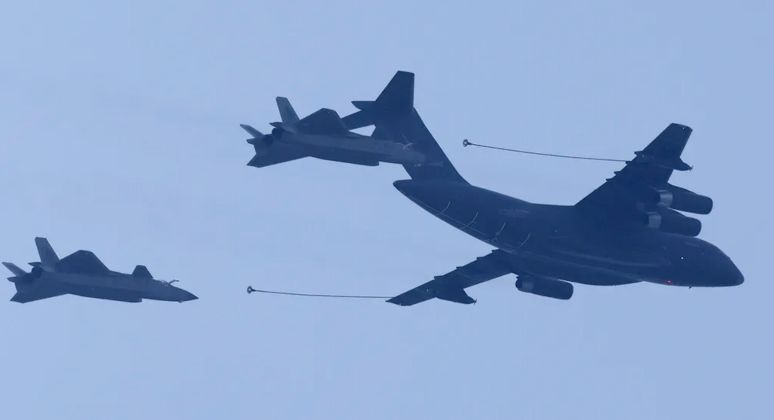
The People’s Liberation Army until the mid-2020s fielded a negligible tanker fleet, with three ex-Soviet Armed Forces Il-78M jets having been its only purpose-built tankers. The YY-20 tanker first began combat readiness training in late 2022, and was developed as a derivative of the world’s largest military transport jet in production today, the Y-20. The new aircraft has placed an increasingly a central role in facilitating longer range operations, with the optimisation of its capabilities with the new AI-assisted system expected to complement the benefits provided by rapid expansion of the available fleet. Even without tanker support, however, Chinese fighters on average have far longer ranges than those in the Western world, meaning they can be deployed for very long range operations without refuelling in the air. The J-20 fifth generation air superiority fighter, for example, has approximately twice the range of the Western world’s most capable fighter type the F-35.
