
Chengdu J-9; China’s Overly Ambitious Plan for an Advanced Multirole Fighter which Inspired a New Generation
Military Watch Magazine Editorial Staff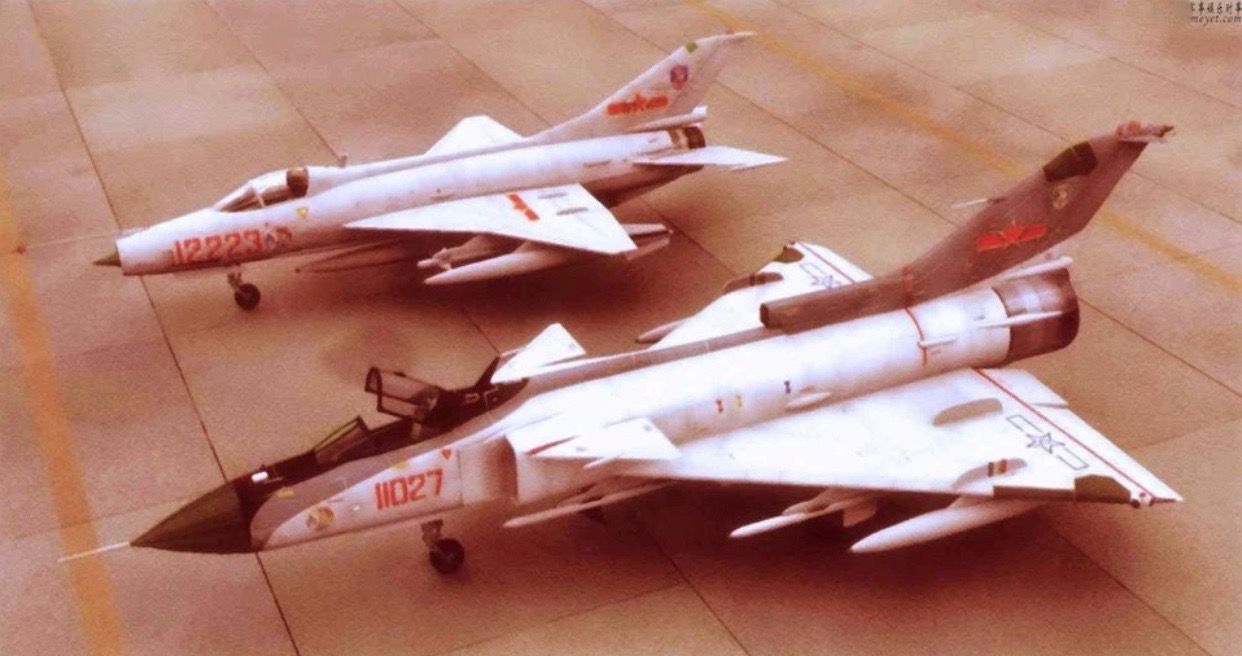
Chinese J-9 and J-7 Fighters - scale comparison
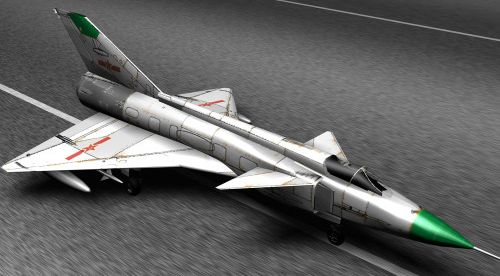
In the early 1960s China’s People’s Liberation Army (PLA) found itself unable to acquire modern fighter aircraft with third generation capabilities, and thus risked imminently losing parity with the United States and Soviet Union - with the former developing the F-4E and F-5E while the latter worked on the MiG-23 and MiG-25. While the PLA did manage to reverse engineer the Soviet MiG-21 based on a partially completed technology transfer, its resulting indigenous second generation platform the J-7 was considerably less capable than the original in its initial years in service - meaning even at the second generation level China suffered a disadvantage in the air. The USSR for its part would go on to heavily upgrade the MIG-21 with third generation technologies - leaving the J-7 program far behind. As a result of the highly unfavourable power trajectories it observed, the PLA initiated two third generation fighter programs - the Shenyang J-8 and Chengdu J-9.
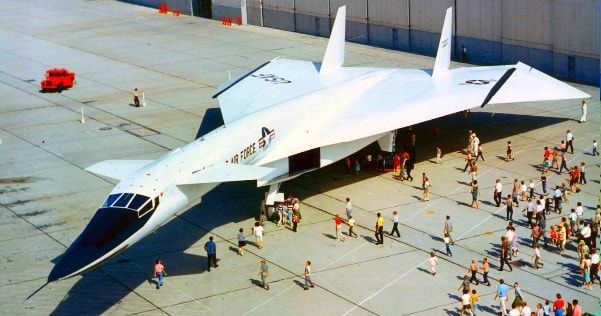
The J-9 program was initiated in 1964, though political instability at the time and poor program management meant it would not see its first flight until 1975 - by which time the United States had already inducted its first fourth generation fighter the F-14 Tomcat. The J-9 was se tot make use of a canard delta wing design and a completely new airframe with a single engine configuration. The fighter’s specifications were highly ambitious - requiring speeds of Mach 2.4 and altitudes of 20km. No single engine fighter has to date ever been capable of such speeds or altitudes - and the twin engine American F-15 Eagle is the only fighter ever to enter service capable of exceeding Mach 2.4. It is likely that the U.S. development of the Valkyrie bomber - an aircraft capable of surpassing Mach 3 at extreme altitudes of over 23km using six YJ93-GE-3 turbojet engines - and Soviet development of the MiG-25 Foxbat interceptor, also capable of surpassing Mach 3, led the PLA to seek a combat jet with such high specifications. While difficulties developing the Valkyrie led to its cancellation, the Soviet MiG-25 would after its development fly several reconnaissance flights over Chinese airspace which the PLA’s air defences and J-7 fighters were unable to intercept.
To achieve high speeds and altitudes the J-9 was to be equipped with a Shenyang WS-6 turbofan engine - also a highly ambitious design with 27,000Ib of afterburning thrust. The engine was comparable to that of the Pratt & Whitney F100 which powered the American F-16 and F-15 fighters of the fourth generation and considerably more powerful that the M88 which powers the French Rafale fighters today. The engine’s specifications were well ahead of their analogues of the time, with the American F-4E Phantom’s J79-GE-17A putting out under 18,000Ib. Complementing its powerful engines, the fighter was to be equipped with a Type 205 radar with a detection range of around 70km and would deploy PL-4 radar guided air to air missiles - a derivative of the AIM-7D Sparrow acquired from North Vietnam which were sampled from downed American aircraft. The PL-4 retained an 18km engagement range, considerable for its time, and was developed specifically for the J-9.
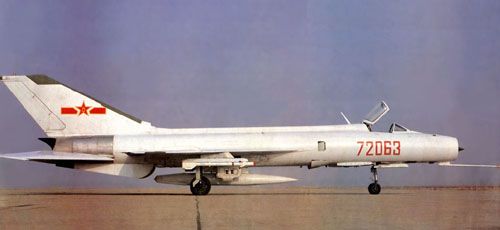
The Cultural Revolution stalled China’s development of its military aviation considerably, affecting both the J-9 program and the accompanying PL-4 program. Difficulties producing the WS-6 engine in particular made development of the aircraft extremely difficult, particularly as officials reportedly altered demands for speed requirements a number of times during development. The parallel J-8 interceptor program, a far simpler and less ambitious aircraft making use of twin Wopen-7A turbojet engines - closely derived from those of the MiG-21, and using an airframe which appeared to apply the same concept as the J-7 only on an enlarged scale, thus became the PLA’s only third generation jet designed for air to air combat. Even this program, however, saw considerable delays due to the political circumstances at the time - and would not enter service before 1980. While the J-8 was initially intended to inherit the J-9’s PL-4 missiles, difficulties developing these munitions led the PLA to equip the interceptors with the far shorter ranged PL-2.
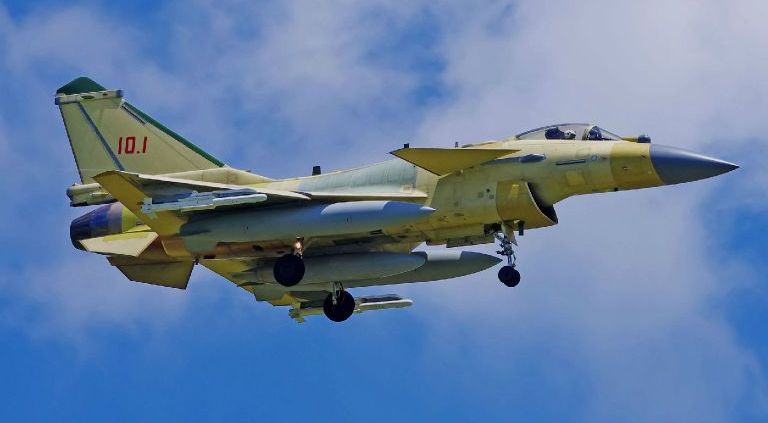
The J-9’s specifications were in many ways comparable to a fourth generation fighter, and many of the fighter’s characteristics were adopted onto the later J-10 single engine fighter program. The J-10 would emerge as perhaps the most capable single engine fighter by 2018 - when the advanced J-10C variant entered service, and its engine thrust was even grater than that of the original WS-6. The fighter is capable of exceeding speeds of Mach 2, deploys a powerful active electronically scanned array radar and is capable of engaging targets up to 150km away with its PL-15 air to air missiles. The J-10 was heavily inspired by the J-9 program, and inherited its canard delta wing design - undermining Western claims that the newer Chinese platform was based on the Israeli Lavi, another canard delta wing fighter, which the J-9 predates. The canard delta wing design would also be applied to the Chengdu J-20, the world's first fifth generation fighter developed outside the United States, and its entry into service would become a landmark in the development of Chinese military aviation - much as the PLA Air Force had intended decades prior when it initiated the J-9 program.
