
Buying Bulk? U.S. Navy Considers Cost Cutting Contract for Two New 100 Ton Supercarriers
Military Watch Magazine Editorial Staff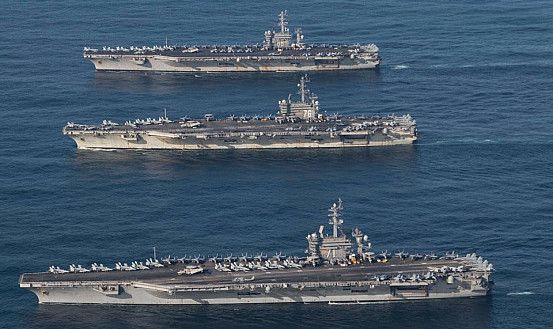
Trio of U.S. Navy Supercarriers
The U.S. Navy commissioned its first Gerald Ford Class supercarrier, the warship USS Gerald Ford, in early 2017. The new carrier class is set to replace the ageing Nimitz Class as the mainstay of the United States' Naval power projection capabilities, and the carriers deploy several new features including electromagnetic launch systems, A1B nuclear reactors and more automated operational systems to reduce the required crew. The Navy plans to commission ten of the new class of supercarrier, though they are to date the most expensive warships ever commissioned in history. Alongside the USS Gerald Ford, the Navy currently fields ten Nimitz Class supercarriers and a number of smaller Wasp and America Class amphibious assault ships capable of carrying specialised STOVL aircraft. The Navy plans to acquire ten Gerald Ford Class warships, though whether this will be a feasible prospect both financially and in regards to the continuous viability of carrier warships in light of the rapid development of anti ship technologies by U.S. adversaries remains to be seen.
To reduce acquisition costs for the Gerald Ford carrier program, the U.S. Navy is has considered commissioning its next two supercarriers together rather than individually. This would allow producers to benefit from significant economies of scale and potentially achieve sizeable savings in the costs of both parts and labour. On Monday March 19th the Navy asked shipbuilder Huntington Ingalls Industries Inc. “to further define the cost savings achievable” should it opt for a block purchase. Should savings be significant, it could well lead to even larger block purchases of three or more carriers at a time in future, which would go a long way towards reducing the cost of modernising the Navy's supercarrier fleet.
Mike Petters, chief executive officer of Newport News, Virginia-based Huntington Ingalls, stated regarding the potential for a bulk purchase: “we believe the most effective way to reduce cost of aircraft carriers is to take a multi-ship purchase approach and build them every three to four years. Buying two ships at once stabilizes the Newport News Shipbuilding workforce and their national supplier base, allows us to buy materials in quantity, and phase work more efficiently.” While a large bulk purchase would require congressional approval, should it be shown to significantly reduce costs per ship it is likely that the Navy will opt for such an acquisition.
