
Britain May Need More Than Two Carrier Warships; Fast Growing Defence Commitments Abroad From the South China Sea and Korean Peninsula to the Persian Gulf Prompt Calls to Invest More in Naval Power Projection Assets
Military Watch Magazine Editorial Staff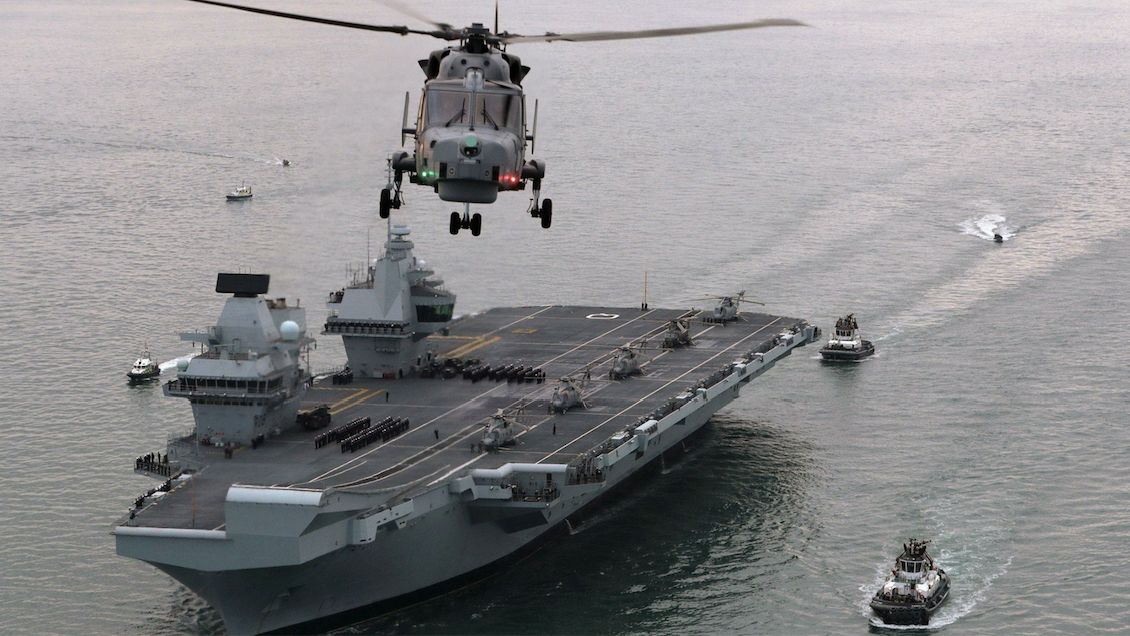
British Royal Navy Aircraft Carrier HMS Queen Elizabeth
Despite planning the induction of two of the world’s largest aircraft carriers, the Queen Elizabeth Class warships, a number of reports indicate that the British Royal Navy may well be seeking to expand its carrier fleet further - acquiring lighter amphibious assault ships themselves capable of deploying combat aircraft for offensive operations. With the retirement of the helicopter carrying amphibious assault ship HMS Ocean, sold on to the Brazilian Navy in 2018, Britain’s ability to support amphibious operations for its Royal Marines have been somewhat lacking - leading to calls from the country’s Defence Committee to consider acquiring similar vessels in future as lighter complements to the Queen Elizabeth Class. A report from the committee stated: “We have recently reported on the continuing relevance and requirement for amphibious capability, concluding that the disposal of amphibious assault ships—reportedly being considered under the NSCR—was ‘militarily illiterate.’”
The report continued: “Written evidence to this inquiry has largely supported these conclusions. The Royal Navy will at some point in the next decade need to consider replacing the amphibious assault ships which are due go out of service in the early 2030s. A landing helicopter dock (LHD) design, combining the ability to operate landing craft and aircraft, should be considered.” This report was accompanied by calls to expand the country’s defence expenditure from 2% of GDP, already among the highest in Europe, to up to 4% - in line with recent calls from U.S. President Donald Trump for other NATO powers to take responsibility for a greater proportion of the Western alliance’s defence expenditures. The growing post Cold War threat of major state adversaries, which have increasingly challenged the dominance of the Western Bloc, was put forward as a key pretext both for the greater investment in offensive capabilities and the potential commissioning of more aircraft carrying warships to support power projection operations.
Britain has increasingly involved itself in supporting U.S. led military initiatives abroad since its participation in the Iraq War in 2003, when it was one of the few Western powers to contribute considerable assets from the outset of the conflict. These deployments have targeted all of the Western Bloc’s four major ‘great power adversaries,’ as referred to by U.S. defence planners, including deployments of naval, marine and air assets to East Asia as part of the U.S. Pivot to Asia initiative targeting China and deployment of ground troops to Eastern Europe aimed squarely at Russia - which has escalated considerably as tensions have mounted since 2014. British forces have also participated in wargames in East Asia near the Korean Peninsula which have simulated attacks on North Korean command and military facilities, as well as wargames held in South Korea itself, while the country pledged in 2017 as tensions between Pyongyang and Washington peaked that it was willing to offer support should the United States consider military action against the East Asian republic. British forces have also deployed to the Persian Gulf, and the Royal Navy opened a sizeable facility in Bahrain April 2018 just 250km from the Iranian coast. Considering the country’s expanding commitments abroad, in which the Royal Navy and Royal Marines have played a leading role among the services, the commissioning of more amphibious assault ships remains a potentially key asset to enhance the country’s power projection capabilities. Future assault ships could be based on a modernised concept similar to the HMS Ocean, or alternatively seek to develop something similar to the French Mistral or South Korean Dokdo Class - warships displacing little under 20,000 tons and deploying large contingents of Marines and combat vehicles supported by rotary wing aircraft for offensive operations. Another alternative may well be to attempt to develop a larger assault ship, similar in size to the Japanese Izumo Class carrier, which are capable of deploying more personnel for assaults and potentially also carrying specialised short takeoff fixed wing combat jets such as the F-35B. While the form future carriers will take remains uncertain, their commissioning in the near future remains likely.
