Backlash; Could the West’s April 14th Strike on Syria Seriously Compromise Israel’s Security? Part Two
Military Watch Magazine Editorial Staff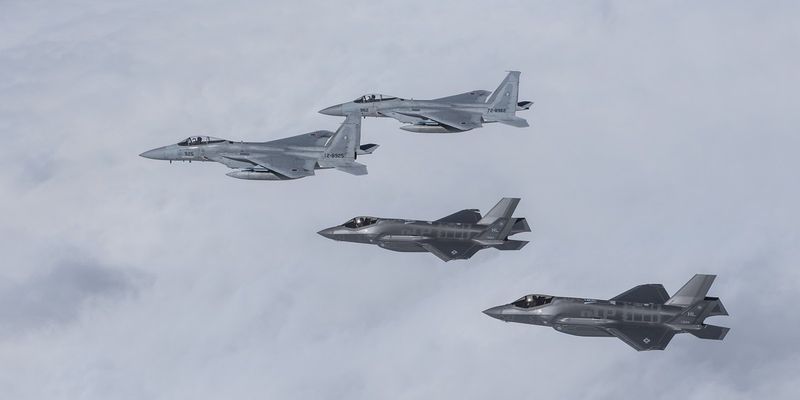
F-15 Air Superiority Fighters (top) and F-35 Stealth Fighters, the Mainstay of Israel's Aerial Warfare Capabilities
Israel has on a number of occasions seen its military aircraft successfully targeted and its missiles intercepted by Syria’s air defence forces, which since the outbreak of war in the country been extensively upgraded with assistance from North Korean specialists. Much like the Western powers did in their own strike on Syria, Israeli aircraft have in recent months relied heavily on striking Syria from beyond its territory, most often from the airspace of neighbouring Lebanon, to ensure they remain beyond the range of the country’s air defence batteries. Israeli air to ground missiles fired from Lebanon have also frequently been intercepted, with an attack on a Syrian military facility near Damascus in December 2017 being largely blunted with 75% of the missiles neutralised. The prospect of more advanced surface to air missile batteries being deployed by the Syrian Air Defence Forces is thus set to make attacks on the country, already difficult as they are, far harder still - perhaps too risky to even be attempted. Deployment of the S-300 or S-400 would allow Syria to target Israeli aircraft well beyond the country’s borders, including over Tel Aviv itself, which poses a significant threat to Israel’s ability to operate its Air Force against Damascus’ assets. The would further shift the balance of power in the Middle East against Israel’s favour. The Times of Israel reported a statement by a high ranking member of the Israeli military’s General Staff which stated: “In our worst nightmares, we never dreamed we would have the S-400 system in our backyard with Syria.” An advanced variant of the S-300 platform such as the S-300PMU2 in Syrian hands could also have a similar effect.
Alongside the potential effects on the Israeli-Syrian balance of forces which delivery of new Russian surface to air missiles would have, Russia’s response to Western airstrikes on Damascus is also set to significantly weaken Israel’s position in regards to its main regional rival Iran. While Russia’s arms deliveries are made with defence against Western attacks in mind, these weapons systems can just as easily be used against Israel’s own aerial assets. While Iran’s armed forces already field advanced S-300 surface to air missile systems, delivered by Russian in 2016, delivery of more modern systems such as the S-400 or BuK-M3 would make its airspace among the best defended in the world. While Israel managed to derail the Iraqi and Syrian nuclear programs in 1981 and 2007 respectively by launching Operation Opera and Operation Outside the Box, delivery of the latest Russian air defence batteries as advocated by chairman Sherin would make an operation to neutralise Iranian military or nuclear facilities by either the Western bloc or Israel go from extremely difficult to near impossible. Under such protection, Iran could proceed with the development of ballistic missiles, the strengthening of its power projection assets across the Middle East, and even a the development of weapons of mass destruction should it choose to, without a significant threat of military action being taken against it.
Not only will Iran's domestic facilities be safe under the protection of modern air defence systems, but Iranian assets deployed near Israel's borders in Lebanon and Syria could also potentially receive protection from Syria's own domestic air defence systems - further weakening the Israeli position vis a vis Iran. Mark Heller, principal research associate at Tel Aviv University's Institute for National Security Studies, stated regarding the potentially serious implications this could have for Israeli security in regards to its ongoing conflict with Tehran: “Israel is concerned that more effective Syrian air defenses built around advanced Russian equipment would limit Israel's ability to operate against Iranian and (Iranian aligned militia) Hezbollah forces in Syria, which are part of Iran's overall regional strategy, as well as against Syrian weapons of mass destruction facilities and supply lines to Hezbollah in Lebanon.”
While gains made by Western airstrikes on Syria were negligible, the blowback from the attacks could well have catastrophic implications for Israel’s security. With the Western bloc likely less willing than ever to intervene against those it terms ‘bad actors’ in the Middle East in the attack's aftermath, and with Syrian and possibly Iranian airspace set to become far more difficult to penetrate in the near future due to deliveries of more modern Russian air defence systems, the attack is set to both empower Israeli adversaries while almost completely eliminating prospects for military action against them. Tel Aviv’s already precarious security situation is thus set to become considerably worse.