
China's Elite AWACS and Tanker Killer; British Think Tank Reports Lethal Purpose for Ramjet Missile Armed J-16 Fighters
Military Watch Magazine Editorial Staff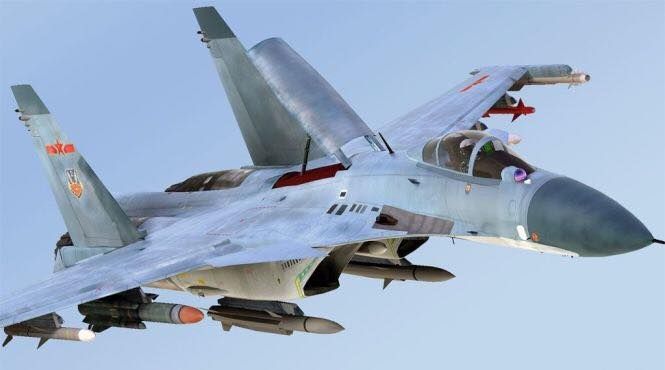
People's Liberation Army Air Superiority Fighter
One of the latest additions to the Chinese People’s Liberation Army Air Force alongside alongside the J-20 air superiority fighter and J-10C light fighter, the J-16 entered service in 2013 as one of the world’s most lethal strike fighters. A highly versatile jet based on the Su-27 Flanker airframe, the next generation platform retained the ability to target ground, air and naval targets with a combination of guided bombs, rockets and missiles, with a specialised electronic attack variant also reportedly having been developed. While primarily designated a complementary strike role to accompany the J-20, the J-16 is highly capable in air to air combat and retains a number of specialised capabilities. Enjoying a high degree of manoeuvrability and a high operational altitude, and able to deploy some of the world’s most advanced air to air missiles including the PL-15 - a platform with a 150km engagement range and high degree of precision, the fighter is well suited to an air superiority role alongside its role as a strike fighter.
According to a study carried out by the International Institute for Strategic Studies, a prominent London based defence and national security think tank, China’s People’s Liberation Army (PLA) Air Force could have another purpose for the J-16 alongside its functions as a strike, electronic attack and air superiority fighter. A report on the capabilities of the PLA indicated that the J-15 is set to deploy China’s heaviest and longest ranged air to air missile, a platform currently under development known as either the PL-XX or PL-21. The new missile is expected to break the record currently held by the Russian R-37 in range, with an engagement range of over 400km, and will make use of a ramjet engine to retain a high degree of accuracy at such distances. Of the three fighters in service today which comprise the PLA Air Force’s new generation, only the J-16 is set to be equipped with these munitions. With the PL-XX measuring twice as long as the PL-10, and 50% longer than the PL-15, which is already considered a very heavy missile, reports indicate that only the J-16 is suited to carrying the new munition. The J-20’s reliance on internal missile bays due to its stealth profile and the light weight of the J-10C both limit their ability to carry large new munitions, and while both these fighters are alongside the J-16 the only fighters to deploy the new PL-15, the PL-XX will thus be limited to the J-16 alone.
Much like the Russian R-37, the PL-XX is expected to fulfil a highly specialised role - allowing the PLA to hunt and destroy high value enemy support aircraft at extreme ranges beyond the retaliation ranges of their fighter escorts. Platforms such as the American E-3 Sentry AWACS platform and KC-135 Stratotanker, both critical to the United States’ potential plans for a war over the Pacific, will thus be made highly vulnerable if deploying anywhere near Chinese shores. American F-22 Raptors, by far the most advanced Western air superiority fighter developed, are only beginning to integrate AIM-120D air to air missiles - which with a 180km range will fall considerably short of denying J-16 fighters the ability to destroy vital support asset at extreme ranges of over 400km. Aerial tankers such as the KC-135 are vital to allowing American fighters such as the F-22 and shorter ranged jets such as the F-35 and F-16 to reach Chinese coasts, while AWACS are vital force multipliers for fighter squadrons to coordinate their attacks should they seek to engage Chinese fighters over the Pacific. The destruction of tankers over the Pacific could seriously undermine the U.S. air fleet’s ability to launch offensive actions against Chinese positions - and should tankers be destroyed mid mission it would leave American fighters stranded over the Pacific and forced either to crash land or else to land at Chinese airbases. The destruction of AWACS systems such as the E-2 and E-3 meanwhile would provide Chinese fighter squadrons, enjoying support of platforms such as the KJ-2000, with a considerable force multiplier and thereby provide an overwhelming advantage when engaging unsupported U.S. air groups. The PL-XX is expected to enter service in the PLA in the near future, and should the J-16 deploy the new missile in large numbers it is likely to prove a major game changer for the balance of power in the Pacific and further strengthen China’s anti access area denial capabilities in the air.
