
As China Promises Economic Support for Venezuela, United States and OAS Threaten Armed Intervention
Military Watch Magazine Editorial Staff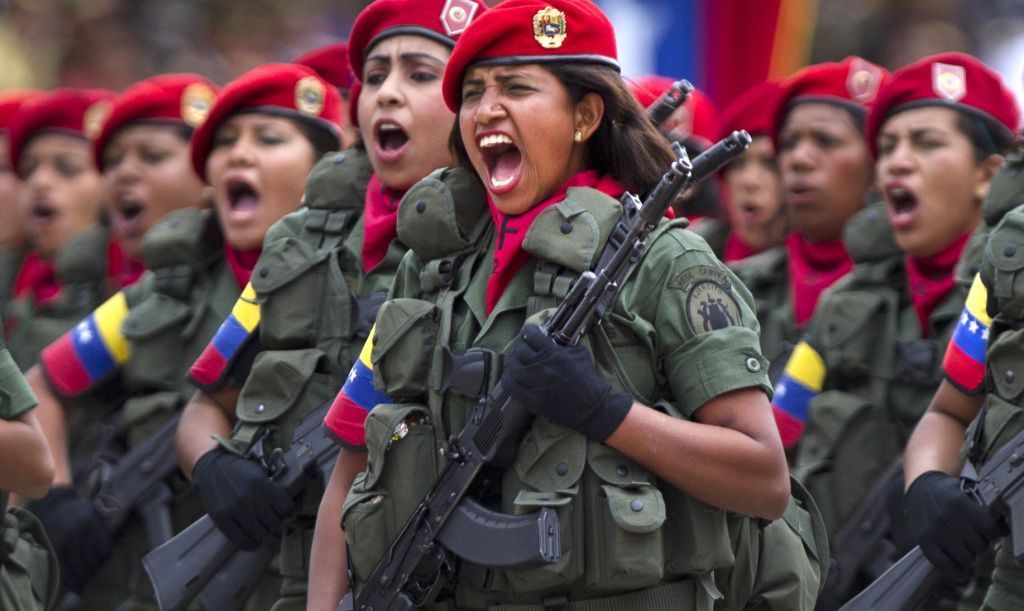
Venezuelan Female Soldiers on Parade
Amid growing tensions with the United States and a number of U.S. aligned Latin American states, Venezuela has been threatened with military intervention by both Washington and the Organisation of American States (OAS) to topple its government. Alongside revelations that the United States has been in communication with members of the Venezuelan armed forces in an attempt to organise the armed ouster of the country’s civilian government, the US has directly threatened to use armed force to topple the Maduro government - reiterating on several occasions that the 'military option' remained on the table to prompt the desired change in governance. OAS Secretary General Luis Almagro similarly stated on a visit to neighbouring Colombia that the organisation would not exclude taking military action against Venezuela, repeatedly referring to recently elected Venezuelan President Maduro as a dictator. Under pressure from US and European economic sanctions, alongside a collapse in oil prices which have devastated its heavily rentier oriented economy, Caracas has endured a considerable financial crisis which has had considerable implications not only for the living standards of its civilian population - but also for its military modernisation plans. Threats made against the country come in the aftermath of an attempt on the life of its President, suspected to have been organised by dissident factions within the country aligned with the United States.
While Venezuela has been threatened by the United States and several of its partners, the country has found considerable support from a number of allies overseas. Coinciding with the statement from the OAS Secretary General, Chinese Premier Li Keqiang has pledged economic support to the struggling South American nation’s economy following talks between President Maduro and Chinese Premier Xi Jinping. Premier Li further noted that his country “will support Venezuela’s efforts to develop its economy and improve people’s livelihoods,” while calling on Caracas to improve legal protection for Chinese businesses operating in the country. China previously lent Venezuela $50 billion, of which around $30 billion have already been paid off in oil shipments, and further loans remain a distinct possibility. With the Venezuelan economy overwhelmingly dependant on the export of natural resources, and with oil prices expected to rise and having already recovered considerably, the country’s ability to repay its debts is likely to improve considerably in future.
Economic support remains critical to propping up the flagging Venezuelan economy, and enabling Caracas to withstand the considerable Western economic pressure brought against it. Ultimately the country’s primary weakness remains an economic one, despite its considerable endowment of natural resources, and continued economic pressure appears a far more feasible means for the country’s adversaries to topple the Maduro led government than military intervention. While a number of Venezuela’s high profile orders for new weapons systems have been cancelled or postponed in light of the economic crisis, the country’s armed forces remain by far the most modern and heavily armed on the South American continent - deploying cutting edge Su-30MK2 air superiority fighters and S-300VM and BuK surface to air missile systems, which serve to seriously complicate air operations against the country, alongside a heavily armed ground force of around 350,000 personnel.
